
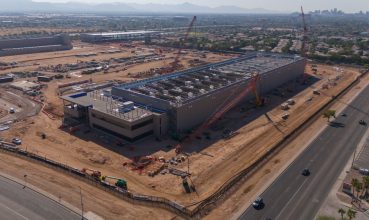
Developers looking at the Midwest for their next data center site keep running into the same question. Is it faster and cheaper to buy and convert an existing industrial building, or is it b...

This Feasibility Software Analyzes 500 Commercial Properties for Vertiport Readiness in 20 Minutes

Written by:
Date:
16 Feb 2026
Share via Facebook

Share via Linkedin

Share via X

Copy to clipboard


The bottleneck holding back advanced air mobility isn’t aircraft certification anymore – it’s identifying which of America’s millions of commercial properties can actually support vertiport infrastructure. Landings just solved that problem with software that can analyze entire real estate portfolios in minutes.
Lisa Wright’s team launched beta testing this week for proprietary feasibility software that scores properties on vertiport readiness by examining parcel size, zoning compliance, terrain contours, FAA obstruction data, energy grid capacity, and soil stability. The breakthrough? Portfolio owners can now upload 200 addresses simultaneously and receive comprehensive feasibility reports in roughly eight minutes.
“We can upload every Prologis location onto our map and run analysis on everyone to see if they’re feasible,” Wright explained during the beta launch. “We can run 500 locations in about 20 minutes to whittle down which ones we’d approach.”
The software represents months of backend development, including a complete rebuild using PostgreSQL geometry lookups rather than traditional coordinate matching. This technical shift – analyzing physical space as three-dimensional geometry rather than simple GPS points – dramatically accelerated processing speed while enabling more sophisticated terrain and obstruction analysis.
For commercial real estate professionals, the platform offers immediate clarity on assets they already own. The scoring system ranges from 0 to 100 and evaluates seven critical factors: parcel size and contour, zoning compliance, obstacle clearance, power grid integration, distributed energy resources, and soil stability. A shopping center in Palatine Bridge, New York, for example, scored 42 out of 100 – not perfect, but feasible with 16.8 acres, an acceptable 6.6% slope, zero obstacles, and existing distributed energy infrastructure in the community.
The energy analysis proved particularly nuanced. Wright’s team initially set requirements too stringently, causing most properties to fail. The beta version now differentiates between high-capacity vertiplexes requiring substantial power and smaller vertistops that can operate with distributed energy solutions like solar arrays and battery backup systems.
“We’re allowing for more different types of locations so we can offer different types of vertiports,” Wright noted. The revised approach recognizes that not every site needs to support a 12-acre vertiplex with rapid charging – 2-acre vertistops with slower charging serve many use cases effectively.
Real estate brokers are among the beta testers, though Wright acknowledges the company hasn’t formalized a broker program yet. “We’re playing the field right now to see how it works,” she said. “If we’re able to get some desirable sites signed by a broker, there will be some way to work with brokers. I understand they work with money.”
The software’s portfolio sharing capability addresses a practical need Wright discovered through early testing. Beta users don’t just want reports – they want collaborative access where teams can review analyses together. Portfolio managers can now share specific property collections with colleagues or potential partners while maintaining control over proprietary data.
Beyond identifying suitable properties, the platform serves a strategic function for Wright’s fundraising efforts. “It shows that there’s interest from people who own land to have a vertiport, which is key,” she explained. “And it shows that our team has the capabilities to scale.”
Current beta testing focuses on 36 counties, primarily in New York State, but Wright’s team can add new regions within 48 hours when commercial interest warrants expansion. Property owners and portfolio managers interested in beta access can submit addresses through the Landings website at landings.co.
The software tackles an infrastructure problem that’s been largely invisible to the broader commercial real estate industry: How do you identify, at scale, which existing properties can transition from their current use to include advanced air mobility infrastructure? Wright’s answer is elegant – let geometry and data do the work that would otherwise require individual site visits to thousands of locations.
As eVTOL manufacturers approach certification and states announce network plans, the race to secure vertiport-ready sites is accelerating. For the first time, commercial real estate owners have a tool that tells them whether they’re sitting on assets positioned for that next wave – or whether they need to look elsewhere in their portfolios.
Disclosure: Individuals or companies mentioned may have a commercial relationship with KeyCrew.
Similar Articles
Explore similar articles from Our Team of Experts.