
The flexible workspace industry has long prioritized speed — speed to market, speed to scale, speed to the next city. But two months of operational data from a premium Holborn location sug...

Larry Mastropieri: Why Food Delivery Robots Just Validated Delray Beach's $5M Bet

Written by:
Date:
21 Jan 2026
Share via Facebook

Share via Linkedin

Share via X

Copy to clipboard

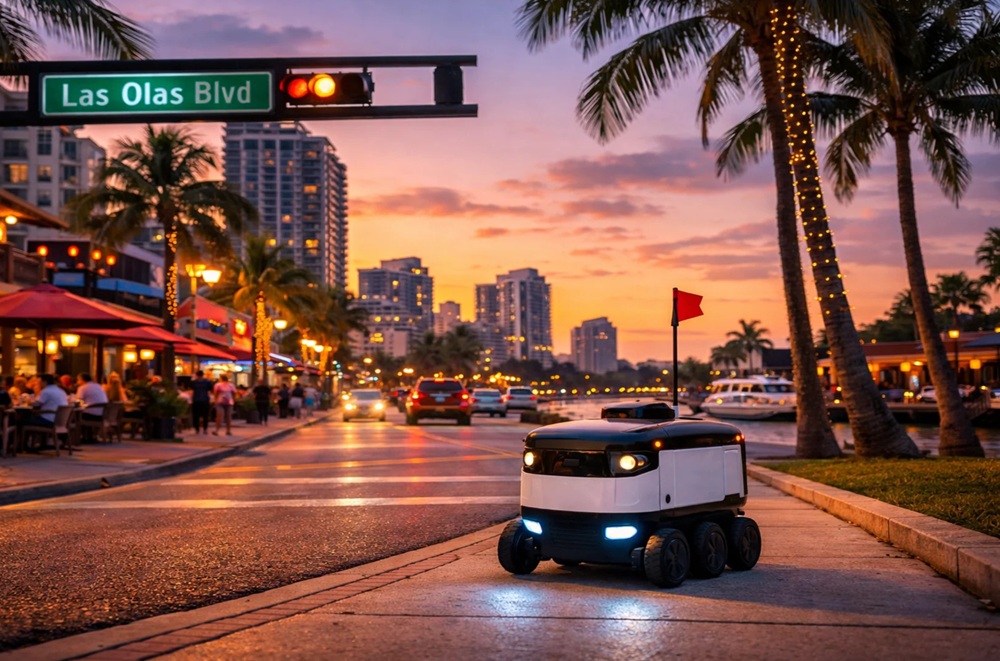
Fort Lauderdale’s autonomous delivery launch confirms what luxury buyers already know about walkable South Florida markets.
On December 5, Serve Robotics rolled out autonomous food delivery robots in Downtown Fort Lauderdale and along Las Olas Boulevard. For most people, it’s a novelty—cute robots delivering tacos. For real estate investors tracking South Florida’s luxury markets, it’s confirmation of something far more valuable.
“Delivery robots don’t choose random neighborhoods,” explains Larry Mastropieri, CEO of The Mastropieri Group and a top Delray Beach luxury expert with over 2,000 transactions. “They choose dense, walkable corridors with predictable foot traffic and quality infrastructure. That’s basically the same checklist buyers and investors use when they’re hunting for staying power.”
Technology Follows Infrastructure, Not Hype
Serve Robotics didn’t launch in Miami’s sprawling suburbs or West Palm Beach’s gated communities. They chose Fort Lauderdale’s densest, most walkable corridors—the same urban DNA that makes Delray Beach’s Atlantic Avenue and downtown neighborhoods like Palm Trail increasingly valuable.
The company plans to deploy 2,000 robots nationwide by the end of 2025, and market forecasts indicate the delivery robot sector will grow significantly through 2029. These aren’t experimental deployments—they’re infrastructure investments that require predictable density, commercial activity, and pedestrian-friendly streets.
For Delray Beach, the pattern validates Mastropieri’s observations of buyer behavior. High-net-worth relocators from New York, Chicago, and even Miami increasingly prioritize walkability over sprawling estates.
“People are walking all the time in Palm Trail, so you see your neighbors and interact with them,” Mastropieri says. “You walk 30 seconds to two minutes, and you’re at restaurants, bars, coffee shops. Walk a little further, and you end up on the beach. Everything’s less than a mile away.”
While National Values Decline, Walkable Markets Diverge
The timing of Fort Lauderdale’s robot rollout is particularly revealing. Zillow just reported that 53% of U.S. home values declined year over year—the highest share since 2012. National headlines are warning of corrections, yet technology companies are deploying capital into South Florida’s densest urban corridors.
Mastropieri tracks downtown Delray Beach neighborhoods where median prices hover around $2.075 million for approximately 200 homes in Palm Trail. Unlike oversupplied suburban markets facing inventory corrections, Palm Trail’s supply is shrinking as developers acquire 1960s and 1970s teardowns and replace them with $4 million to $7 million custom homes.
“You have developers building there like crazy,” Mastropieri notes. “Long-term, the area becomes more homogeneously safe, clean, and attracts even more investment while maintaining that residential vibe.”
Delray Beach’s geographic constraints create natural supply limits. The downtown core consolidates around Atlantic Avenue, with development pressure pushing upward—up to four to six stories maximum—while surrounding residential neighborhoods remain protected.
Infrastructure Investments Signal Long-Term Confidence
The robot deployment is one data point in a larger pattern. Recent South Florida infrastructure investments include Ampera’s nuclear energy headquarters relocating to the region, Stephen Ross’s $190 million Ben Hotel acquisition in West Palm Beach, and Palm Beach County’s proposed Project Tango—a 202-acre AI data center campus.
These aren’t speculative plays. They’re capital commitments from billionaires and institutions betting on South Florida’s role in energy, technology, and logistics over the next decade.
For Delray Beach buyers in the $3 million to $7 million range, the infrastructure momentum confirms the long-term appreciation thesis. Unlike rental-driven markets vulnerable to cash flow downturns, Delray Beach attracts high-net-worth owners making lifestyle purchases with generational holding intentions.
“If you’re buying in downtown Delray Beach with the goal of pure cash-on-cash return, it’s not as interesting,” Mastropieri explains. “More of the value is on the appreciation side. This is for a wealthier clientele willing to hold and enjoy it.”
The Walkability Premium
While national housing data shows widespread declines, walkable urban markets with constrained supply continue attracting both technology infrastructure and luxury buyers. Fort Lauderdale’s Las Olas Boulevard and Delray Beach’s Atlantic Avenue corridor share the same characteristics: dense, restaurant-heavy, pedestrian-friendly, and increasingly validated by institutional capital.
“Ten years from now, it’s going to be impossible to buy something in downtown Delray Beach for $5 million,” Mastropieri predicts. “Everything will be modern construction on lots where there’s no more land to build.”
Food delivery robots arrived in Fort Lauderdale because the infrastructure, density, and pedestrian activity justified the investment. The same factors driving robot deployment are driving luxury real estate appreciation in Delray Beach—and both trends are just getting started.
Looking to buy or sell in Delray Beach? The Mastropieri Group specializes in Palm Beach County’s luxury markets. Contact Larry Mastropieri at (561) 544-7000 to explore off-market listings and exclusive properties in South Florida’s most walkable luxury neighborhoods.
Disclosure: Individuals or companies mentioned may have a commercial relationship with KeyCrew.
Similar Articles
Explore similar articles from Our Team of Experts.