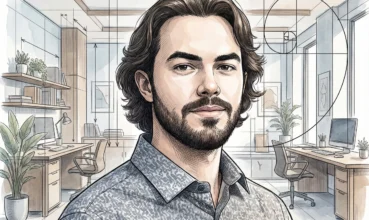

“There’s no time like the present,” says Matthew Baron, founder and president of Baron Property Group (BPG), when asked about his advice for aspiring real estate investors....

Home Staging Technology Emerges as a Catalyst for Multi-State Real Estate Growth

Written by:
Date:
10 Nov 2025
Share via Facebook

Share via Linkedin

Share via X

Copy to clipboard


The journey from selling handbags to transforming home staging may seem unconventional, but for Alex Ryden, founder and CEO of Guest House, it was a logical progression shaped by opportunity and customer needs.
What started as a retail experiment in a Denver home has evolved into a technology platform that has helped facilitate the sale of more than $2 billion in residential real estate across several states. The story of Guest House demonstrates how recognizing inefficiencies in traditional industries can drive meaningful change.
A Chance Beginning
Ryden’s entry into real estate technology was unplanned. In 2018, while running a bag brand and searching for retail space, he discovered his recently purchased Denver home was zoned for commercial use. “I decided to try to sell our bags out of our house in the living room on the weekends,” Ryden recalls. “People started to ask, ‘Is the dining room for sale? Is the sofa for sale? What about the rug?’ I said no, but maybe it could be.”
This experience led to transforming his home into a showroom where customers could shop for furniture and home goods in a real-world context. The idea quickly caught the attention of real estate professionals who saw potential beyond retail.
“People said, ‘I really like the furniture, but I’m in real estate. Do you do staging? Can we work with you and use this furniture inside staged homes? And we’ll pay you to do it,’” Ryden explains. “I said, ‘Wow, that’s interesting.’”
Uncovering Industry Challenges
As Ryden explored the staging industry, he identified significant operational challenges. “It’s a very fragmented space, really cumbersome with the logistics of moving furniture, and just really inconsistent quality,” he notes. The traditional staging process was slow, often taking weeks or months to coordinate and involving multiple vendors.
The staging market itself was shifting. What once served only ultra-luxury properties in markets like New York and San Francisco began expanding to homes in the $750,000 to $1 million range as agents recognized the value. “When you stage a home, it’s going to sell for more and sell faster compared to a vacant listing,” Ryden states.
Despite this shift, the supporting infrastructure hadn’t kept up. Coordinating staging, cleaning, moving, photography, and other listing preparation services usually required working with several vendors and could take up to 30 days just to align schedules.
A Digital Solution
Guest House’s platform tackles these inefficiencies by consolidating multiple services into a single digital experience. Users answer three questions about their property and receive an instant quote showing recommended rooms for staging and additional services.
“We quickly give you an instant quote that shows you what we’d recommend for staging and services as part of your go-to-market strategy in that area,” Ryden explains. “You can add or subtract in real time and see how your total cost changes. You can easily share that view with the homeowner so they’re aligned and approving.”
The platform automatically schedules all services, reserving dates and enabling listings to go to market in as little as three days—an improvement over traditional timelines.
Comprehensive Service Delivery
Unlike platforms that only provide digital tools, Guest House manages the entire physical staging process. “When they’re selecting their date and services, they’re leaning on us to bring that final design,” Ryden says. “We’re picking the right furniture for that home, and then we deliver everything in as little as three days.”
The delivery process is thorough: “What I mean by deliver isn’t boxes for them to set up themselves. It’s literally set up by our designers and movers in just a few hours. We come to the home, knock it out, leave.”
Ryden believes that successful technology companies must combine digital convenience with dependable physical execution. “Great businesses today need to have that balance. Otherwise, if one piece is out of balance, the whole value proposition falls apart.”
Impact and Results
The results underscore the platform’s effectiveness. In a recent Denver case study, where the average days on market had reached 60 days, a Guest House-staged property received multiple offers within the first week and sold 10% above the target price.
This performance stands out against broader market trends. “The market in Colorado saw 50% of homes last month take a price cut,” Ryden notes. “With Guest House, over 50% of our homes are receiving an offer within the first week.”
The company has maintained high customer satisfaction, with Net Promoter Scores above 80—exceptionally high for real estate services.
Targeted Market Expansion
Guest House’s growth strategy centers on high-growth markets rather than established metropolitan areas. The company operates in Denver, Boulder, San Diego, Orange County, Phoenix, and Scottsdale, with plans for additional markets by year-end.
“We tend to focus on markets that have an incredible amount of growth,” Ryden explains. “We want to be in markets that people are going to want to move into for the next 10 years, for the next 50 years. We see this as a long-term play.”
This approach targets markets where homeowners have built equity and budgets for listing preparation, while ensuring future customers will also have similar resources as home values appreciate.
Industry Partnerships and Recognition
The National Association of Realtors recently invested in Guest House, recognizing the platform as a valuable tool for real estate professionals. “They see us as such a critical tool to the agent stack,” Ryden says. “They want to continue to support us and bring us into more associations, more MLS organizations, more brokerages.”
This support reflects growing recognition of staging’s importance in today’s real estate market. In a cooling market with reduced buyer demand and higher interest rates, properties must stand out through presentation and marketing.
A Broader Mission
Guest House aims to be the “easy button for home prep or listing prep,” expanding beyond staging to encompass all services needed to prepare a property for market. The company sees an opportunity to become a household name in the listing preparation category.
“If you think about the full transaction, people go from listing into pricing and marketing, where they trust Zillow, then into transactions and financing where they might trust Rocket Mortgage, and closing where they might trust DocuSign,” Ryden explains. “The listing step—there’s no household name that’s really the go-to here. It’s arguably the most important step because it sets up the ability to price correctly and market well.”
With $2 trillion passing through the residential real estate market annually, Guest House aims to help properties sell faster and for higher prices through improved listing preparation. The platform shows how technology can streamline traditional real estate services while maintaining the quality and expertise that lead to results.
For real estate professionals operating in Guest House’s current markets or interested in future expansion, the platform offers instant quotes and transparent pricing at guesthouseshop.com.
Similar Articles
Explore similar articles from Our Team of Experts.