
As most of the residential real estate market cools from pandemic-era highs, one segment is moving at a surprising pace: small investment properties. According to Jillian Kemmerer, owner and...

Developers Turn to Mixed-Use Projects to Weather Real Estate Volatility

Written by:
Date:
19 Oct 2025
Share via Facebook

Share via Linkedin

Share via X

Copy to clipboard

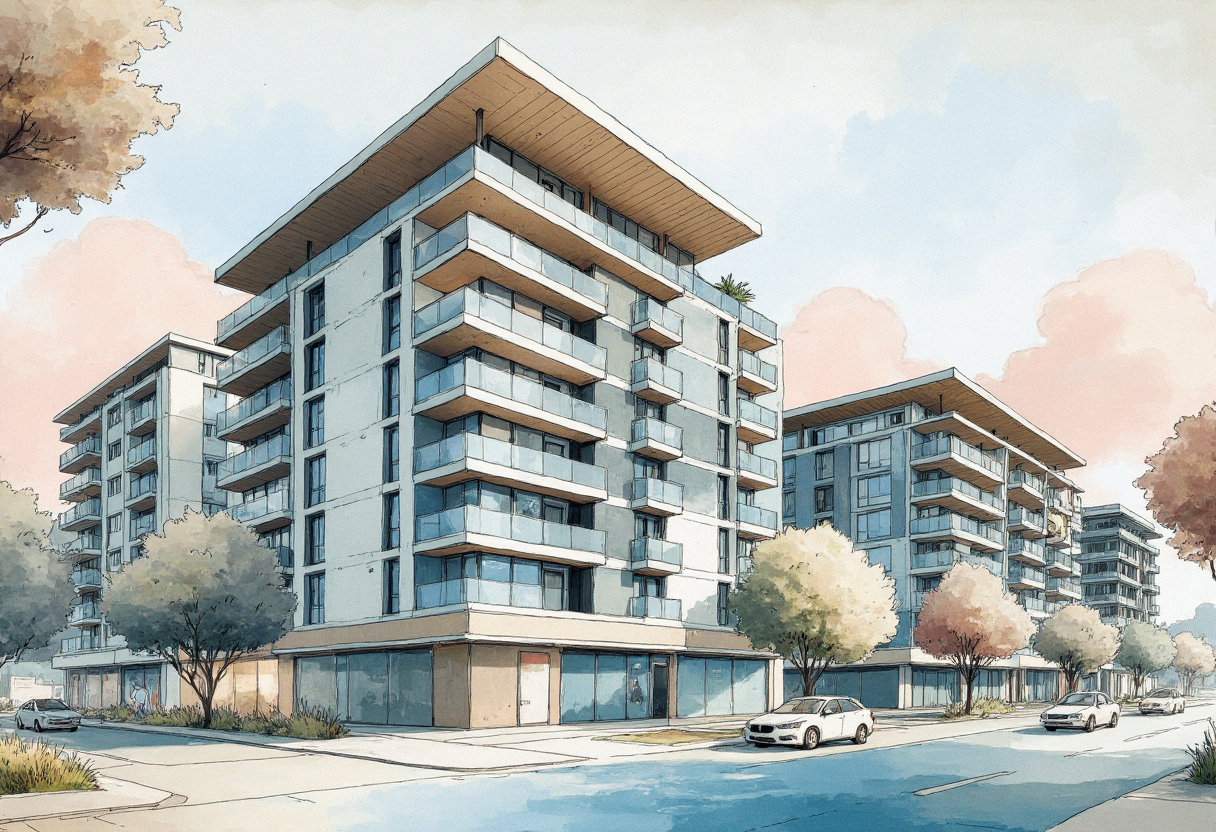
Mixed-use development serves as a built-in “spare tire” against market downturns, according to Mark Fansler, CEO of M Vincent Assets (MVA) LLC, who argues this approach offers unique protection in today’s uncertain environment.
“I focused on mixed-use throughout my career because no matter what the market cycles were doing, generally only one type of real estate is in a tank at a time,” Fansler says. “If housing was in the tank, then I could still keep the job going with the retail and the office piece.”
The Power of Multiple Revenue Streams
Fansler’s strategy involves combining at least three different property uses in a single development. “It could be, if it’s a mid-rise building, it could have condos or apartments with office and retail underneath of it,” he explains.
This diversification acts as insurance against sector-specific downturns. “They were sort of like built-in spare tires for a car,” Fansler says. “You could manage to keep going and let the market come back to you. When it came back to you, pick up the piece and the part that was failing.”
Market Cycles Drive Strategy
According to Fansler, real estate typically moves in 8-11 year cycles, with different property types falling in and out of favor. “Commercial mixed-use is more vital now than ever if you’re looking for long-term investments,” he argues.
The approach appears particularly relevant given current market conditions. “Single occupancy uses certain subsets of what their loans are focused on are in double digits, between 12 to 25% in delinquencies,” Fansler notes.
Beyond cycle resistance, Fansler argues mixed-use offers inherent value protection. “Even if somebody does a poor job with the investment, the real estate still has value,” he says. “Unlike the stock market, if the market tanks, whatever you’re going to sell has less value than before. In real estate, historically, everything you’re doing is increasing in value.”
Fansler’s company puts this philosophy into practice through its national mixed-use investment platform. “We can put a project together that might have 300-400 condos in it, a couple hundred thousand square foot of retail, and 50 to 100,000 feet office space in it, maybe a ground lease package to a Hilton Garden Inn,” he explains.
This diversified approach, Fansler argues, provides stability while others struggle. “While others tend to specialize in one thing, when they’re in their market cycle, it’s a ride just to try to hang on to outlast it. In ours, it’s just a portion of the job overall.”
Similar Articles
Explore similar articles from Our Team of Experts.