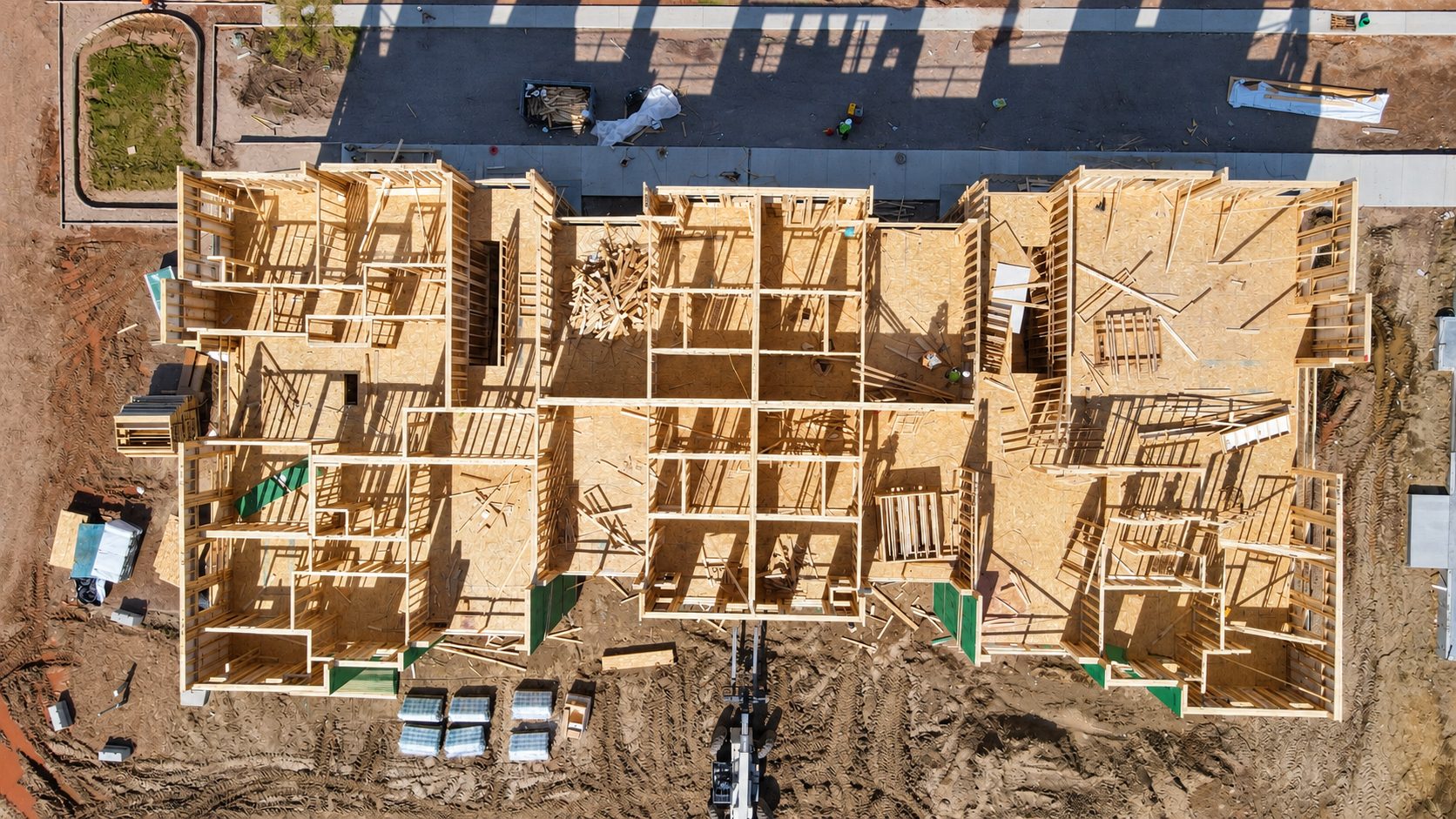
Dusten Hendrickson, founder of Mailbox Money Real Estate, sees today’s market as a good window for apartment development. His firm builds workforce housing in Sioux Falls, South Dakota, and across secondary and tertiary Midwest markets, and he says developers who build steadily are well positioned right now.
Here is what he is seeing on the ground and how his firm approaches development in this kind of market.
Land and Construction Pricing
Land is easier to secure right now. Hendrickson says fewer speculative projects, meaning projects built without a committed tenant or buyer lined up in advance, are starting across many property types, including office and industrial. That leaves more sites available for developers who are ready to build.
“There’s not very much competition for land right now,” he said. “We have many options on land that’s available for us.”
More options give a developer more choice in where to build. Construction labor is also more available, and that is showing up in bids.
“Since there is abundant labor in the construction industry right now, you can get much better pricing,” Hendrickson said.
Hendrickson sees this as a window. In his view, building costs tend to move up over time, so a project that locks in pricing today may be built for less than the same project started a few years from now.
Less New Supply Is Coming
With fewer projects breaking ground, Hendrickson expects a thin pipeline of new apartments over the next several years. That matters because a project started today will open its doors into a market with fewer new communities competing for the same renters.
“Now is a really good time because there’s going to be very little supply coming on the market over the next five years, in my opinion,” he said.
Demand for housing remains strong. Commonly cited estimates put the number of additional homes the U.S. needs at 4 million to 8 million.
Why Steady Building Works
According to Hendrickson, it takes two to three years at minimum to build, lease, and stabilize an apartment community. That timeline is why he does not wait for ideal conditions before starting a project.
“If you come in and try to build when the returns are good, you miss the curve,” he said.
Developers who build on a consistent schedule already have units coming online when conditions improve, instead of starting late.
“You can’t develop and then not develop and then develop again. It’s really hard to do that,” Hendrickson said. “It’s easier to just steadily develop.”
How Mailbox Money Builds
Steady development depends on careful underwriting. Hendrickson’s firm looks for undersupplied markets and makes sure each project can stand on its own at today’s rents.
“We just find the markets that are undersupplied, and we build in those markets,” he said. “If we can break even at current market rates, then we should be fine.”
The firm also keeps healthy reserves and designs its communities for high occupancy and low operating expenses. Hendrickson says that combination is what allows the firm to keep building through different market cycles.
That approach shapes Mailbox Money’s development pipeline, which includes planned workforce housing communities in South Dakota, Minnesota, and Iowa.
If you’re interested in learning more, book a call with Mailbox Money’s investor relations team.
About Mailbox Money Real Estate: Mailbox Money Real Estate is a vertically integrated developer of workforce housing in secondary and tertiary Midwest markets, including Sioux Falls, South Dakota, and Rochester, Minnesota. The firm manages each project in-house, from site selection and construction through leasing and asset management, on behalf of its accredited investor partners.
This article is based on information provided by the expert source cited above. It is intended for general informational purposes only and does not constitute legal, financial, or real estate advice. Readers should conduct their own research and consult qualified professionals before making any real estate or financial decisions.