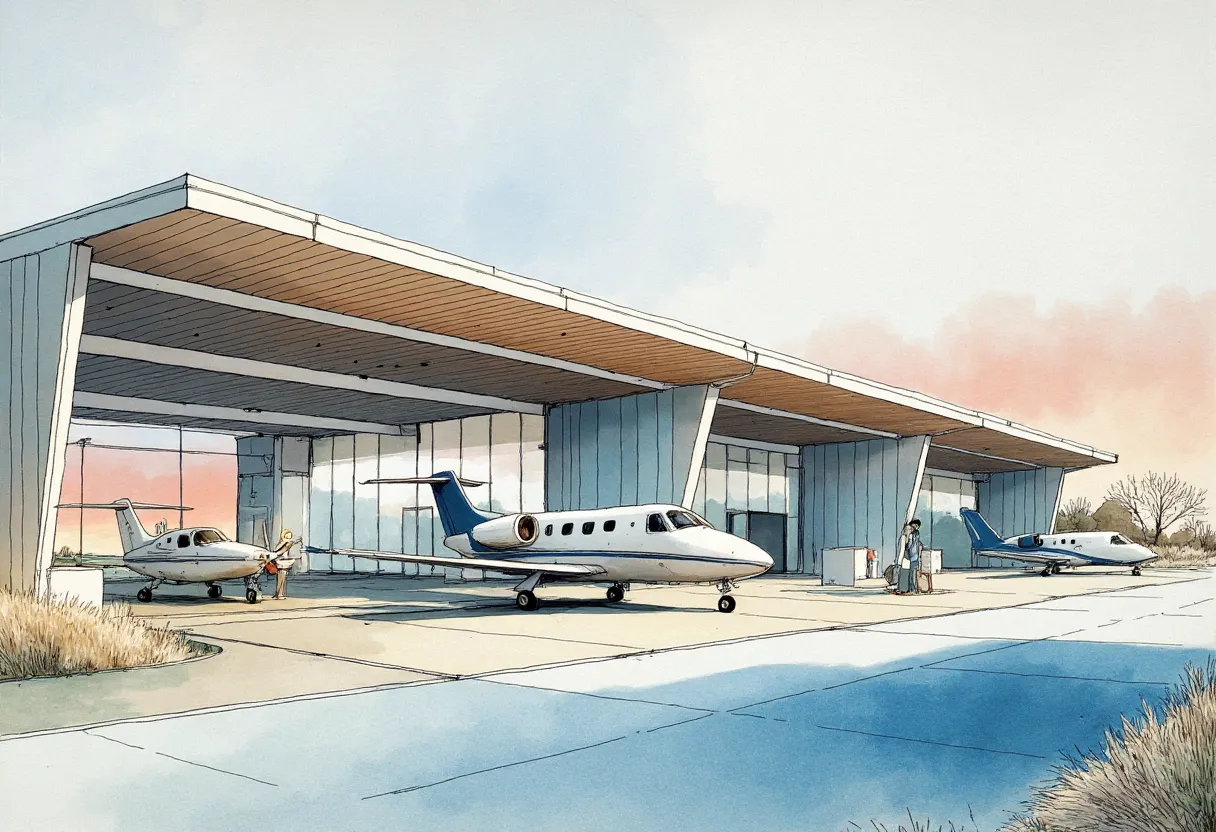
The aviation hangar development sector is facing a sharp divide between new and existing rental rates. New hangar facilities are commanding rents 60-70% higher than older inventory at the same airports. Despite the steep increase, tenants are accepting these higher rates because the alternative is remaining on waitlists that can stretch for years.
Cary Goldberg, president of Diversified Companies, has delivered 94 hangar units across Florida, with additional projects underway in Texas and Georgia. He says the current pricing gap is directly due to a prolonged supply shortage. Most regional airports have seen no new hangar construction for more than a decade. “The last new project that was built in Vero Beach was delivered, I think, 13 years ago,” Goldberg says. “Their rent levels are at $700 a month for a small hangar.”
The New Economics of Hangar Development
Goldberg explains that current construction costs and higher borrowing rates have made it impossible to deliver new hangars at prices comparable to those of legacy facilities. “I’ve got to come in and just to be able to deliver it and try to build to an 11% yield—and we all know what we’re borrowing money at—I’m going to be in it $1,100, $1,200 a month,” he says.
This leaves developers with a basic risk calculation: build new hangars at much higher rents and hope that persistent demand will outweigh tenants’ initial resistance to the price. Goldberg’s strategy is to rely on the years-long waitlists at most regional airports and the lack of any competing new supply to fill units despite the sticker shock.
So far, this approach has worked. Goldberg reports that his company is leasing new facilities even at the higher rates, driven by what he calls “tremendous demand” from several sources: pilot shortages, growth in flight schools, and aircraft owners’ need to protect their investments from weather and environmental damage. “You’re going to go and invest X dollars into an aircraft, even if you got a tiny, small single-engine four seater and bought it used for $100,000—you put it outside, let that salt and whatnot get on it, you’re done,” Goldberg says.
The Supply Constraint Reality
According to Goldberg, the supply shortage is not a temporary blip but a lasting feature of the aviation hangar market. He points to regulatory hurdles, lengthy FAA approval processes, and the complexity of negotiating ground leases with airport authorities as significant barriers that have kept new developers out of the sector. “There hasn’t been any new development. It just hasn’t been,” he says.
This creates a market where existing hangars command much lower rents because they were built under different cost structures. At the same time, new facilities must charge significantly more to cover higher construction and financing costs. The result is what Goldberg calls “initial sticker shock”—a gap that developers must overcome by relying on demand rather than competitive pricing.
To address this, Diversified Companies differentiates its product by including small amenity centers with air conditioning, pool tables, and bathrooms, features that older facilities usually lack. “We’re building tin cans for the most part. These are sweat boxes,” Goldberg admits. “But the guys like to sit out there and talk and hang out, so we build these little amenity centers. Nothing big, but just something to give them a little different than what they’ve had.”
Broader Market Implications
The current pricing structure raises questions about the long-term outlook for the aviation hangar market. If new supply can only be delivered at a 60-70% rent premium over existing inventory, the market may split into legacy facilities for price-sensitive tenants and new facilities for those willing to pay more for immediate access and upgraded amenities.
Goldberg is confident that demand will continue to support the higher pricing. “The United States is the number one country in the world for flight training,” he says. “We have great conditions, fantastic infrastructure, and top-notch airport and tower control systems. It’s just been chaos for people trying to get space.”
Whether other developers move into the sector may depend on their willingness to accept the initial pricing risk Goldberg describes. For now, Diversified Companies is expanding, with projects underway or planned in Florida, Texas, Georgia, and potentially Arizona—all based on the expectation that strong demand will continue to support higher rents, even as the gap with legacy facilities persists.
This article was sourced from a live expert interview.
Every month we conduct hundreds of interviews with active market practitioners - thousands to date.
Amid growing market uncertainty, private lending expert Philip Bennett argues that experience in evaluating distressed commercial real estate assets has become more crucial than ever, partic...
Office-to-residential conversions are gaining traction in Ohio’s city centers. Still, Brian Lorenz, Director of Planning and Permitting for the Ohio House of Representatives, warns that th...
The Manhattan office market is undergoing significant changes as companies respond to post-pandemic workplace dynamics. Tenant improvement budgets and space planning requirements are evolvin...
Colliers Executive Vice President David Gabbai, who has spent 36 years in commercial real estate, says the most successful brokers are those who can solve problems creatively when market fun...
The commercial real estate industry stands at an inflection point. While other sectors have undergone significant digital changes over the past decade, real estate has remained relatively un...
The rush to build AI data centers in remote locations may be misguided, according to Knight Frank’s Global Head of Data Centres Stephen Beard, who argues that next-generation AI will a...