

The luxury real estate market has shifted decisively in buyers’ favor, according to Atlanta broker Keianna Williams, who says traditional marketing approaches are no longer sufficient ...

Amenity Fees Evolve as Smart Building Technology Becomes the Norm

Written by:
Date:
29 Oct 2025
Share via Facebook

Share via Linkedin

Share via X

Copy to clipboard

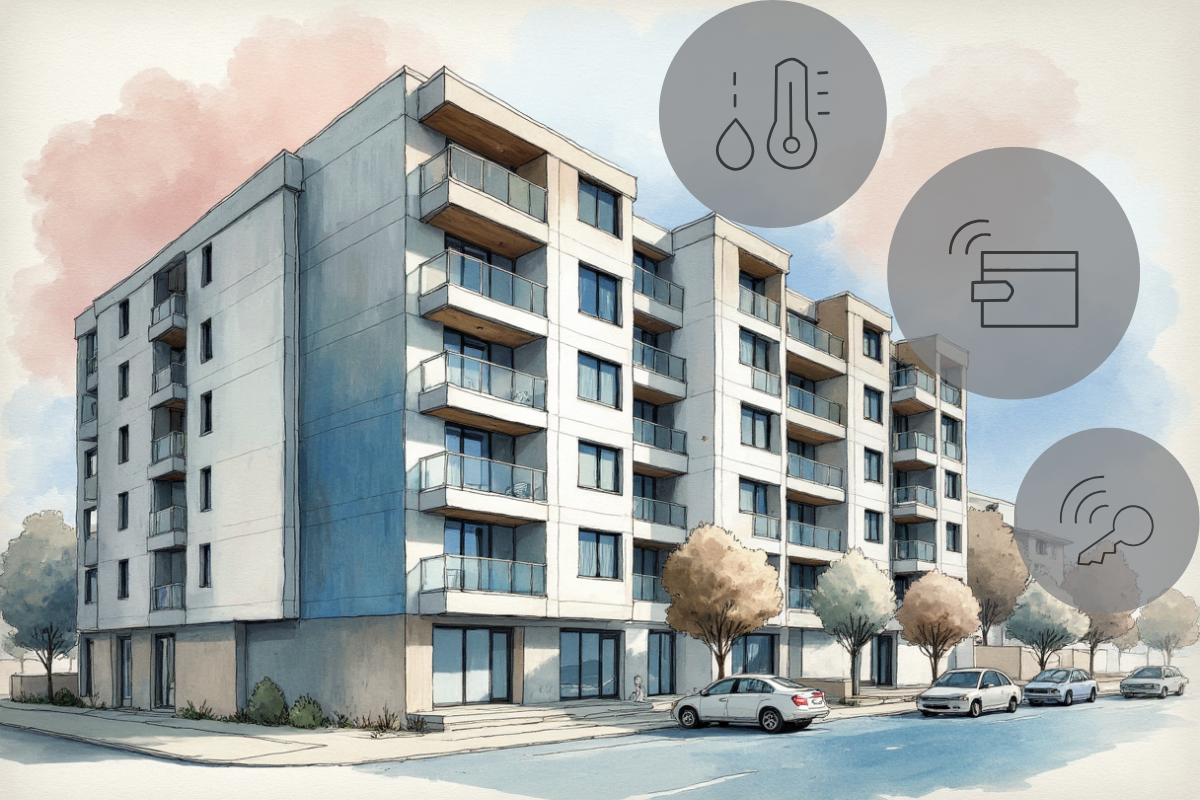
Multifamily operators now face a decision similar to the hotel industry’s past approach to internet access: will smart building technology remain a premium amenity fee, or will it become a standard feature included in base rent? Lance Platt, President and CEO of Groove Technology Solutions, says the industry is experiencing this transition now.
“Yes, yes and yes,” Platt responded when asked whether technology serves as a differentiation tool, becomes a baseline expectation, or is shifting between the two roles. His company’s experience across hospitality, senior living, and multifamily sectors offers insight into how technology amenities move from luxury add-ons to standard features.
A Parallel to Hotel Internet Access
Platt points to the hotel industry’s shift, where internet access moved from a fee-based service to a standard amenity. “When you were traveling on business 15 years ago, you would go to a hotel, and you would expect that if you wanted to get on the internet, you would pay your $10, $15, $20 to get internet access,” he explained. “But now, if I stay in a Marriott, regardless where I am, I don’t pay for that internet. I just get it.”
This evolution from a paid service to an included amenity is now taking place in multifamily properties with smart building technology. The change reflects broader market trends where competitive pressure pushes premium services to become standard offerings.
Current Market Dynamics
In today’s multifamily market, both approaches exist at once. Properties often use amenity fees to highlight technology offerings while keeping base rent competitive. “Right now there’s a lot of amenity fees to make you to stay here. Your base rent, you can compare our rent to the rent down the street, but we’re going to have an amenity fee,” Platt noted.
However, this creates a challenge. As more properties in a market adopt smart building technology, the advantage of offering it as a differentiator fades. “When you have four apartments on a block, and two of them, or three of them are starting to offer some kind of smart building tech, then you’re going to be at a disadvantage,” Platt observed.
Integration on the Horizon
Competitive pressure is leading properties to include technology costs in base rent. Platt expects this shift to mirror the hotel industry’s experience: “I think in the future that base rent becomes, it’s just rolled in. Our base rent is going to be $1,700 and it includes all of these technologies.”
This transition is more than an accounting change, it marks technology’s shift from novelty to necessity. Just as hotel guests now expect reliable WiFi without extra fees, apartment residents are beginning to see smart building features as standard.
For multifamily operators, the key challenge is timing. Moving too soon means absorbing costs before the market demands it, while waiting too long risks losing ground to more advanced competitors. The industry is nearing a point where smart building technology is as expected as in-unit laundry or fitness centers.
Similar Articles
Explore similar articles from Our Team of Experts.


Perspectives, Commercial Real Estate, Market Analysis & Policy, Real Estate Investment, Industry News
Major San Francisco office properties are trading at dramatic discounts to replacement cost, creating what one local expert calls an unprecedented opportunity for investors with ready capita...