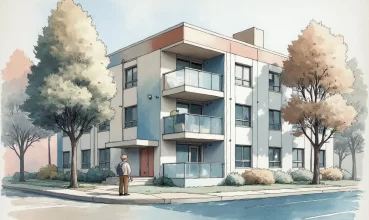
The fourth largest city in Michigan is pioneering a comprehensive strategy to address the challenge of mid-sized commercial vacancies that have become difficult to fill in today’s retail landscape. Sterling Heights has developed an innovative overlay ordinance system that gives flexibility to property owners struggling with vacant pharmacies, big-box retailers, and other commercial spaces.
The challenge facing Sterling Heights mirrors issues across the country. Traditional retail spaces, particularly those ranging from 8,000 to 30,000 square feet, are sitting vacant as national chains shutter locations due to shifting shopping patterns and the rise of e-commerce. These properties often occupy prime real estate but present unique challenges for new tenants.
“We started to notice that the mid-size pharmacies, eight to 12,000 square feet, and then retailers up to about 30,000 square feet that are going vacant are having a really difficult time finding new tenants because of how people’s shopping trends are changing,” explains Jake Parcell, City Planner and City Development Manager, City of Sterling Heights.
Despite maintaining a healthy 9% commercial vacancy rate, the city recognized that these larger vacant spaces represent a disproportionate challenge. The traditional need for variances and special approvals for new uses was creating barriers for property owners trying to adapt to market demands.
A Comprehensive Planning Approach
Sterling Heights’ solution emerged from an extensive community engagement process that began in 2024. Working with planning consultant Giffels Webster, the city updated its master land use plan, including input from nearly 5,000 survey respondents and hundreds of in-person participants at open houses and educational sessions.
The planning process revealed the need for greater flexibility in commercial zoning, especially in “nodes and corridors,” high-priority areas first identified in 2017 where the city wants to encourage adaptive reuse and new development.
The city’s response was overlay ordinances expanding the choices for property owners in these districts. Rather than being limited to specific commercial classifications (C1, C2, C3), owners can now access a broader range of permitted uses without variances or special approvals.
Administrative Solutions for Real-World Challenges
One of the main barriers to adaptive reuse has been parking requirements. A former pharmacy converting to a restaurant, for example, would typically need triple the parking spaces under traditional zoning codes. Sterling Heights addressed this through administrative parking reductions that allow staff to work directly with property owners to right-size parking requirements based on actual usage.
“The biggest one that is kind of the ace in the hole is the administrative parking reduction,” Parcell notes. “They can’t be expected to invest much into a parking lot expansion, or they just don’t have the space for it, but they have an incredible user tenant ready to come in, then we can work with them to help redesign the site in a way that meets their needs.”
This approach is backed by parking studies revealing significant oversupply in many commercial areas. The city’s analysis shows that many parking lots have 400 to 600 more spaces than needed, creating opportunities for infill development and improved site design.
Success Stories and Market Response
The flexible approach is already yielding results. Auto parts stores, which offer products not easily purchased online, have filled some former pharmacy locations. Secondhand retailers like Salvation Army and Goodwill have renovated shuttered buildings with improved facades and signage.
One successful conversion transformed a former pharmacy into a local halal market with a cafe, located near multifamily housing to serve residents within walking distance. This project exemplifies the city’s vision of connecting commercial services directly to residential neighborhoods.
Sterling Heights is also seeing interest in entertainment and experiential uses. Indoor recreation facilities, golf simulators, and billiards halls partnered with restaurants are finding success in these repurposed spaces. The city is actively courting its first brewery, recognizing the potential for craft brewing to serve as an anchor use in redeveloped commercial areas.
Innovative Parking Lot Development
Perhaps most notable is Sterling Heights’ approach to underutilized parking lots. The city encourages owners to develop within their own parking areas, either through infill retail or residential projects. One example includes a multifamily development built in a parking lot near the Lakeside Mall area.
“We’re encouraging people to develop in their parking lots in this dead space,” Parcell explains. “If they’re not using spaces, we encourage them to bump up to the road and build a second row of retail and fill in there and kind of take away the space that’s just paved and sitting there and not benefiting anyone.”
This addresses multiple objectives: reducing impervious surfaces, creating more walkable environments, and generating development opportunities in a largely built-out community.
Public-Private Partnership Strategy
Sterling Heights knows that commercial revitalization requires both public and private investment. While overlay ordinances provide regulatory flexibility, the city is also investing in streetscape improvements, landscaping, tree planting, and other amenities that enhance the attractiveness of commercial areas.
The city maintains databases of vacant properties and actively connects potential tenants with available spaces. Staff regularly field calls from prospective businesses and can direct them to appropriate locations that match their needs and the new zoning parameters.
Broader Implications for Communities
The Sterling Heights approach offers lessons for other communities facing similar challenges. Flexibility in zoning and parking requirements can remove major barriers to adaptive reuse without compromising standards. Administrative processes that let staff work directly with property owners can expedite approvals and reduce costs.
The city’s focus on connecting commercial areas to residential neighborhoods through improved walkability and reduced setbacks reflects broader trends toward mixed-use, pedestrian-friendly development. By encouraging buildings closer to streets and offering flexibility for shared parking and access, Sterling Heights is facilitating more integrated development patterns.
Looking Forward
Sterling Heights is preparing for its next phase. The city recently published its comprehensive parking study and is opening an RFP process for a full zoning ordinance rewrite to align all regulations with the updated master plan.
“We want good, strong businesses to come to Sterling Heights, to partner with the city and be there for our residents and provide a very high level of service,” Parcell emphasizes. “We are exhausting every option we can to try and make that happen.”
The Sterling Heights model demonstrates how proactive municipal planning can address market challenges through regulatory innovation rather than simply reacting to development pressures. By providing flexibility while maintaining standards, the city is creating conditions for successful adaptive reuse that benefits property owners, businesses, and residents alike.
For real estate professionals and investors, Sterling Heights represents an example of how forward-thinking municipal policy can create opportunities in challenging commercial real estate markets. The city’s comprehensive approach, combining regulatory flexibility, administrative efficiency, and strategic public investment, offers a roadmap for communities seeking to revitalize commercial areas amid rapid retail change.
This article was sourced from a live expert interview.
Every month we conduct hundreds of interviews with active market practitioners - thousands to date.
The commercial real estate finance sector has undergone significant change since the Federal Reserve began raising interest rates in 2022. While many anticipated a wave of distressed assets ...
The ongoing artificial intelligence boom is fueling a surge of ultra-high-net-worth buyers in Silicon Valley, generating record activity in the region’s luxury real estate market. At the s...
The ultra-luxury real estate market in Miami Beach is seeing a significant trend toward cash transactions, reflecting advanced wealth management strategies among high net worth buyers, accor...
The multifamily acquisition market is splitting into two distinct channels with very different economics, according to one acquisitions executive who has closed over $300 million in transact...
Investors who acquired Class A industrial properties in Atlanta’s top submarkets as recently as four months ago are now facing immediate valuation losses of 20% or more, according to a bro...
For Ryan Porter, a 25-year technology veteran currently working with AWS, real estate investment has grown from an opportunistic side project into a calculated cross-border operation. As a P...