

In commercial real estate, the most expensive technology mistake isn’t buying the wrong system. It’s letting your vendors decide what you need. That is the core argument Bill Dou...

Protecting Hotel Operations: A Strategic Approach to Water Leak Risk Management
Share via Facebook

Share via Linkedin

Share via X

Copy to clipboard

Water leak incidents create immediate operational challenges for hotel operators, from guest complaints to costly remedial work. However, the long-term impact of a serious water leak incident may not be fully realized until the hotel’s property insurance policy is due for renewal. Hotels with a history of water damage claims may face a reassessment of their risk profile, potentially leading to premium increases from their renewal date onwards. And in extreme cases, some hotels may find it difficult to secure coverage at all.
A recent case involving an Atlantic City casino brings this into sharp focus. A single frozen pipe incident in a mechanical area resulted in substantial damage, necessitating an insurance payout of more than $5 million. But beyond the remedial work to fix the property damage, the hotel’s insurance broker projected an insurance premium increase at renewal of over $5 million. What’s more, attracting the multiple carriers that were required in order to provide sufficient capacity to cover the total insured value of the hotel proved challenging.
Risk Assessment: Mapping Your Vulnerabilities
Effective water leak detection and prevention begins with understanding your property’s specific risk profile. Conduct a comprehensive room-by-room assessment, documenting bathroom fixtures, HVAC units, and any areas with historical problems.
Mechanical systems and areas require equal attention. Evaluate boiler rooms, pump areas, pool equipment, and laundry facilities, which are all spaces that often house the highest-risk equipment. A guest bathroom leak may affect a single room, while a mechanical room failure can shut down elevators and displace entire floors.
Review maintenance logs, insurance claims, and guest complaints from recent years to identify any seasonal patterns and recurring problem areas. This historical analysis can provide useful context for when planning targeted prevention strategies.
Technology Solutions: Smart Monitoring Implementation
Modern water leak detection technology can deliver comprehensive early warning capabilities via a network of wireless sensors. Battery-powered sensors can be installed throughout your hotel, communicating wirelessly to gateway units that cover large building areas.
Strategic sensor placement maximizes protection effectiveness. In guest rooms, position sensors under sinks, behind toilets, and beneath HVAC units. For mechanical spaces, place sensors near all pressurized equipment and in areas that have a history of water leaks.
These devices, roughly the size of a popsicle stick with 10-year battery life, continuously monitor the property and can alert staff in under a minute through multiple channels.
Other types of sensors can also be deployed and connected to a monitoring system. Temperature sensors can be deployed, for example inside economizers, to detect freezing temperatures that can cause burst pipes.
When evaluating connectivity options, choose sensors that use LoRaWAN (Long Range Wide Area Network) protocol rather than Wi-Fi. LoRaWAN’s lower power consumption needs make it better suited for battery-operated devices while providing superior connectivity range compared to Wi-Fi systems.
Emergency Response: Minimizing Damage Impact
Staff response times determine whether small leaks become major problems. Therefore, ensure your staff response protocols are aligned with the alerts and reporting that is provided by your smart monitoring system.
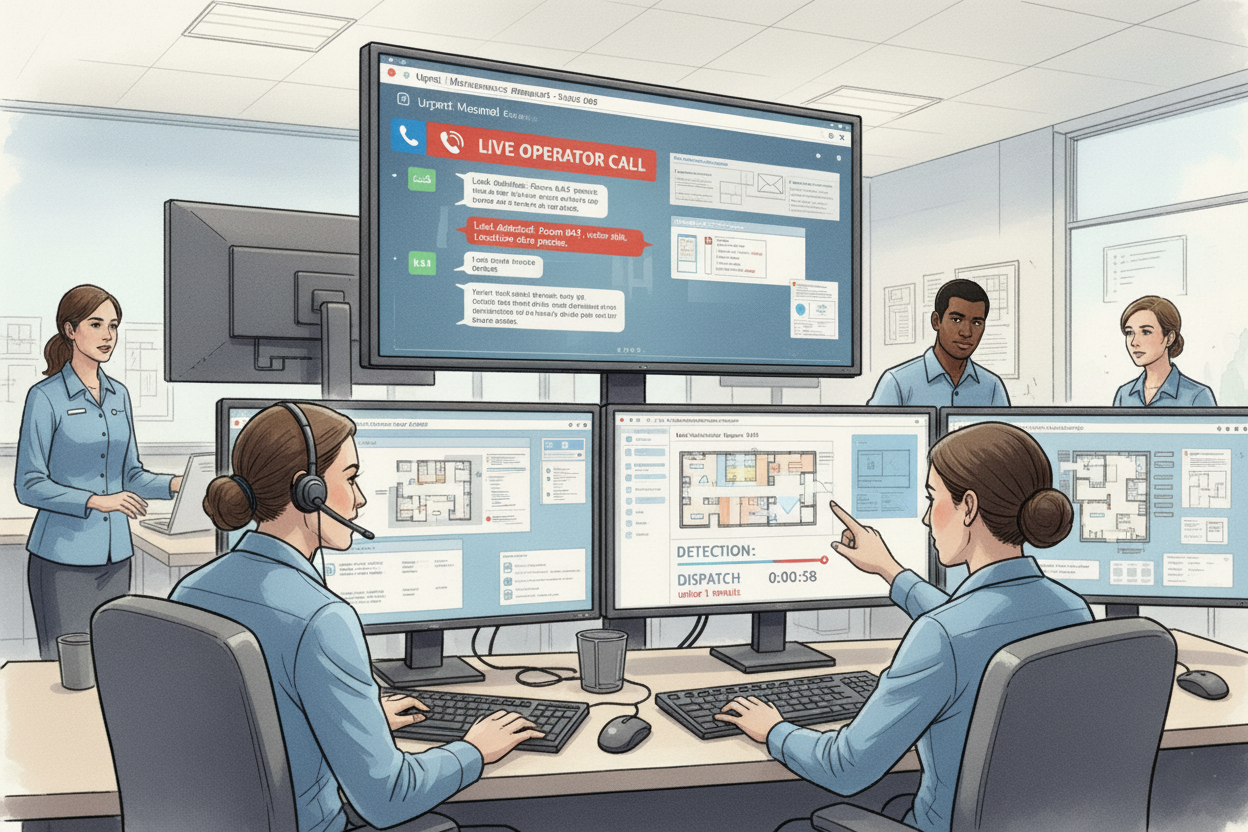
Work with your monitoring provider to create multi-channel alert systems that deliver appropriate information to relevant personnel. While live operator calls and text messages provide immediate notification for urgent response, email alerts offer incident documentation. Ensure alerts reach the appropriate staff members through different communication channels to guarantee timely response regardless of shift schedules.
Ensure your protocols are clear, understood, and easily accessible in the event of an emergency. Define specific roles for relevant team members during water emergencies, eliminating confusion when rapid response is critical. For example, maintenance staff should know shutoff valve locations and operation procedures, while front desk staff should know the guest communication protocols for water-related disruptions.
Insurance Considerations: Leveraging Risk Mitigation
As mentioned, hotels with water damage history may face increased insurance premiums at renewal. However, comprehensive leak detection systems can potentially help reduce these projected increases by demonstrating proactive risk management to carriers.
Insurance brokers and risk management consultants are increasingly partnering with smart-monitoring companies to develop risk mitigation strategies that can be presented to insurance carriers. While outcomes depend on each property’s unique loss history and risk factors, proactive measures can strengthen negotiating positions when securing coverage terms.
For example, the aforementioned Atlantic City casino invested in monitoring technology, which helped to reduce its forecasted insurance premium renewal increase.
Building Long-Term Resilience
Effective water leak risk mitigation requires ongoing commitment to both technology deployment and operational procedures. Regular system testing, staff training updates, and equipment maintenance ensure your property remains prepared for water-related incidents.
Focus implementation efforts on high-risk, high-impact areas including guest bathrooms, mechanical rooms, HVAC systems, pool areas, and locations with a history of water damage. The wireless design of modern sensor systems allows for quick installation with minimal disruption to guest areas.
By implementing smart monitoring systems and comprehensive response protocols, hotel operators can transform their properties from reactive to proactive water leak risk management. This approach not only reduces the risk of major disruptive incidents but may also help properties with water damage history to secure more favorable insurance renewal terms.
By Nadav Schnall, CEO of smart building monitoring company ProSentry, which provides comprehensive wireless sensor networks that monitor for water leaks, gas leaks, and other building risks, delivering real-time alerts and live operator calls to prevent issues from escalating into major claims. The company’s platform has caught over 3,600 leaks with zero false alarms, helping buildings secure insurance discounts and coverage that might otherwise be unavailable.
Similar Articles
Explore similar articles from Our Team of Experts.