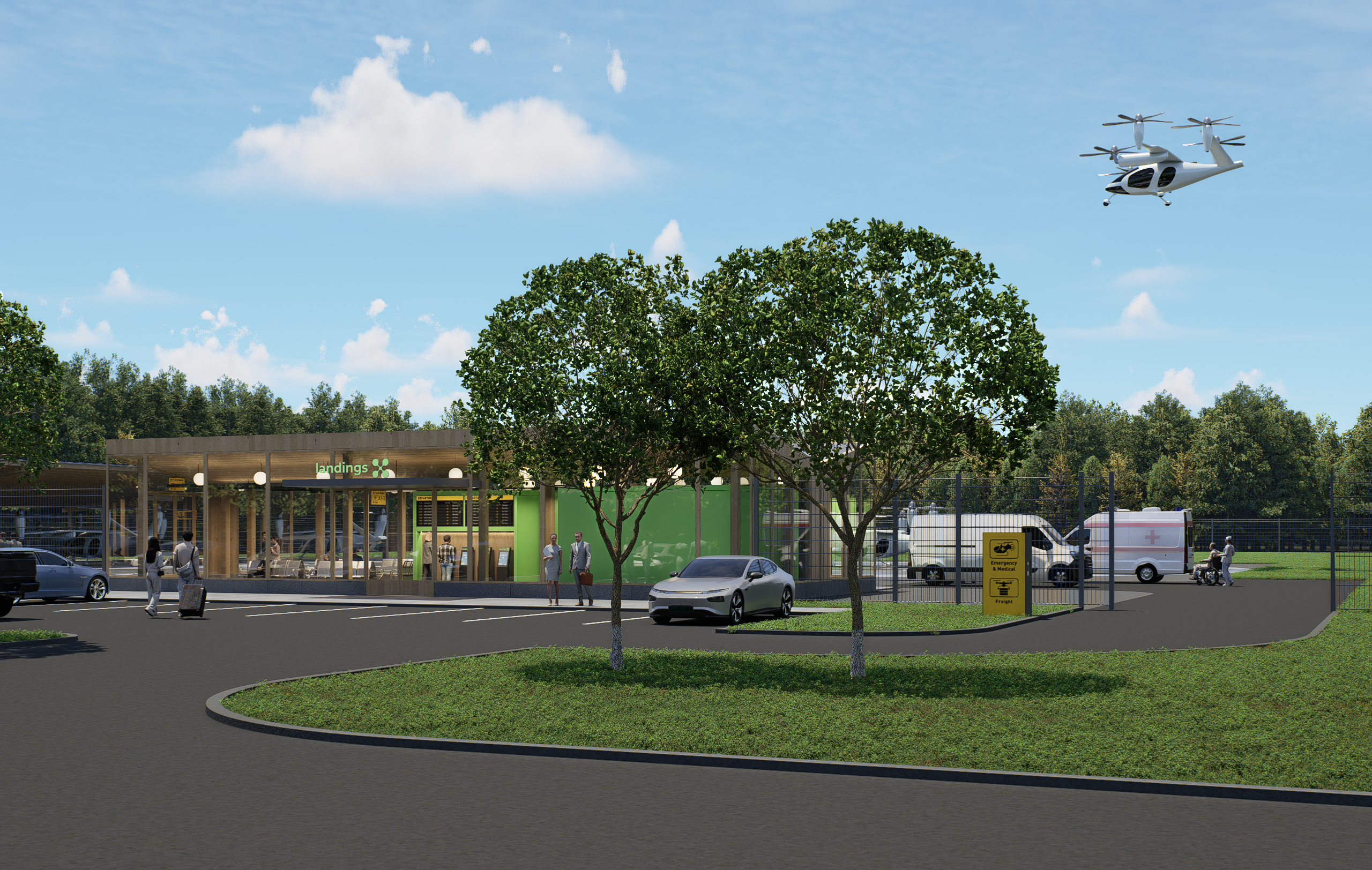
Landings has introduced a new approach to address the infrastructure shortage facing electric aviation, according to CEO Lisa Wright. In a recent interview, Wright outlined how the company’s rural-focused strategy is making an impact in underserved markets while major competitors concentrate on urban opportunities.
The Problem
“That’s great that there’s 600 manufacturers building these aircraft right now. Where are they going to land? How are they going to charge? How are they going to be maintained and operated? Where are we going to train pilots? There’s an entire real estate industry around the landing and charging of these aircraft,” said Wright, who has over 20 years of commercial architecture experience and previously worked with PropTech companies acquired by major real estate firms.
The current lack of infrastructure has created a bottleneck for the expanding electric aviation sector, with 2 million commercial drones expected in operation by year-end and eVTOL passenger aircraft awaiting FAA approval for commercial operations within the next year.
The Solution
The company is leveraging cutting-edge site selection technology to streamline development planning. Its upcoming MVP app will allow users to input an address and instantly receive a detailed analysis covering factors such as zoning, lot size, elevation, and terrain flatness, essentially automating the same due diligence a professional development team would conduct manually.
Through a network of strategic partnerships, the company is also expanding its ecosystem to include charger and energy providers, as well as aviation service partners. These collaborations extend to light sport aircraft operators offering emergency services, underscoring a broader commitment to building a connected and adaptive infrastructure.
Finally, the firm’s flexible infrastructure model ensures scalability and risk management. Rather than developing entire sites at once, projects are executed in phased stages, with options secured on multiple properties to allow for strategic growth and adjustment as demand evolves.
Implementation in the Mohawk Valley
Wright described how Landings has put its solution into practice in the Mohawk Valley region of upstate New York.
“We’ve got this agreement with six different counties that we’re going to build their infrastructure. Whether that’s added charging, that’s kind of a benefit to the community as well. They really want not only the additional services that the vertiports will bring, but it will bring also energy systems to them,” she said.
The project leverages the region’s existing advantages, including a 1,000-square-mile area of FAA-approved drone airspace and strong community support for aviation innovation.
Results and Community Impact
Landings’ approach has led to strong community engagement. “The Mohawk Valley, we got 12 letters of support from the community wanting to have our network up there.”
Wright highlighted that communities view vertiports as more than aviation infrastructure; they see them as catalysts for broader economic development, such as attracting drone manufacturing and pilot training programs to rural areas that traditionally lack such industries.
Challenges and Adjustments
Despite progress, Wright acknowledged ongoing challenges. “Energy is a very complicated situation. However, we are reserving the site, so we’re actually modeling it more after like the cell tower industry, where we’re getting options on the land.”
She noted that energy availability is the main constraint, with “90% of the time not enough energy available in the area.” Landings has responded by partnering with energy providers who will finance and install the electrical infrastructure needed for aircraft charging.
Future Plans
Looking ahead, Wright sees opportunities to expand their approach into new markets and use cases. “I’m actually going to start banging on those doors again, saying, ‘Look, you know, Landings is especially in New York, for now, right now, like, let’s see who owns malls.’ Malls are a great candidate. Tractor Supply stores and the same sort for me are great locations,” she said.
Landings plans to target national REITs and property owners to develop networks that could serve both rural communities and suburban retail locations.