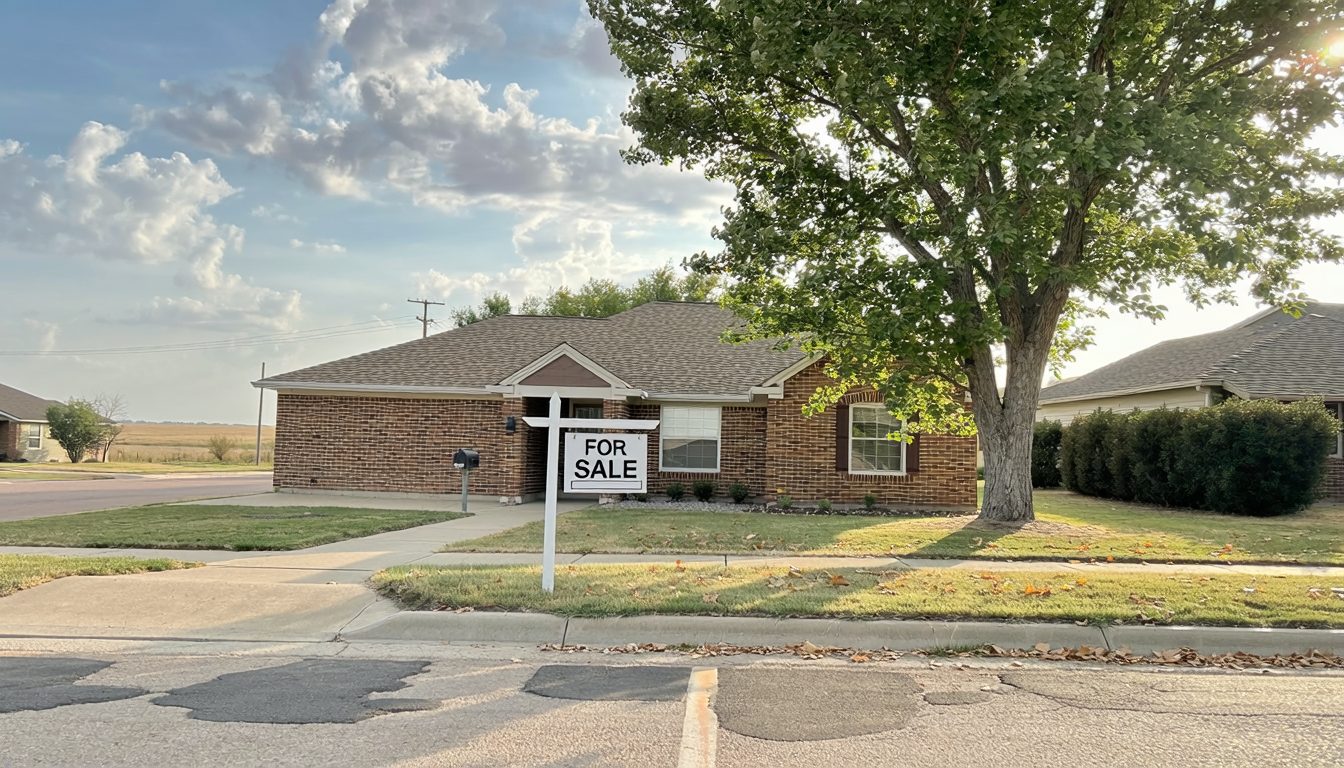
South of Wichita, Kansas, the obstacle to closing a sale has moved from the list price to the buyer’s wallet. Mortgage rates in the sevens have shrunk what buyers can borrow and left them with less cash to bring to closing. In towns like Belle Plaine, Mulvane, and Oxford, sellers increasingly make up the difference: they cover closing costs, absorb the buyer’s agent commission, and build those costs into the price.
Katelyn Gooch, who runs K+J Homes and has worked the area since 2019, dates the change to August. Rates in the sevens hit buyers twice, she says – first, they slow down, and then “the price range that they could afford is dropping.” Sellers who still price for the market of a few months ago put their homes out of reach of buyers who could have afforded them before.
Closing Costs a Standard Concession
The cash squeeze shows up first at the closing table, where seller-paid closing costs have shifted from an occasional bargaining chip to a near-universal term. Gooch says sellers have covered part of the buyer’s closing costs on every contract she has written recently except one.
Buyers also press harder on everything else. Gooch describes them “coming in and wanting the moon, the sun and the stars at negotiation times,” and contracts are falling through. In a single recent week, she lost one contract, and another local agent she compared notes with lost two.
Sellers who want to move have little choice but to meet these buyers partway. A buyer who qualifies for the house but lacks the cash to close cannot buy it, so the seller’s concession becomes the cost of getting the sale done at all.
Commission Change
The same reality – buyers with little spare cash – decided how the commission rule change played out in these towns. The NAR settlement ended advertised commission offers on the MLS, but in practice most sellers here still pay the buyer’s agent, because the buyer usually can’t. As Gooch puts it, “a lot of times the buyers don’t have that added money in their pockets.” Agents in the area tell sellers that if they need to cover the commission, they can list higher by that amount, which moves the cost into a price the buyer finances rather than pays in cash.
The transition went smoothly partly because Gooch taught her agents well before the settlement that sellers had always been free to negotiate the buyer’s agent commission. Some sellers have asked about the change after hearing about it, but Gooch says only a couple have refused to pay.
The new written buyer agreements have created more friction, though almost entirely with strangers. Buyers who come to Gooch through referrals sign without hesitation because they already know they want to work with her. Prospects from yard signs and online leads more often want a one-time showing agreement than a six-month commitment, and their first question is what obligation they take on. Gooch answers by telling them either side can walk away if the fit is wrong. “I don’t want to work with somebody that doesn’t want to work with me because this isn’t going to make my life any better either,” she says.
She also sees a benefit for sellers in the agreements. Because buyers now need a conversation with an agent before they tour, they arrive better prepared. “We only want pre-approved, ready-to-go buyers coming through here because otherwise it’s a waste of everybody’s time,” she says.
The Right Price
Covering a buyer’s costs keeps a deal together only when the list price leaves room to do it, and Gooch says most sellers still list higher than agents recommend. Some of her listings now sit strictly because of price. To close the gap, she gives every seller a comparative market analysis and walks them through homes at two price points: where the data says to list, and where the seller wants to list. Setting the homes side by side makes the difference concrete – the higher-priced house, she might point out, has a much nicer kitchen and no 1980s wallpaper.
With sellers who insist on their own number, she sets a deadline. “In two weeks, if we are getting a lot of feedback that we’re overpriced, or we’ve had not a single showing, then we need to drop the price because the market is clearly telling us that we’re overpriced,” she says. The harder lesson is that a later reduction doesn’t erase a bad start. “It is hard to get sellers to understand that the way you come onto the market at the very beginning is so important,” she says. Gooch doesn’t treat slower sales as a problem in themselves, since the post-Covid pace was never normal. “I don’t think it’s necessarily harmful that we’re sitting on the market a little longer, but it is harmful if it’s because we’re overpriced.”
Pricing From Fewer Sales
Finding the right price takes more work in towns where a handful of sales make up the whole record. Gooch starts with sales inside the town from the past six months, then reaches back 12 and sometimes 18 months. If that still leaves too little, she moves to neighboring small towns and adjusts for the differences between them; Mulvane, for instance, generally trades higher than Belle Plaine.
Distance from Wichita also shapes what a home is worth to a given buyer. The farther south buyers go, the more house and land they get for the money, and many move out of Wichita or Derby specifically for a few acres. The drive cuts the other way. Gooch recently worked with buyers who loved a Belle Plaine house but couldn’t accept the 30-minute commute. “Those of us that have lived in Belle Plaine forever, it’s nothing for us,” she says, but newcomers weigh shorter drives against more bang for the buck.
Realistic Pricing
Many of the sellers listing now don’t have the option to wait. Gooch’s recent business has tilted heavily toward listings driven by life changes such as divorces and older owners moving into nursing homes. For those owners, pricing correctly from the first day matters more than holding out for a number.
For sellers who accept those terms, the market still works. Gooch says correctly priced homes in both Belle Plaine and Mulvane sell within about 30 days – as long as “priced right” means “priced right for right now, not priced right for what it was even at the beginning of the year.” The deals closing south of Wichita are the ones where the seller priced for current conditions and planned from the start to cover part of what the buyer can’t.
About the Expert: Katelyn Gooch is a sales associate with K+J Homes at Berkshire Hathaway HomeServices PenFed Realty, serving Belle Plaine, Mulvane, Oxford, and other communities south of Wichita, Kansas.
This article is based on information provided by the expert source cited above. It is intended for general informational purposes only and does not constitute legal, financial, or real estate advice. Readers should conduct their own research and consult qualified professionals before making any real estate or financial decisions.