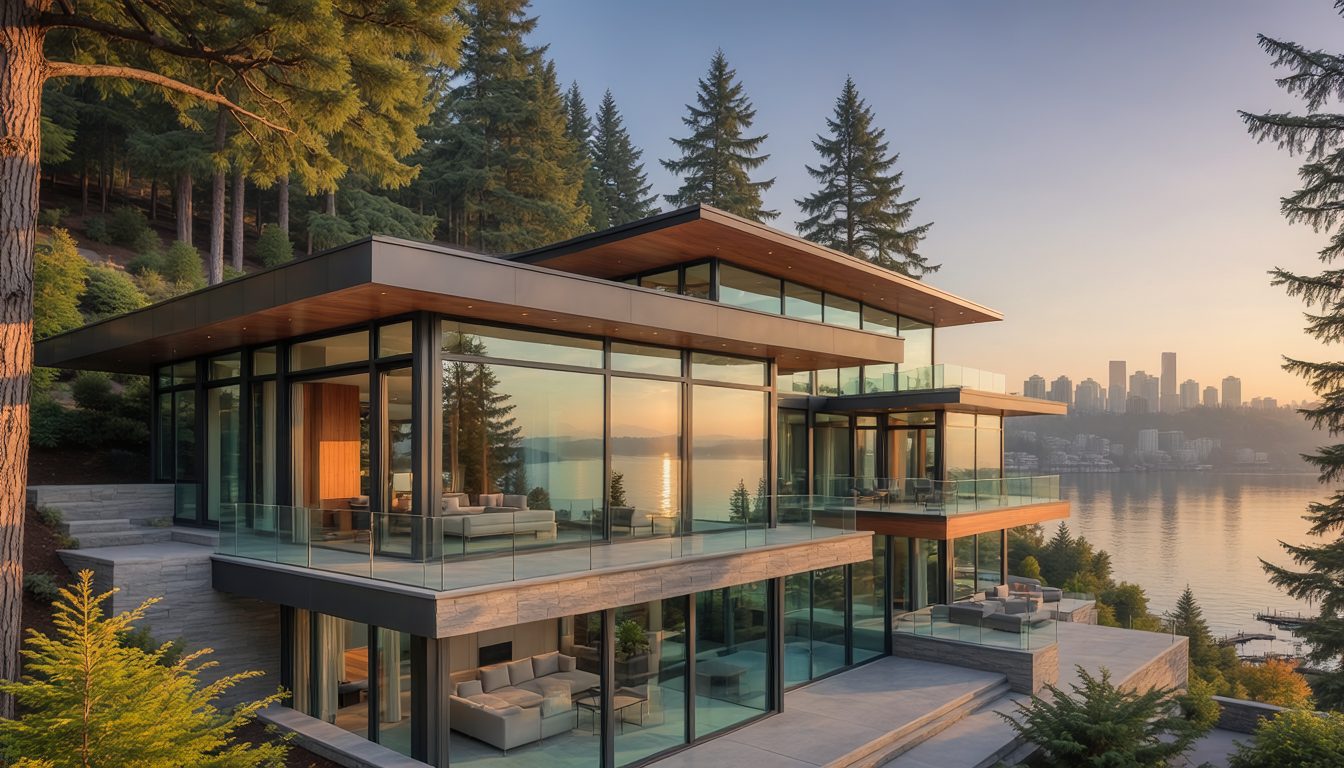
Seattle’s luxury housing market has cooled through 2026, but the cooling has not landed evenly. Inventory has risen, price reductions are common, and buyers who spent the summer on the sidelines have returned in no hurry. Yet homes with genuinely scarce attributes, such as significant architecture, level waterfront or unobstructed views, are still drawing fast offers, sometimes at full price.
Eric Akines, a luxury real estate broker with REAL Residential who works across Seattle, Mercer Island and the Eastside, describes the result as two luxury markets operating side by side. One is made up of exceptional properties that can still create urgency. The other is everything else, competing for buyers who have more options than they have had in years.
Where the Softness Sits
The weakness is concentrated in homes Akines describes as good but not exceptional. Buyers are discounting compromised locations, dated renovations and awkward floor plans more heavily than they did during the 2020 to 2022 run-up. They are least forgiving of aspirational pricing, where a seller anchors to a neighbor’s sale from the market’s peak.
“Buyers aren’t reluctant to buy,” Akines said. “They’re reluctant to settle.” That distinction explains why rising inventory has not translated into more competition for the best properties. More listings do not mean more extraordinary listings, and the supply of homes that combine architecture, provenance and location remains thin.
Scarcity at Work
Two recent sales illustrate the gap. A penthouse in the Lamplighter, a Capitol Hill building commissioned around Seattle’s 1962 World’s Fair and sited to take in views of Seattle Center, sold within 24 hours of listing at its full asking price of $1.15 million. Its views reach across the city, Lake Union, Puget Sound, and the Olympic Mountains.
“The buyer isn’t asking what the average price per square foot is on Capitol Hill,” Akines said. “They’re asking when they’ll ever have another opportunity to own something like this.”
On Mercer Island, a custom-built home on level waterfront with a deep-water dock sold for $8.85 million in under a month, while much of the island’s waterfront inventory listed at the same time remained on the market. The buyers had already been under contract on a non-waterfront home in Bellevue’s Clyde Hill neighborhood when the Mercer Island property appeared.
Buyers With Options
Above roughly $3 million, Akines said, most buyers are not constrained by the monthly payment. What has changed is optionality. With more choices available, urgency fades, and the question shifts from whether a buyer can afford a house to why they should buy this one, at this price, now. Sellers now have to answer that question through pricing and presentation.
Buyers who watched the market through July and August returned in September better informed. They had seen homes sit and prices fall, and many understand they can negotiate. One relocating couple Akines represented found a West Seattle view home that met nearly every requirement, then waited about a month to see whether it would sell. When it didn’t, they returned and bought it well below the asking price.
The Rate Lock
Financing remains a drag on both sides of the market. Mortgage rates sit well above the 3% range many owners secured earlier in the decade, which discourages financed buyers and keeps would-be sellers in place. Akines expects most owners with low-rate mortgages to stay put unless a life event, such as a new job, a growing family, a death or a divorce, forces a move. That keeps resale inventory below what demand alone would suggest.
The Year Ahead
Akines expects prices to keep softening over the next year, then level off before appreciating again within roughly two years. Several variables could change that path quickly: the Nov. 3 vote on Initiative 645, which would repeal Washington’s new 9.9% tax on household income above $1 million; the direction of interest rates; and global conditions that have kept everyday costs elevated.
He sees the current window as favorable for cash buyers in particular. For sellers, the requirements have narrowed to three: a price grounded in the current market rather than the peak, presentation that holds up against the best competing homes, and positioning aimed at a specific buyer profile. Sellers who cannot meet all three, he said, may be better served waiting.
Whether the luxury market stabilizes on that timeline will depend less on any single factor than on how many of them shift at once. Until then, the two markets are likely to keep diverging, with scarce homes setting their own pace while everything else competes on price.
About the Expert: Eric Akines is a luxury real estate broker with REAL Residential in Seattle. He specializes in architecturally significant and design-driven homes across Seattle, Mercer Island, and the Eastside, and is also licensed in Idaho, where he works with clients in Sun Valley. ericakines.com
This article is based on information provided by the expert source cited above. It is intended for general informational purposes only and does not constitute legal, financial, or real estate advice. Readers should conduct their own research and consult qualified professionals before making any real estate or financial decisions.