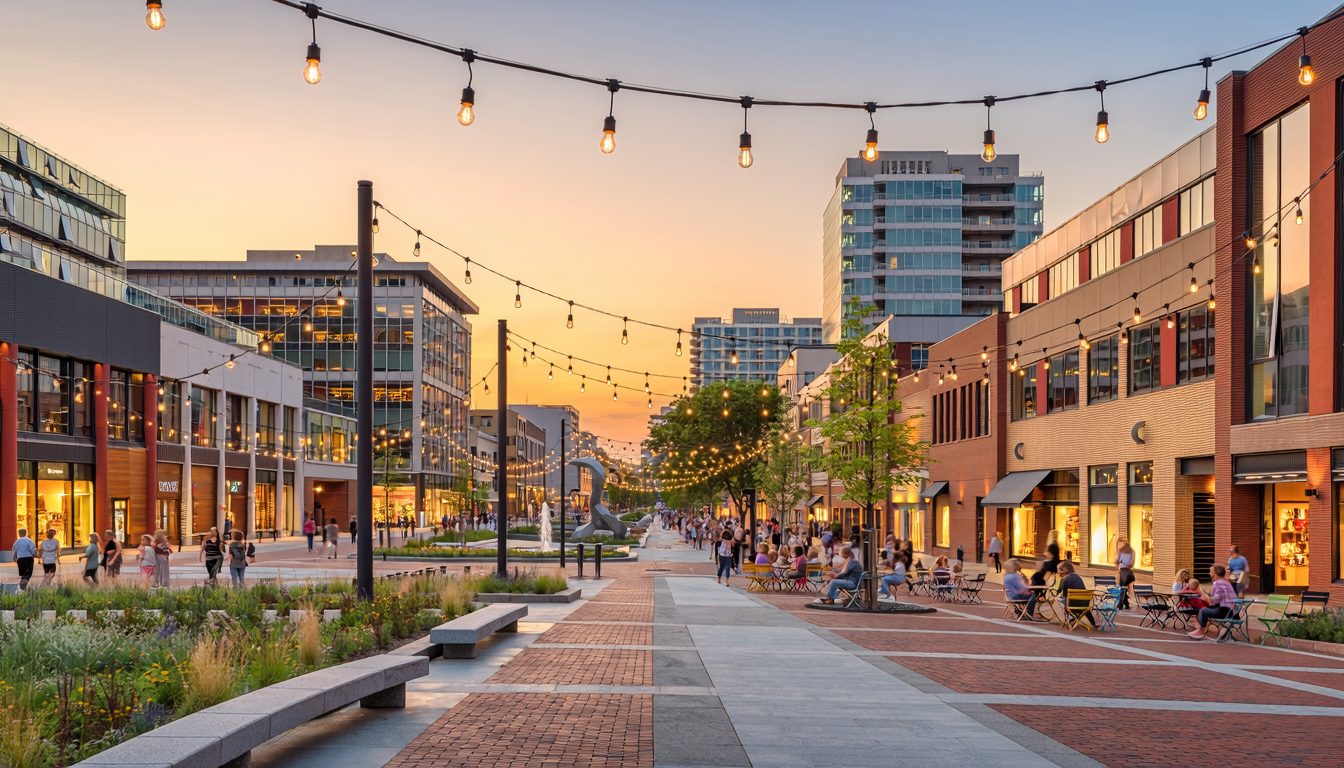
A mixed-use development may stack apartments, offices or life science space above its shops, but most people experience it from the sidewalk.
“The ground floor is where people actually experience a neighborhood. They don’t experience the floors above it,” said Ann Ehrhart, a Boston, Massachusetts retail strategist and founder of EVERSTREET.
Identity, she said, is how a place makes you feel. It comes down to whether you want to stay, or you buy what you came for and leave. Neither is wrong, Ehrhart said. But many mixed-use business plans count on people staying and lingering, and that kind of identity has to be built on purpose.
Here is how she approaches it, from the first site plan to the years after opening day.
Build the Identity in Layers
Ehrhart describes good placemaking as layered, with no single element doing all the work. She starts from the outside in. Retail belongs where people can see it and reach it easily, not wherever it fits best next to the lobby and the mailroom.
From there come the blocking and massing of the retail, the split between anchors and smaller more granular storefronts, and variety in storefronts and signage. Owners can give tenants their own branded storefronts or work with their design team on storefronts that become the brand. EVERSTREET works through these decisions in the Assess and Plan phases of its Activate Your Street framework.
The space between buildings matters just as much. Ehrhart calls it connective tissue: places to sit, varied planting and paving, public art and lighting. “Never underestimate the power of a few good strands of string lights to really set the tone,” she said. Widening and narrowing sidewalks quietly moves people through a space at different speeds.
“The best places have elements that are fixed and consistent and elements that are always changing and new,” she said.
The goal is for none of it to feel forced. “When it’s done well, it’s invisible,” Ehrhart said. “If it’s too heavy-handed, it feels manufactured.”
“Authenticity is everything,” she added. It matters most with discerning, affluent customers who have options, and the tenants a developer wants? They are typically chasing that same customer.
Match the Programming to the Corridor
Leasing storefronts means filling space inside four walls. Programming a place covers the whole experience, including the buildings, the storefronts and the connective tissue between them. The key, Ehrhart said, is knowing what you’re trying to create and what you’re starting with.
EVERSTREET classifies locations into three corridor types, and the rules differ for each:
- Destination: The placemaking is often already done, because residents, tourists and office workers already go there. Leasing means understanding why they come and filling vacancies to match.
- Convenience: People come for what they need and move on. “A charming little patisserie probably isn’t your target for a power center off a highway exit,” Ehrhart said.
- Untested: There’s no proven demand yet, so programming is everything. Every storefront, operator and outdoor space has to work together to change people’s habits, often on a weekly or even daily basis.
Visibility and access are the foundation in all three. In ground-up development, she advises putting retail closest to the traffic patterns that already exist. “Get as close to your consumer as you can,” she said. That matters most in an Untested Corridor, where people won’t yet go out of their way.
In a repositioning, the first question is whether the retail is still in the right place at all. Ehrhart points to Boston after the Big Dig, which buried an elevated highway and created the Greenway. Building sides that once turned their backs on the highway now face a park. Before re-leasing, she recommends taking a fresh look at where the storefronts are and which way they face.
Any change ripples through EVERSTREET’s core formula: merchandising, design and underwriting, aligned with each other and with market demand. If one shifts, the others need to be recalibrated. That same patisserie, Ehrhart noted, may be turned off by a sterile glass storefront that reads like a bank branch, even in the right neighborhood.
Plan a Tenant Mix the Corridor Can Support
Balancing national and local tenants isn’t always the landlord’s choice. Prime national tenants often consider only Destination Corridors, and many have co-tenancy requirements. If the brands they usually sit next to aren’t there, the site is out.
In an Untested Corridor, that makes local operators the likely end user. Ehrhart plans for it early, with spaces that can be subdivided into smaller suites and tenant improvement allowances and rents underwritten to match.
She doesn’t see that as a drawback. An authentic, curated mix of local talent draws customers, customers drive sales and sales drive demand. “Once demand is there, it’s no longer an Untested Corridor,” she said. “It’s been transformed.”
Where there’s enough demand to lease entirely to national tenants, her rule of thumb is to save food and beverage space for local operators. That brings authenticity and protects the income potential of the dry retail space.
Retailers read the neighborhood too, and they do it deliberately. They want to know who comes, when and for what. A customer may grocery shop there every week without coming back for weekend brunch. “If the vibe isn’t right, they’ll go somewhere else,” Ehrhart said.
Protect the Identity After Opening Day
A neighborhood’s identity can drift after it opens, especially in Untested and Convenience Corridors. That’s why EVERSTREET’s Sustain phase is about keeping a finger on the pulse.
A common assumption in retail is that an underperforming tenant should simply be replaced. Ehrhart said that isn’t always the answer. It means taking on vacancy and paying a fresh set of transaction costs, and without understanding what went wrong, the next tenant can end up in the same spot.
Before making that call, she keeps asking a few questions. Who’s coming here? Who did we plan for that isn’t coming? What about the environment isn’t attracting them, and what can we change to get them here?Is this a merchandising issue? A design issue? Or an economic issue?
She also gives clients three tips:
- Check in with tenants regularly. Compare sales against projections. If they’re short, look at what people are buying, when they come and whether the tenant can adjust.
- Leave room to experiment. Set aside areas for outdoor activation and programming, along with smaller clusters of storefronts where tenants are easier to swap out as demand becomes clear.
- Give it time. “Real estate is a slow, physical business,” Ehrhart said. Changing people’s habits in an Untested Corridor doesn’t happen overnight.
Ideally, she said, lease terms are already written for that slow burn by the time a project reaches Sustain.
About EVERSTREET
EVERSTREET is a Boston-based retail strategy, leasing, and advisory firm serving developers, investors, and municipalities. Its proprietary Activate Your Street™ framework helps clients align merchandising, design, and underwriting with location to reduce retail risk and build long-term asset value.
General: This article is based on information provided by the expert source cited above. It is intended for general informational purposes only and does not constitute legal, financial, or real estate advice. Readers should conduct their own research and consult qualified professionals before making any real estate or financial decisions.
Third party vendor: This article is intended for informational purposes only and does not constitute legal, financial, or investment advice. The views and opinions expressed herein reflect those of the individuals quoted and do not represent an endorsement of any company, product, or service mentioned.