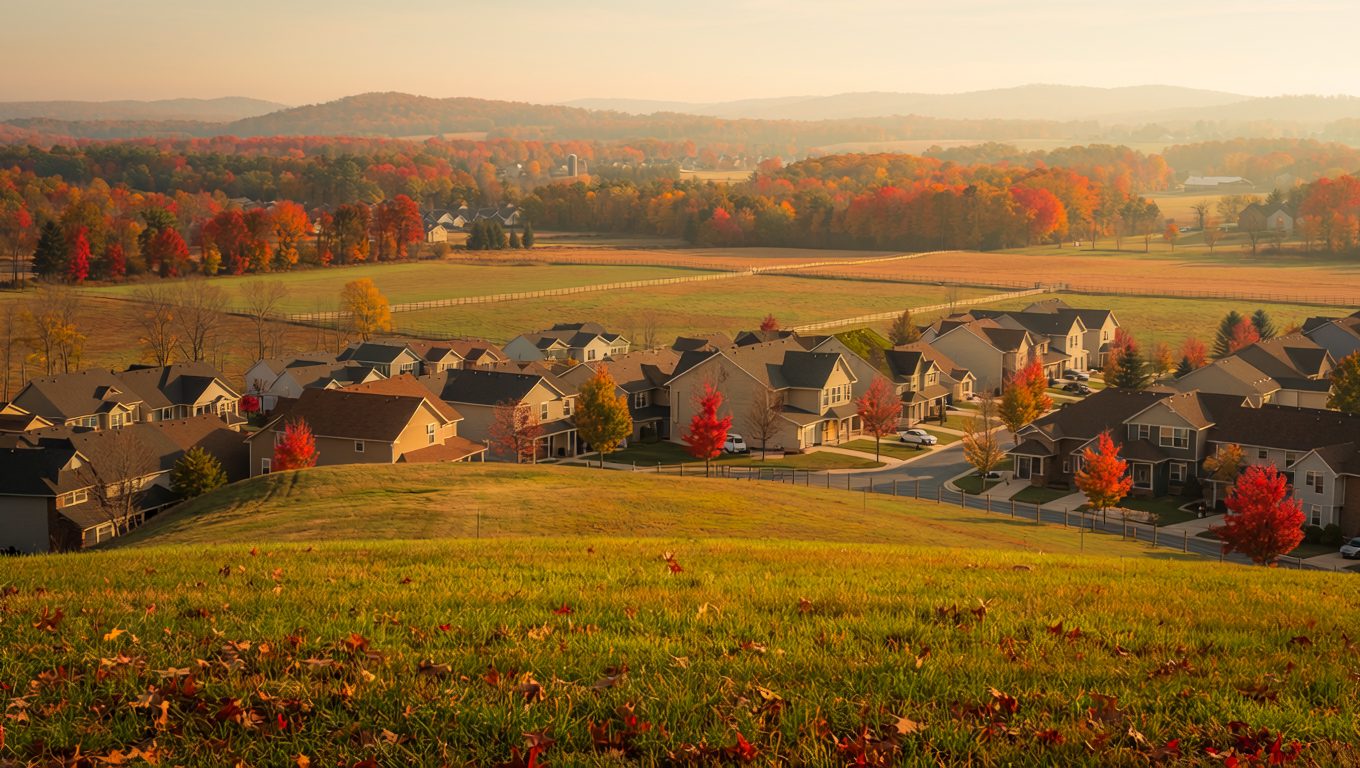
Harford County, Maryland, never gave back its pandemic-era gains. Prices in the rural county 30 minutes north of Baltimore rose slowly and without a dip from 2020 until about May of this year, according to Lee Tessier, who leads the Lee Tessier Team of eXp Realty in Bel Air. Over the same stretch, he says, parts of Florida, California and Texas fell roughly 25 percent beginning in late 2022. Then Harford County prices crested, and sellers started giving ground.
The change has shown up in contract terms. Buyers no longer waive inspections, sellers now pay for repairs and closing costs, and listings priced above the market sit. With mortgage rates at 7.6 percent, well-priced homes still sell quickly and on strong terms.
Engineers and Federal Jobs
The county’s resilience starts with the jobs that keep people there. Harford County has no dominant employer beyond Aberdeen Proving Ground, a military installation where most of the jobs are engineering roles rather than military ones. Washington, D.C., sits an hour and 15 minutes to an hour and a half away, close enough for federal employment to anchor local demand. “Government jobs help protect us,” Tessier says.
The housing stock reflects that workforce. Tessier’s team sells homes at an average price of about $400,000, mostly townhouses and single-family houses, and few sales in the county top $2 million. “We’ve just been slow and steady,” Tessier says. The county lacks the rapid appreciation of Austin, Dallas or Florida, but it also avoided the drops those markets absorbed after 2022.
What Changed This Spring
That steadiness makes the spring shift easy to trace. Tessier recalls a busier stretch, when rates had dipped to 5.99 percent, in which his team listed a home at $875,000 and sold it for $1 million. Until about April, many buyers either skipped inspections or ran them for informational purposes only.
Since then, that pattern has reversed. “Now inspections are in full force,” Tessier says, and sellers increasingly make repairs and help with closing costs. Some offer rate buy-downs, but closing costs and repairs are the two biggest concessions. Around May, prices stopped climbing and began to crest. Rates now stand at 7.6 percent.
The turn has also changed who walks into Tessier’s office. He now regularly meets sellers whose homes sat for 90 days with another agent and never sold. He tells every seller the same thing: “You’re in a beauty contest and a pricing war.” Winning the beauty contest means staging – depersonalizing, decluttering and neutralizing the house.
Realistic Pricing Still Wins
Pricing explains a result that seems to contradict that shift. With sellers conceding repairs and closing costs again, a seller this fall should not expect a cash offer with no contingencies. Yet Tessier’s team just secured one. The difference, he says, is aggressive pricing: homes priced below their likely value still draw competing buyers, and homes priced above it sit.
The cash offer came on a house whose seller was moving out of state to be near grandchildren and needed to stay until her new home was finished. Tessier estimated its value at about $975,000 but listed it at $925,000 to draw competition he could trade for terms. The first buyer asked what it would take to win the house that day. Tessier answered that the offer had to start with a seven-digit number. The buyer offered $1 million in cash, with no inspection, no appraisal and a free rent-back until January 15, and the final agreed price reached $1,010,000.
Overpricing produces the opposite outcome. A remodeler who works with Tessier’s team listed a house at $475,000 to test the market, prompted by a comparable home down the street still listed at $550,000, though Tessier valued it closer to $425,000. Two weeks brought a few showings and no offers. At $425,000, the house drew offers above list price, in cash, with settlement in under a month. “If you’re not pricing aggressively,” Tessier says, “you are sitting.”
Payment Shock After the Contract
Pricing governs whether a listing draws an offer, but the higher rate environment now threatens deals after the contract too. Cash buyers make up about 10 percent of the market or less, Tessier says, so most purchases depend on financing. Many buyers start pre-approval without working through their full numbers with a lender. Once under contract, they see the real monthly payment with taxes, insurance and any HOA fee – on top of grocery and gas prices that already strain their budgets – and some walk away. Nationally, Tessier estimates, 13 to 14 percent of buyers are backing out.
His answer for listing agents is to question the buyer’s lender early. Has the lender reviewed the buyer’s tax returns? Verified income? For a self-employed buyer using a bank statement loan, collected every statement? Those questions catch problems that would otherwise surface later in the transaction.
Tessier also pushes back on buyers who hesitate over rates alone. The average first-time buyer is now 40 years old, he says, and buyers often tell him they don’t want to pay today’s interest rates. His response: “You’re renting. You’re paying 100 percent interest.”
What a Crested Market Offers
The same steadiness defines the opportunity for investors: slow appreciation paired with rents that come close to the 1 percent rule. Tessier, who owns about 30 investment properties himself, says a $300,000 house in Harford or Baltimore County rents for about $2,500 a month, compared with roughly $1,200 for a house at the same price in California. Annual taxes run $3,000 to $3,500, plus a small HOA fee on townhouses.
Tessier also watches the port expansion around Dundalk and Sparrows Point in neighboring Baltimore County, where he has bought properties for years. “Jobs always help with rent,” he says. For investors and owner-occupants alike, he points to a window most buyers skip: the stretch between Thanksgiving and New Year’s. “A lot of people don’t like moving then,” he says. “But you can usually get a discount during that time of the year.”
About the Expert: Lee Tessier leads the Lee Tessier Team of eXp Realty in Bel Air, Maryland, covering Harford County and surrounding areas including parts of Pennsylvania. The team has sold nearly 6,000 homes over a 20-year track record.