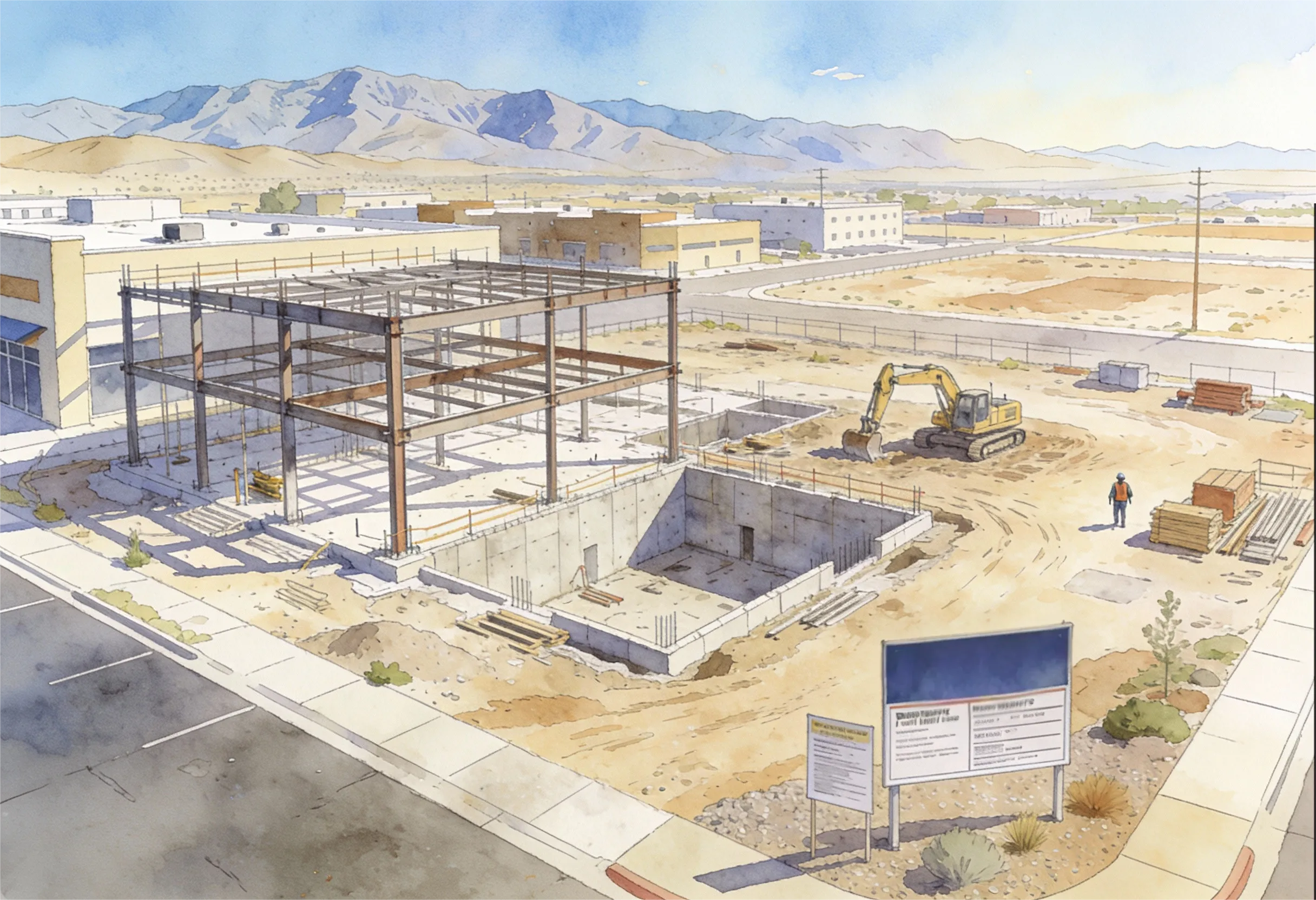
Northern Nevada’s development market has nearly stopped, with commercial building permits down 80 percent, according to Ted Stoever, Executive Vice President at Colliers. Stoever attributes the drop to construction costs that have made new projects financially unfeasible.
“Industrial is slowed down substantially,” Stoever says. “Building permits, commercial building permits in general, are down 80 percent.” He points to high construction costs as the main obstacle: “It’s tough to hit the minimum returns.”
Yet Stoever believes this dramatic slowdown could trigger the very correction needed to revive the market. He argues that as building activity stays low, the resulting decrease in demand for materials and labor may cause costs to fall, making stalled projects viable again.
The Cost-Deflation Argument
Stoever maintains that the national construction slowdown will eventually reduce costs. “With the slowdown overall in construction over the last year, you know that the cost of construction is going to have to come down, and deals will start making sense,” he says.
His argument relies on basic supply and demand: with fewer projects underway, material prices should level off, and labor should become more available. Projects that have been shelved due to high costs might move forward if expenses drop enough to meet minimum return requirements.
This dynamic is crucial for Northern Nevada, which, according to Stoever, continues to see strong demand but lacks the cost environment to bring new supply to market. “We grew by, I want to say, 110,000 people in the last 10 years,” Stoever says, referencing a roughly 20 percent population increase in a metro area of about 600,000. “Multifamily, like I said, very low vacancy, very low supply coming online.”
Demand Is Not the Problem
Stoever is clear that Northern Nevada’s development freeze is not due to weak demand. He says industrial space is predominantly spoken for, with most properties in key areas sold out. Multifamily housing remains in short supply, with vacancy rates at historic lows.
“We have everything that people want,” Stoever says, listing Lake Tahoe, outdoor recreation, and the Truckee River as draws for residents and businesses. “It’s just difficult. The barriers to entry are supply.”
He frames the central issue as one of cost, not market appetite. If construction costs decline as building activity remains low, he expects a surge in new projects from developers who have been waiting on the sidelines.
Looking Ahead to 2026
If Stoever’s cost-deflation scenario plays out, Northern Nevada could see significant development within the next 12 to 18 months. Lower construction costs would unlock a backlog of shelved projects, leading to a sharp increase in building activity.
This effect would be most pronounced in markets like Northern Nevada, where demand remains strong but new supply has stalled due to high costs. The 80 percent drop in permits points to a large pool of potential projects that could move forward quickly if the economy improves.
However, Stoever’s outlook depends on whether a national construction slowdown leads to meaningful cost reductions. Material prices, labor rates, and overhead do not always drop in step with reduced demand, especially if supply chains remain disrupted or labor markets stay tight.
Navigating the Current Market
Colliers, under Stoever’s leadership, is focusing on financially feasible projects despite high costs. “My business is up again, because I only focus on things that I know I can get done,” Stoever says. “If there’s a way, there’s a will. If I can show people that this was going to work, I show them the fundamentals of the area, I get stuff done.”
By concentrating on deals with strong fundamentals and reliable financing, firms like Colliers can keep some transaction activity going even as most of the market remains stalled. This approach may offer a blueprint for developers and brokers facing similar cost pressures.
The next several quarters will reveal whether Stoever’s prediction holds. If construction costs fall as he anticipates, Northern Nevada’s steep decline in building permits could reverse, with developers moving quickly to launch projects that have been on hold. If not, the region may continue to see limited new development despite strong demand.
For now, the future of Northern Nevada’s development pipeline hinges on whether a national slowdown can deliver the cost relief needed to reignite building activity. Stoever and his firm are preparing for that possibility, ready to act if and when the numbers finally make sense.
This article was sourced from a live expert interview.
Every month we conduct hundreds of interviews with active market practitioners - thousands to date.
A dramatic migration pattern is reshaping the New York metropolitan area’s real estate landscape as residents seek more affordable alternatives to Manhattan and Brooklyn, according to ...
The widespread shift to remote and hybrid work has left office and retail real estate with more space than companies now need, creating a long-term oversupply that persists regardless of ret...
Despite having the financial and technological muscle to do so, major tech companies are deliberately steering clear of replacing the Multiple Listing Service (MLS) system, a decision that i...
Over the past 18 months, the balance of power in commercial real estate leasing has shifted, according to Michael Rait, Founder and President of BR Design Associates. Landlords, responding t...
Florida’s luxury residential developers are facing a visibility problem that few have recognized. Laurie Andrews, President of Cotton & Company, a real estate marketing firm specializi...
First-time homebuyers in Rhode Island are struggling to compete for move-in-ready properties, but there are alternatives for those willing to adjust their expectations, according to Walt But...