
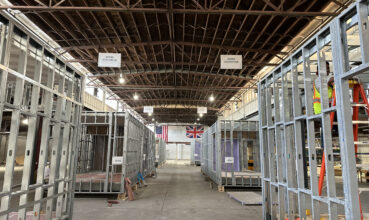
In an era where affordable housing shortages plague communities across America, MMY US’s first US facility is leveraging innovative modular construction technology to dramatically accelera...

How the Raleigh Triangle Market Is Finding Its Footing After Years of Frenzy

Written by:
Date:
01 May 2026
Share via Facebook

Share via Linkedin

Share via X

Copy to clipboard


After nearly a decade of sharp price growth and intense competition, the Raleigh-Durham-Chapel Hill Triangle is settling into something that feels increasingly unfamiliar to agents who started their careers in the post-pandemic market: normalcy. Inventory is rising, buyers are taking their time, and sellers are learning that presentation matters again.
The cooling follows a national pattern of rising inventory and slower sales. Still, the Triangle’s version carries local texture — entry-level prices that have more than doubled, a luxury segment reshaped by out-of-state buyers, and a due diligence fee structure unlike anything in most other states.
For Susan Bashford, a broker with Hodge & Kittrell Sotheby’s International Realty who has worked the Triangle market for 14 years, the change is welcome. “Agents are actually having to work for their commission,” she says. “For the last five years, it was a piece of cake.”
A Market Finding Balance
The Triangle’s trajectory over the past several years has been steep. Home values climbed sharply, inventory stayed thin, and buyers routinely waived inspections and appraisal contingencies to secure a contract. That dynamic has changed. Buyers now have more options, more time, and more leverage than at any point in recent memory.
Bashford notes that buyers are no longer settling for properties that need work. Instead, they want homes that are polished and move-in ready. “If they can tell that the house just has lipstick on it, they’re passing and moving on to the next house,” she says.
That change in buyer behavior has practical implications for sellers. Pre-listing inspections are becoming more common, and agents are coaching clients to address visible issues before listing. The days of listing a dated property and watching offers pile up regardless of its condition are largely behind us.
Deal fall-throughs, once rare during the peak years, are ticking up as buyers exercise their due diligence rights more fully. Bashford says more contracts have fallen apart in the past year or two than during the frenzy. The silver lining is that this reflects a healthier transaction process — one in which buyers make informed decisions rather than panic purchases.
The Entry-Level Shock
Perhaps the most striking signal of how far the market has moved is where the floor now sits. First-time buyers in the Triangle, a segment that once entered the market around $200,000, are now routinely looking at $500,000 as a starting point.
“Now, a first-time buyer is looking at a $500,000 house,” Bashford says. “That’s pretty shocking to me, that you’re paying half a million just to get into the market.”
Interest rates compound the pressure at this price point. Buyers stretching to afford a $500,000 home feel every basis point. Buyers in the upper price ranges, by contrast, are largely insulated. Bashford, who bought her first home at an 18% interest rate in the 1980s, argues that today’s rates shouldn’t be a dealbreaker. “A 6% interest rate is really not that bad and not a reason to pause and not purchase,” she says, adding that buyers who waited several years ago, hoping for rates to drop, would have been better served by acting when they had the chance.
Luxury Has Become Mainstream
The Triangle’s growth as a luxury market is one of the clearest signs of the region’s maturation. When Bashford closed a $5 million sale roughly six or seven years ago, it made the local paper. Today, that figure barely registers.
“They’re not sitting. They’re selling, especially if they’re unique and in the right place,” she says of homes in the $4 million to $5 million range.
Much of this activity is driven by relocation. Buyers arriving from California, the Northeast, and other high-cost markets often view Triangle pricing as a relative bargain, even at the upper end. That inflow of outside capital has reshaped the luxury segment, creating a buyer pool that did not exist in the region a decade ago.
Generational wealth is also a factor. Younger buyers with family money or trust funds are appearing at price points that even experienced agents find surprising. New construction in the $2 million-plus range has responded to this demand, with builders adding inventory that would have been unthinkable in the Triangle just a few years back. The challenge is timing — by the time builders complete projects that respond to a supply shortage, market conditions can change, creating pockets of surplus at the top end even as demand remains strong in the middle.
North Carolina’s Distinctive Due Diligence Rules
One aspect of the Triangle market that consistently catches out-of-state buyers off guard is North Carolina’s due diligence fee structure. Unlike most states, which offer buyers a free inspection period, North Carolina requires buyers to pay a non-refundable fee directly to the seller in exchange for the right to conduct due diligence. If the buyer walks away for any reason during that period, the fee stays with the seller.
“People moving here from other states go, ‘That’s robbery,'” Bashford says. “They can’t wrap their head around it.”
During the peak market years, the fees reached extraordinary levels. Bashford recalls one transaction on a $4 million property where the seller requested a $1 million due diligence fee. The market has since recalibrated, with fees for a $500,000 home now typically in the $3,000 to $10,000 range, depending on competition.
The fee structure also serves a strategic purpose in competitive situations. A buyer offering slightly below the asking price but putting forward a substantial due diligence fee can be more attractive to a seller than a higher offer backed by a minimal fee, because the larger fee signals commitment. “The seller feels, well, they’re not going to back out of this sale, not with $20,000 down,” Bashford explains.
Working Ahead of the MLS
As the market becomes more selective, the agents gaining an edge in the Triangle are those operating well beyond what populates the public listings each morning. Bashford describes a deliberate off-market strategy built on relationships with other agents, former clients, and neighborhood contacts.
“You have to dig, and you have to have connections,” she says. “You’ve got to keep your ear to the ground.”
For buyers with specific neighborhood targets, this kind of proactive outreach can mean the difference between securing a property before it hits the market and competing against multiple offers once it does.
The broader pattern is clear: the Triangle is no longer a market where momentum alone closes deals. Buyers are pickier, sellers need to prepare more carefully, and the agents who are succeeding are those doing the kind of work that frenzy-era conditions didn’t require. What comes next depends largely on interest rates. Whether the steady flow of out-of-state buyers continues — but for now, the Triangle is rewarding patience, preparation, and skill over speed.
About the Expert: Susan Bashford is a broker with Hodge & Kittrell Sotheby’s International Realty in the Raleigh-Durham-Chapel Hill Triangle. With 14 years in the market, she has guided buyers and sellers through every phase of one of the Southeast’s most dynamic real estate markets.
This article is intended for informational purposes only and does not constitute legal, financial, or investment advice. The views and opinions expressed herein reflect those of the individuals quoted and do not represent an endorsement of any company, product, or service mentioned. Readers should conduct their own due diligence and consult qualified professionals before making any investment decisions.
Similar Articles
Explore similar articles from Our Team of Experts.