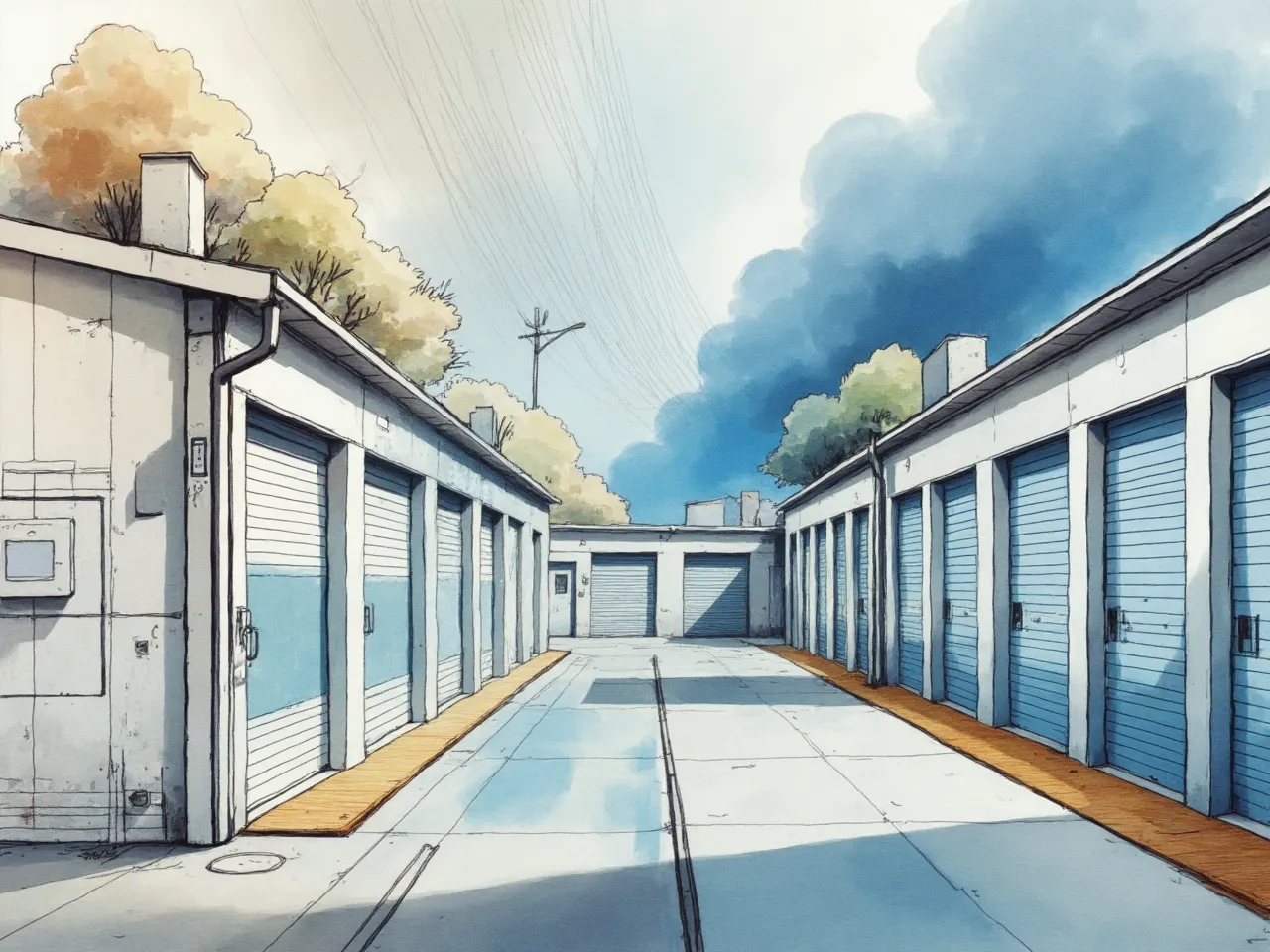
Extended lease-up periods for newly constructed self-storage facilities are creating a mismatch between construction-loan expectations and the realities of securing permanent financing, according to David Smyle, Vice President at Pacific Southwest Realty Services in California. What was once an 18-to-24-month stabilization period has now stretched to 24-to-36 months. Developers are adjusting financing models and, in many cases, relying on bridge loans before qualifying for permanent debt.
It now typically takes two to three years for a new self-storage property to reach stabilized occupancy. This longer timeline is complicating the financing process for owners and developers.
Debt Coverage Challenges Borrowers
The longer path to stabilization is causing problems for borrowers who secured construction loans based on shorter lease-up assumptions. Many construction loans were underwritten on the assumption that properties would reach stabilized occupancy within 18 to 24 months, with permanent loans available at interest rates of 4% to 5%. With permanent financing rates now closer to 6%, the debt service coverage ratios that supported 80% loan-to-cost construction loans no longer hold.
As a result, borrowers are facing a gap between their original financing plans and current market conditions. To refinance into permanent debt, borrowers must either inject more equity or accept significantly lower leverage than initially planned. Developers who modeled projects on higher leverage face lower projected returns and must revisit their capital structures.
This issue is especially acute for properties leasing up more slowly than anticipated. Many owners are turning to bridge loans to extend their timeline until a property reaches the occupancy required for permanent financing. Bridge loans allow owners to pay off construction debt and gain more time, but at a higher cost than permanent loans.
Digital Marketing Slows Lease-Up
The extended stabilization timeline reflects changes in how self-storage properties attract tenants. The industry has shifted from traditional Yellow Pages advertising to digital and smartphone-based marketing, fundamentally altering the tenant acquisition process. Properties now depend on push notifications, location-based ads, and social media to reach potential customers, requiring new marketing strategies and budgets.
Smyle points out that in the past, operators relied on being listed first in the Yellow Pages to attract customers. Today, the Yellow Pages have disappeared, and mobile marketing dominates. Properties must now engage customers through targeted digital campaigns, with smartphones delivering ads to users searching for nearby storage options.
This transition has made the lease-up process less predictable and, in many cases, slower than in previous years. Operators who have not adapted to digital marketing are struggling to fill units and reach stabilized occupancy within traditional timeframes. The need for effective online marketing has introduced new costs and learning curves for many owners.
Lender Appetite Remains Strong
Despite these challenges, lenders’ appetite for self-storage remains strong. Life insurance companies, banks, and credit unions continue to favor the asset class, and financing programs are still widely available for properties with stable cash flow.
Standard permanent loan programs remain in place for properties that reach stabilization on schedule. These properties can access long-term debt at competitive rates and terms. The longer lease-up period has created a two-tier market. Properties that stabilize on time move smoothly into permanent financing, while those that lag are pushed into more expensive bridge loans.
While bridge financing is more readily available today than in the past, it remains costlier than permanent debt. Bridge loan rates have come down, with some deals now pricing below double digits, but rates still exceed those available for stabilized properties.
What Developers and Investors Face
Developers planning new self-storage projects must now underwrite for a 24- to 36-month stabilization period, rather than the 18 months that was once standard. Financing strategies should include contingency plans for bridge loans if a property does not reach the required occupancy on schedule. Relying on a rapid lease-up and a seamless transition to permanent financing is no longer a viable strategy.
Operators who invest in effective digital marketing and adapt quickly to the new tenant acquisition landscape are more likely to achieve stabilization within the new timelines. Those who do not may face higher financing costs and greater pressure to inject additional equity.
Self-storage borrowers will need to build more flexibility into their capital plans and prepare for longer lease-up periods. The market is rewarding developers who adapt to new marketing realities and plan for a slower path to stabilization, while penalizing those who rely on outdated assumptions. Bridge financing remains a necessary tool for many, but it is no substitute for careful planning and operational agility.
Even well-funded proptech companies with nearly $40 million in backing can encounter capital allocation challenges that force strategic pivots. Rentberry’s recent withdrawal from modular h...
Austin’s multifamily market is grappling with significant oversupply, particularly in the luxury segment, as developers’ aggressive building programs have outpaced population gro...
Santa Monica is experiencing a surge in luxury apartment construction, with new towers rising along Broadway and Lincoln. These developments offer studios for over $3,000 a month and penthou...
Property expert says economic development initiatives are creating unexpected retail opportunities in secondary markets. A wave of semiconductor manufacturing investment is reshaping the ret...
Amid growing market uncertainty, private lending expert Philip Bennett argues that experience in evaluating distressed commercial real estate assets has become more crucial than ever, partic...
A six-week vacation sparked an unexpected career pivot for Brian Seidensticker, leading him from missile defense systems to distressed real estate investing. “I went on vacation for si...