
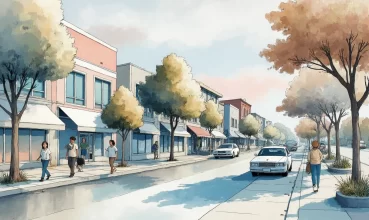
A clear pattern is developing in mature suburban real estate markets around major cities, according to Sarah Peters, Team Leader at eXp Luxury Realty. Walkability has moved beyond a lifestyl...

Large-Scale Homebuilding in Wayne County Marks 91 Lot Sales Amid Shortage

Written by:
Date:
07 Feb 2026
Share via Facebook

Share via Linkedin

Share via X

Copy to clipboard


Ryan Homes’ entry into Wayne County, Ohio, marked the first time a national builder had launched a large-scale development in the area. Over 21 months, the community sold 91 lots and quickly moved into a second phase, with 17 additional lots already sold. Despite the rapid sales, the influx of new homes has not eased the inventory shortage as expected, according to Amy Marinello of Berkshire Hathaway HomeServices Professional Realty, principal broker in Wayne County.
“We thought that development would open up some of our lower-end homes because people would be moving up,” Marinello says. But the outcome was more complicated. Many buyers used the new construction as an opportunity to build retirement homes, rather than moving out of existing local properties and freeing up inventory for first-time buyers.
Unexpected Buyer Cohorts
The standard expectation was that new development would trigger a housing ladder effect: existing homeowners would buy new construction, making their older homes available to entry-level buyers. Instead, Marinello observed that the Ryan Homes project attracted a diverse range of buyers, including retirees building three-bedroom, two-bath homes as their last move. Many of these buyers were relocating from outside the area or downsizing from homes that did not match the entry-level price range.
“There was some higher-end inventory coming on the market as well,” Marinello notes, but not in the volume or at the price points needed to address the shortage for first-time buyers. The anticipated chain reaction in which move-up buyers freed up affordable homes did not materialize at scale.
Why Wayne County Lacked Large-Scale Development
Wayne County’s lack of major subdivisions was not due to insufficient demand but to high infrastructure costs. “The cost to build infrastructure is very expensive,” Marinello explains. These costs kept national builders away for decades, leaving the market dominated by custom home builders constructing one-off homes.
This custom builder segment is now shrinking. “A lot of our custom builders are getting older. One’s retired. One’s handing it off to his children,” Marinello says. As these long-time builders retire or scale back, they are not being replaced fast enough, creating a supply gap that national builders are now beginning to fill.
However, the homes built by companies like Ryan Homes differ from traditional custom builds. “The Ryan Homes build isn’t a custom build, but people are still getting a new house, so it makes sense for them right now,” Marinello observes.
Construction Costs and Buyer Accessibility
The surge in construction costs during the COVID-19 pandemic made custom homes even less attainable for many buyers. “Prices of everything tripled. Lumber was expensive, shingles were expensive, windows were expensive,” Marinello recalls. These price spikes hit small custom builders hardest, further reducing the number of affordable new homes.
National builders can offer new homes at lower prices by leveraging economies of scale. While buyers may sacrifice customization, they gain access to new construction at prices they can afford, particularly as the custom market has become less accessible.
Market Segmentation, Not Expansion
Instead of broadening housing options across all price points, the arrival of national builders has created a new segment serving specific buyer groups, including retirees and out-of-area buyers. The hoped-for increase in entry-level inventory has not occurred. Buyers pre-approved for $100,000 to $130,000 still struggle to find homes. “It’s a rough market right now” for these buyers, Marinello says.
At the high end, Wayne County is seeing record prices. “For the first time in my 30-year career, we’re actually going to have two properties that close out over $1 million in the next three weeks,” Marinello reports. These are local sales, not spillover from Cleveland or Akron. In these cases, buyers paid cash, and there were no recent comparable sales to justify listing prices above $1 million, but demand was strong enough to support the deals.
What This Means for Small-Town Development
Marinello’s experience challenges the assumption that new construction automatically triggers a cascade that solves inventory shortages at lower price points. Instead, national builders may bring in new buyers or serve existing segments without freeing up affordable homes for first-time buyers.
The quick sellout of the Ryan Homes project indicates strong demand for new construction in Wayne County. But the development has not resolved the core issue for buyers at the bottom of the market. Whether additional phases or more builders will eventually address this shortage remains uncertain.
As national builders target more small-town and rural markets, understanding these dynamics is crucial. The standard housing ladder model does not always apply, especially in areas where infrastructure costs, custom builder retirements, and the specific mix of buyers shape the impact of new development. For now, Wayne County’s experience suggests that large-scale projects may create new options for some buyers while leaving the most acute inventory problems unsolved. Local officials, developers, and analysts will need to track how these patterns evolve as more national builders enter similar markets.
Similar Articles
Explore similar articles from Our Team of Experts.