
Restored bonus depreciation provisions in 2025 are creating tax advantages for short-term rental (STR) investors that long-term residential landlords cannot access, according to Lucas Piper,...

Arizona Industrial Market Shifts From Spec Buildings to Tenant Improvements

Written by:
Date:
04 Jan 2026
Share via Facebook

Share via Linkedin

Share via X

Copy to clipboard

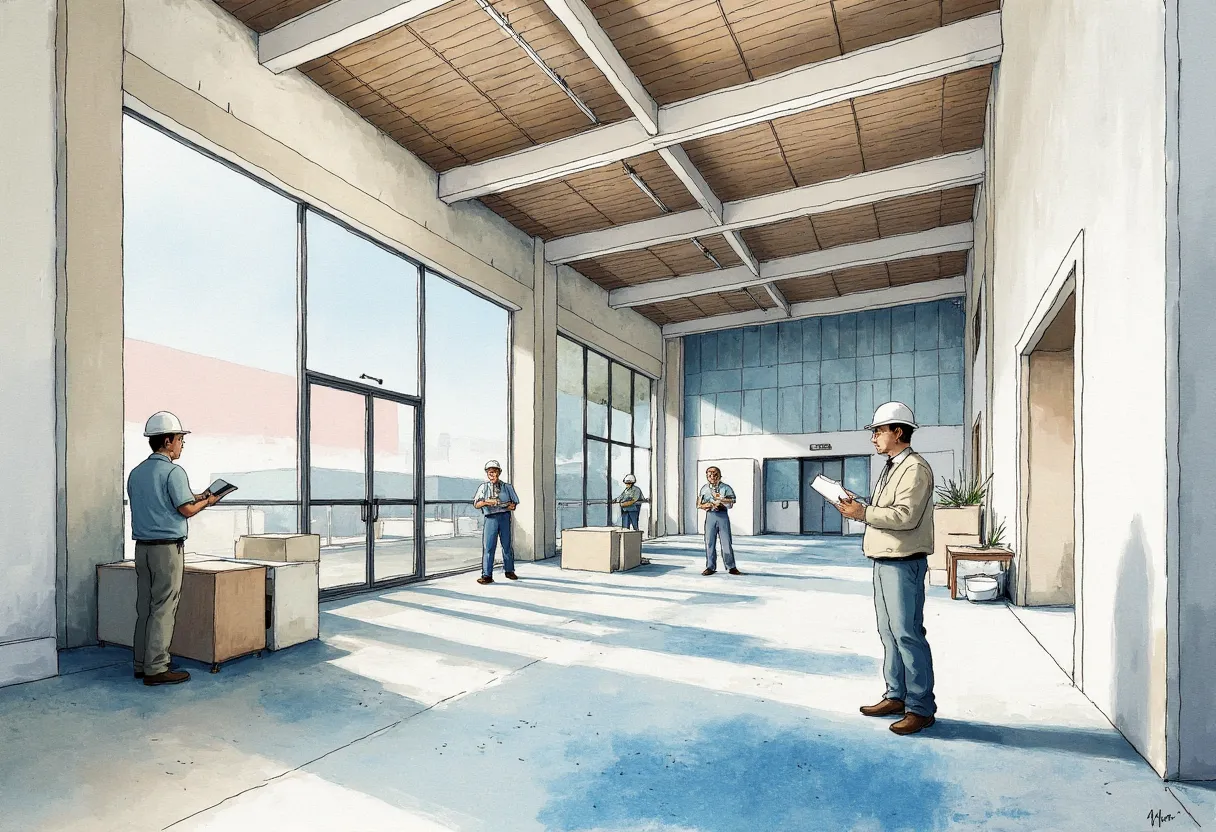
Arizona’s industrial real estate market is moving beyond its recent surge in speculative construction, with developers and contractors now focusing on sophisticated tenant improvement (TI) projects. This transition marks a new phase in the region’s industrial sector, in which customization and advanced technology requirements are taking precedence over the rapid ground-up development that has defined the past several years.
Jim Roland, Senior Vice President of Arizona Operations at Alcorn Construction, observes an apparent change in the types of projects filling his company’s pipeline. “A lot of what we’re seeing on the industrial side is maybe fewer ground-ups, but more TIs that are happening,” Roland says. “We’re looking at maybe some more advanced technology type tenant improvement work, which is good to see for the tenants that are coming into the area.”
According to Roland, the market is shifting from a land-acquisition and speculative-building phase to a more measured approach, in which developers prioritize customized, tech-forward spaces over standard industrial shells.
What’s Driving the Shift
While Arizona remains a significant market for speculative development, several factors are changing the pace and focus of new projects. Roland points to infrastructure constraints, particularly power grid limitations, as a key reason developers are becoming more selective. “With our massive growth out here, and the fact that we’re the new data center hub of the country, it seems there’s been a large tax on our power grid,” he says.
These power constraints make it riskier to build on speculation, as tenants may struggle to secure adequate electricity for their operations. “A client is less inclined to build a spec building if you can’t fill it with the tenant, because the tenant can’t get power to their building,” Roland explains.
Additionally, the initial wave of speculative construction has already filled much of the prime land in corridors like the Loop 303. Roland describes the area as “miles and miles of million square foot buildings.” With the bulk of the buildout completed, the focus is now on optimizing and customizing existing assets to meet tenant needs.
The Advanced Technology Tenant Factor
A notable trend is the emergence of tenants with more complex, technologically advanced requirements. Rather than seeking basic warehouse space, many new entrants demand specialized buildouts that support manufacturing, logistics automation, or data center operations. “We’re seeing maybe some more advanced technology type tenant improvement work,” Roland notes.
These projects call for contractors with expertise in complex, customized construction, often requiring work within occupied or partially occupied buildings and careful coordination with tenant schedules and operational needs.
Roland also sees this trend expanding into other property types. “We’re seeing a little bit of hospitality work coming in. There’s been a little bit of talk of maybe office is coming back a little bit,” he says. “I’ve seen some updating and some refreshing of large floor plan TIs in area buildings.” This broadening of TI work beyond the industrial sector suggests a wider market evolution in the region.
Risk Management and Project Economics
The move toward tenant-focused development also reflects a more disciplined approach to risk and project economics. Developers are less willing to build on speculation and instead prioritize projects with committed tenants, enabling tailored design and reducing financial exposure.
Roland says Alcorn Construction’s strategy is to engage clients early, ensuring projects are designed to meet both budget and operational needs from the outset. “We want to get in early with the client, work with them, understand where they’re at budget-wise, what their expectations are, so that we can get them a project that is within their budget and ideally exceeds all expectations,” he says.
This early collaboration model enables better alignment of design, budgeting, and scheduling, reducing the risk of costly overruns or project misalignment with market demand. Roland describes Alcorn’s emphasis on “design, build, and design assist work that allows us to be very active at the beginning of a project with bringing in the architects, working through our pre-construction effort to make sure pricing and budgeting and everything is dialed in to the best cost possible.”
Contractor Skill Set Evolution
For contractors, the current environment requires a shift in skill sets. Tenant improvement work is more complex and collaborative than the ground-up spec building that previously dominated the market. Faster execution, flexibility, and close coordination with tenants have become essential.
“We work closely with the tenants too, to make sure that they’re getting what they need,” Roland says, describing a more hands-on, service-oriented approach than traditional spec construction.
Alcorn Construction has positioned itself for this transition by diversifying across multiple sectors, including hospitality, multifamily, Native American gaming, medical office, and retail. “We’re looking at some other market diversification,” Roland notes, reflecting a strategy designed to weather fluctuations in any single sector.
This approach aligns with the company’s origins. Founder Chris Alcorn, who worked with developers that had in-house construction teams, established the firm to provide comprehensive, integrated contractor services to a broad client base. “He wanted to provide that type of service to everybody,” Roland says. “Be able to provide a one-stop shop.”
Market Outlook and Broader Implications
Despite the move from speculative development to tenant-focused projects, Arizona’s industrial market remains strong. “We’re still seeing a huge influx of businesses and people moving into the state from other states,” Roland says.
He emphasizes that the rise in tenant improvement work signals market sophistication rather than weakness. “We slowed, in perspective to internally, where we are here, but we’re still leading the nation,” he says.
For contractors, adapting to the new landscape will be critical. Firms capable of delivering complex tenant buildouts and managing adaptive reuse projects will find ample opportunities. “There’s work out there,” Roland notes. “Part of my job is to find those opportunities for us.”
Whether other contractors can succeed in this environment will depend on their ability to move beyond ground-up construction and embrace the demands of a more customized, tenant-driven market.
Similar Articles
Explore similar articles from Our Team of Experts.