

Developers in Santa Fe are delaying or halting projects amid tariff volatility and political uncertainty, making construction costs impossible to predict. With prices for pipes, steel, and o...

Miami’s New Warehouse Market Is Being Bought Almost Entirely With Cash

Written by:
Date:
15 Dec 2025
Share via Facebook

Share via Linkedin

Share via X

Copy to clipboard

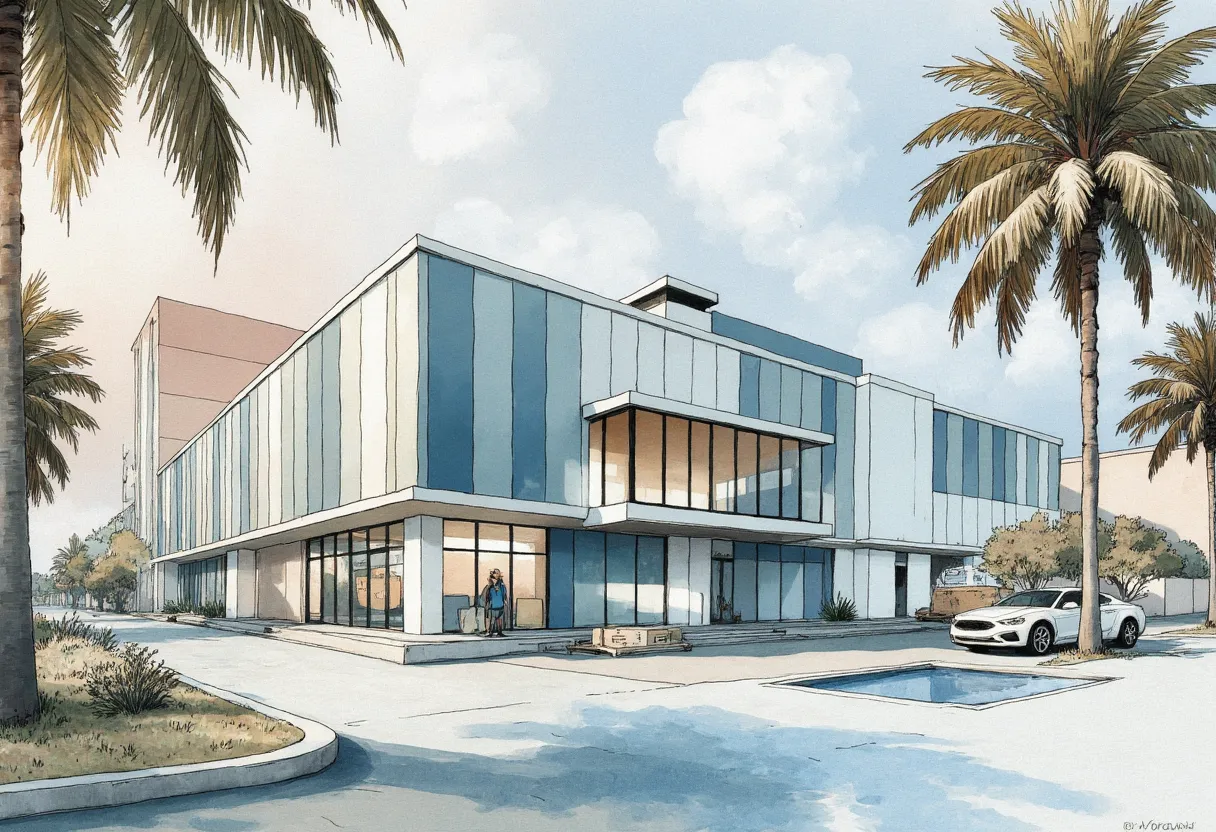
Miami’s industrial real estate market is seeing a shift in how new warehouse properties are bought and sold. According to Irene Dakota, Senior Commercial Advisor at Metro 1 Commercial, the latest wave of amenity-rich warehouses in Miami’s urban core is being absorbed almost entirely by cash-paying owner-occupants. These buyers prioritize operational efficiency and proximity over investment returns, setting this segment apart from traditional industrial markets driven by institutional investors.
“The new construction warehouse is not an investor product, unless you believe in Miami that much,” Dakota says. “It’s really an end-user product.”
This approach diverges from the standard model, where warehouses are purchased for leasing income or appreciation. Instead, Dakota explains, these properties are acquired by business owners seeking to consolidate their operations and minimize time lost to Miami’s congested commutes. The goal is to streamline daily logistics, not to maximize financial yield.
The Cash Transaction Phenomenon
The transaction patterns in this segment underscore the break from standard investment logic. Dakota notes, “Most of my career, I have sold to end users. Most of these buildings have sold for cash. If they got financed, they got financed at a higher rate. I’ve only done one bank loan on over 20 something buildings.”
This heavy reliance on cash buyers signals that these properties attract owner-operators with significant liquidity, who see the purchase as a strategic operational move. The rarity of traditional bank financing suggests that lenders have difficulty underwriting these deals, as they do not fit the typical industrial investment profile.
Geography is critical to this model. Dakota explains, “Somebody who lives in the Biscayne Corridor has an office in Brickell, a warehouse in Doral, and says, I do not want to be driving an hour every day. It’s probably an hour and a half now, and that was the success, because they got a beautiful office and a beautiful warehouse 15 minutes from their house.”
This proximity justifies the higher cost per square foot for new construction, compared to older industrial properties in outlying areas.
A Different Physical Product
The new warehouses differ sharply from legacy inventory. Dakota describes the contrast: “The older warehouses have columns. They have 14 to 16-foot ceilings. When you walk into a warehouse that has no columns, 22-foot ceilings, is fully air-conditioned, has a kitchenette, and a bathroom that is more home-like than warehouse-like, it’s a beautiful product.”
One current project Dakota highlights includes four warehouses with 30-foot ceilings, each with its own natural gas backup generator, elevator to second-floor office space, kitchenette, bathrooms, and some with showers. All are equipped with three-phase power.
The buyers for these properties reflect their unique features. Dakota says, “The new warehouse has attracted wine exporters, people who store supercars, and importers of NASCAR uniforms. The people who bought from us were very, very interesting people and new businesses coming to Miami.”
Cap Rate Compression Without Demand Destruction
Despite rising cap rates, this market segment has not seen a drop in demand. Dakota reports that cap rates have increased from the “fives” several months ago to “six, six and a half” currently. Typically, such compression would deter investor interest, but end users continue to purchase new supplies, undeterred by these changes.
“It’s a product that’s like a unicorn,” Dakota says, “because it’s not an old warehouse and it links to the new Miami of today.”
Implications for Market Participants
For developers and brokers accustomed to marketing industrial properties to institutional investors, Dakota’s experience points to the need for a different strategy. The sales process must focus on the practical needs of business owners, such as commute reduction and operational convenience, rather than on financial returns. Financial analysis must consider factors like time savings and quality of work environment, not just rental yields or appreciation.
Metro 1 Commercial’s Approach
Dakota’s firm, Metro 1 Commercial, has played a significant role in redeveloping Miami neighborhoods like Wynwood and Magic City under founder Tony Cho. Dakota joined in 2005 after moving from residential real estate and began specializing in new construction warehouses after 2017, when she partnered with an Argentina-based developer.
That initial project, Dakota recalls, drew skepticism but ultimately achieved record prices and set the standard for future developments in this category. The approach has fostered ongoing relationships, with Dakota noting she recently sold buildings to a client, leased them, and then resold them – demonstrating the repeat business common among owner-occupants.
Whether this end-user-driven model spreads to other markets will depend on how quickly developers and lenders recognize that not all industrial real estate fits the traditional investment framework. For now, Miami’s new warehouse segment stands as a case study in how operational priorities and local geography can reshape the logic of commercial real estate.
Similar Articles
Explore similar articles from Our Team of Experts.