

As traditional real estate marketing struggles to generate showings in an increasingly competitive market, geo-fencing technology is emerging as a significant tool for agents seeking more pr...

AI in Commercial Real Estate: How Bryckel AI is Using New Technology To Automate Document Workflows and Boost Productivity

Written by:
Date:
23 May 2025
Share via Facebook

Share via Linkedin

Share via X

Copy to clipboard


In commercial real estate, where multimillion-dollar transactions hinge on dense and often inconsistent paperwork, time is rarely spent on flashy software. Instead, it is consumed by the tedious work of reviewing, organizing, and processing documents, which slows down deals and drains resources across the industry.
“80% of time in commercial real estate goes into dealing with messy, bespoke documents—not the software systems that receive all the attention,” says Sienam Ahuja, CEO and Co-Founder of Bryckel AI a document intelligence platform that’s transforming how commercial real estate professionals handle their most time-consuming tasks.
Bryckel AI uses artificial intelligence to streamline these behind-the-scenes processes, automating everything from lease abstractions to property management records. The goal is to help brokers, property managers, and asset managers redirect their time toward what matters most: closing deals and growing portfolios.
The Document Intelligence Problem
The commercial real estate workflow is riddled with document-intensive processes that drain productivity. Ahuja breaks down several examples:
- Property comparison: “If you’re trying to find a 10,000 square-foot retail space in South Florida, you’re going to take 50 broker flyers and type every single element to create a competitive Excel spreadsheet for apple-to-apple comparisons.”
- Lease review: “Every version of a 200-page lease needs to be compared to the LOI to make sure all commercial terms are reflected and nothing got changed. The broker reviews it, the property manager reviews it, and the lawyer reviews it. All three people doing the exact same work.”
- Due diligence: “If you’re a tenant, you’re researching the landlord. Especially in today’s climate, you don’t want their debt to be so much that the asset you’re planning to occupy might not be there. Likewise, landlords need to verify that new tenants can afford to pay for the next 10 years.”
- Lease abstraction: “When the lease is signed, that data has to go into a property management or lease administration system. You end up sending it to a BPO in India or the Philippines, and that person has no context. They’ll provide an error-filled version.”
- Ongoing management: “Every time you have a conversation—HVAC breaks, somebody’s got to figure out if the landlord’s paying for it or the tenant—your system of record may not be accurate, so you go back to the lease document.”
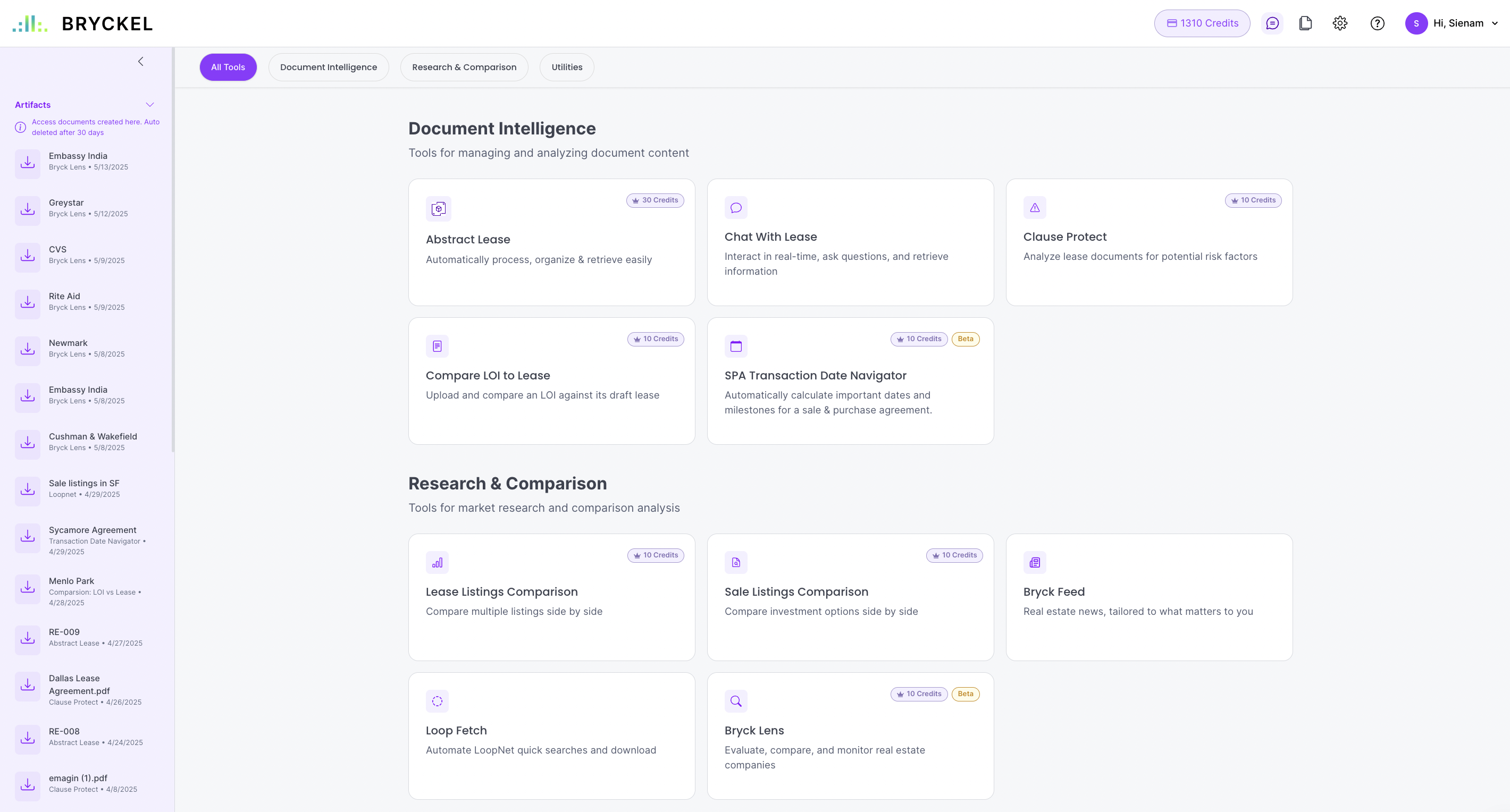
Bryckel AI addresses these pain points by automating document intelligence tasks that previously required hours of manual work. “Every single workflow takes less than three minutes in Bryckel,” Ahuja claims. “You put a lease in, I’ll automatically abstract it and push it to your property management system. You put an LOI to lease, I’ll compare it and give you proper analysis.”
From Real Estate Operations to AI Innovation
Ahuja’s journey to founding Bryckel AI follows a path through various facets of the real estate industry. Her career began at Levi’s, where she was responsible for new location transactions. This experience sparked an entrepreneurial venture building a hospitality chain across the Northeast.
“One of the things my team struggled with was keeping on top of dates and dollars for each real estate location,” Ahuja recalls. “We were doing all of it manually with Excel sheets. Everything was very disorganized.”
After successfully selling her business, Ahuja entered the brokerage world, first with Corcoran and later with Compass, where she had her first significant realization about real estate technology.
“People keep saying real estate is a tech-backward industry. It’s not tech-backward, it’s that the tech doesn’t catch up to the people and the way they want to use it,” she explains.
Her career then took her to WeWork in India, where she gained further appreciation for how effective technology could improve real estate operations. When her husband’s work brought them to California during the early days of ChatGPT, Ahuja recognized a significant opportunity.
“Up until now, all the legacy technology has fixated on 20% of data that is extracted to drive workflows of property management and ERP systems,” she notes. “But the real work happens in those messy documents that brokers, property managers, and asset managers are working with daily.”
Simplifying Implementation
One of Bryckel’s key differentiators is its approach to implementation. Unlike legacy systems that require extensive setup, Bryckel aims to be frictionless.
“I literally call ourselves a ‘no UI UI company,'” Ahuja explains. “All you have to do is log in and start putting your documents in, and we will extract information about your company. We’ll extract your brand logo and brand colors. Everything is ready to go.”
The platform employs what Ahuja calls “multi-agentic workflow” but doesn’t require users to build agents themselves, a common pain point in an industry where technical sophistication varies widely.
“Everything is a tool,” she says. “You say, ‘I want to abstract the lease.’ Upload. Bryckel does everything. I want to assess lease risk? The only question we’re going to ask is from the landlord’s perspective or tenant’s perspective. Upload, and we’ll do everything.”
This simplicity is by design. “We are very diligent and religious about limiting every workflow to less than three steps,” Ahuja emphasizes. “Your decision-making model is: I want to do this, I only need to give this much context to Bryckel, and I’m going to get what I want as a polished deliverable.”
AI Accuracy and Trust
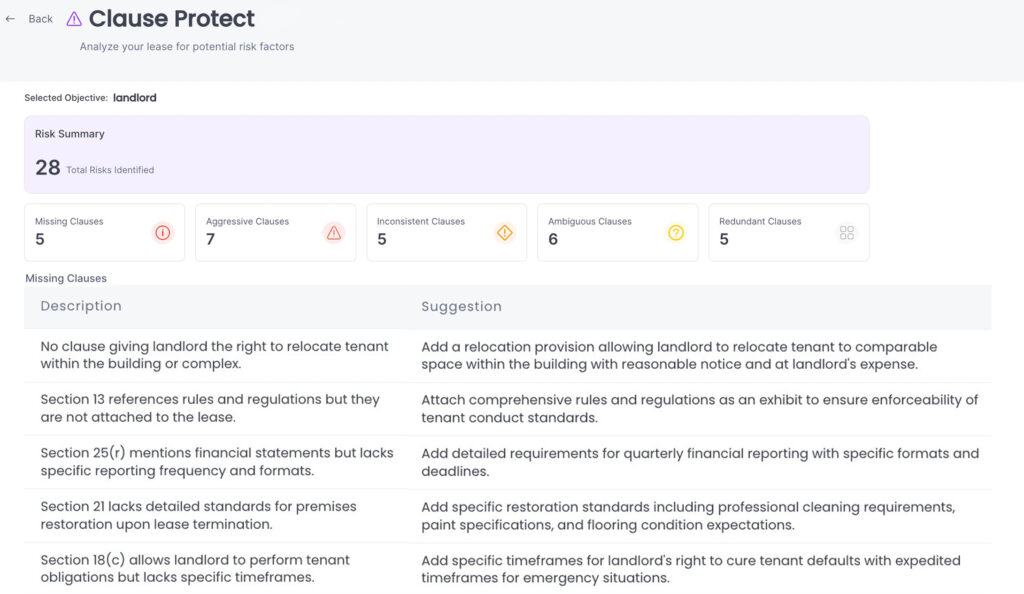
Achieving high accuracy in document intelligence requires more than just applying general AI models to real estate documents. Bryckel has fine-tuned its approach through several layers:
- Document preprocessing: “You can upload any size document of any condition or type. We will parse, preprocess, clean it up, and only take the relevant pages.”
- Industry-specific training: “We use over 10,000 documents to fine-tune the models. That’s why we have 99% or higher accuracy.”
- Semantic understanding: “If you’ve seen commercial lease documents, one will call it ‘commencement date,’ another ‘possession date,’ another ‘start date.’ We’ve done the tagging of every type of document with hundreds of words so we can recognize the semantics.”
- Standardized outputs: “Everything is standardized, normalized, and templatized so that every single time your output is identical. In our case, reliability is the key factor.”
- Anti-hallucination guardrails: “Our AI does not hallucinate if information is not there. If it doesn’t say anything about parking surfaces available, it’s going to say it’s not spelled out in the document.”
To build trust with users accustomed to manual processes, Bryckel maintains human oversight. “We still keep humans in the loop so that you gain trust over time,” Ahuja says. “It’s like a Tesla where you have autopilot, but you can still keep your hand on the wheel and see whether it actually does the job right.”
The platform provides citations for every piece of information extracted, highlighting exactly where in the document the data was found. “If you want to double-check, that’s all you’re doing,” Ahuja explains.
Market Strategy and Real-World Impact
Bryckel initially targeted enterprise clients but has pivoted its strategy based on market realities. “The incumbents do have a lot of stickiness because they were built back in the ’80s. We’re talking about a 50-year period of people using them,” Ahuja notes, referencing established players like Yardi and MRI.
“Originally our intent was, can we for some use cases replace them? We very quickly realized that was a bad idea,” she admits. “What we decided is to sit adjacent to them, so we are an added tool to make life easier, work faster, accelerate productivity, rather than talking about replacing an incumbent.”
These insights led to a strategic pivot toward mid-sized brokers and property managers. “The fastest growing customer segment for us are people who are mid-sized brokers and property managers who want to show to their potential customers that with AI they are more efficient, can deliver results people want, and can do it with leaner teams,” Ahuja says.
One Southern California brokerage managing over 15 million square feet has seen dramatic improvements. “All of this document intelligence work got cut down to an hour internally, rather than spending days,” Ahuja reports. “Their clients are impressed by the speed at which they present options and advance negotiations.”
For property management firms, Bryckel addresses a looming workforce challenge. “One of the biggest challenges is that the people doing this manual entry work are generally moving out of the workforce—people who’ve been in companies for 30-40 years,” Ahuja explains. “No Gen Z is particularly enthusiastic about taking on roles that involve typing thousands of fields.”
Looking Ahead
As AI continues to evolve rapidly, Bryckel is focused on expanding its capabilities. “The part that gives me sleepless nights is the speed at which AI is evolving,” Ahuja admits. “We just recently were able to do comprehensive research on companies because of how LLM plus web search has evolved.”
Future developments may include automated valuations. “I’m excited about exploring how we can do things around valuations within our system itself, rather than people using four different clunky tools,” she says. “It should be a click of a button.”
For distribution, Bryckel is benefiting from industry word-of-mouth. “One of the advantages of the real estate industry being small is virality,” Ahuja notes. “Our early customers, especially brokers, are driving our traffic. Now I see three to five inbound calls easily because brokers are talking in the market.”
As commercial real estate continues to navigate challenging market conditions, tools like Bryckel AI that increase efficiency and reduce operational costs are finding receptive audiences. By focusing on the document-intensive processes that consume so much of real estate professionals’ time, Bryckel addresses a pain point that has long been overlooked by traditional proptech solutions.
“My brain just races on how many things can be instantaneous, rather than having to go to so many different sources,” Ahuja concludes. For an industry built on paperwork, that vision of instant intelligence could fundamentally improve productivity.
Similar Articles
Explore similar articles from Our Team of Experts.


Perspectives, Property Technology, Real Estate Services, Market Analysis & Policy, Industry News, Residential Real Estate
Industry expert argues rising costs are forcing innovation in transaction fee structures. The convergence of record-high home prices and mortgage rates has created an unprecedented affordabi...