Most title companies know their quality control process has gaps. Fewer talk about how large those gaps are. In many operations, only a small sample of the search packages coming back from vendors, field abstractors, or internal staff ever gets a second look before the file moves forward.
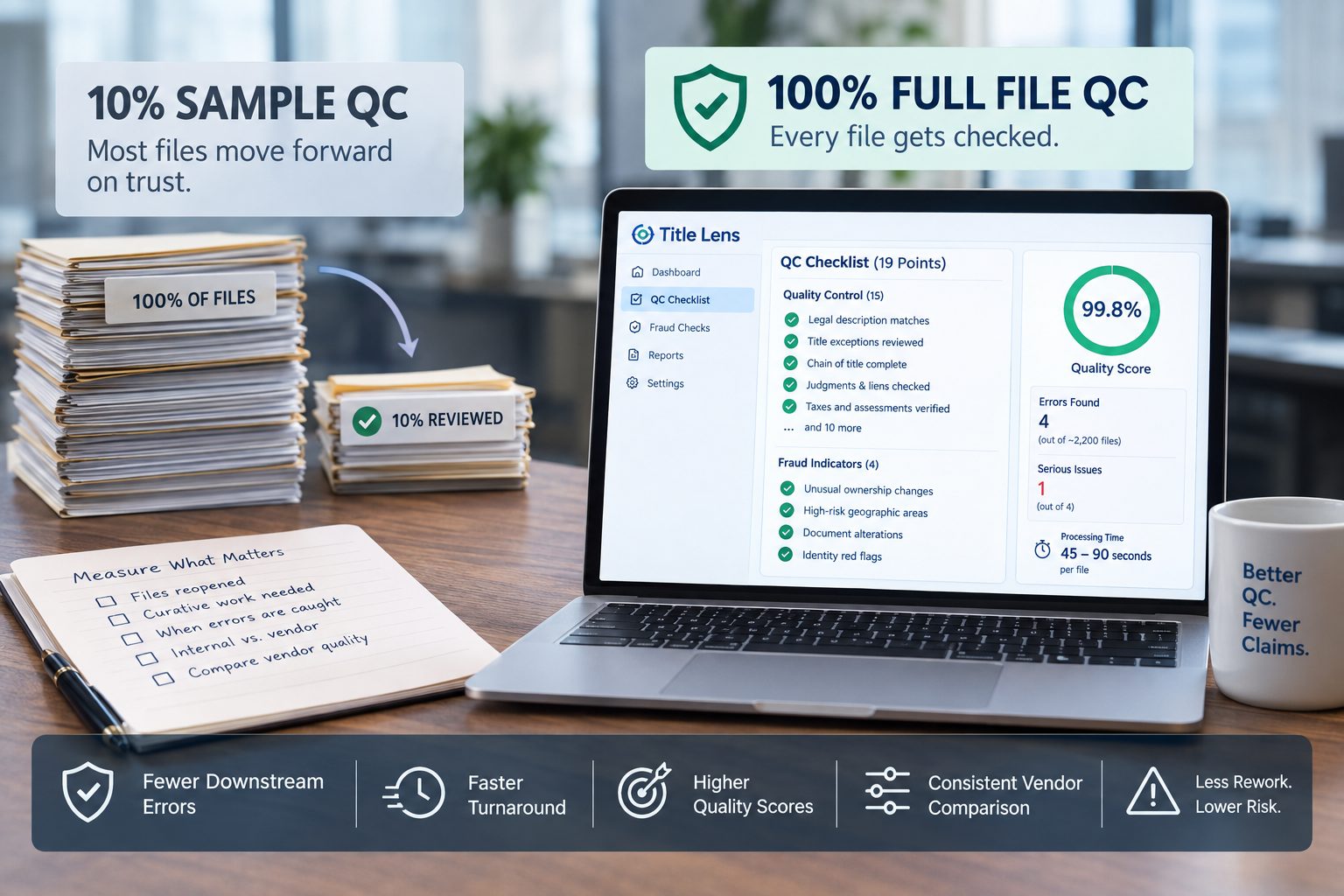
Jimmy Lewis, CEO and Co-Founder of TrueFocus Automation, says that in his experience, most title companies review roughly 10% of their search packages. The rest move downstream on trust. That gap is what led his team to build Title Lens, a QC and fraud check tool that reviews title search packages and commitments automatically so every file gets checked, not just a sample.
Why a 10% Sample Leaves Real Risk in Place
Sampling made sense when every review required an examiner’s time. If a careful review takes a meaningful chunk of someone’s day, checking every file isn’t realistic for most teams. So companies spot-check and hope the sample reflects the whole.
The problem is that title errors rarely show up right away. As Lewis explains, many mistakes aren’t exposed when the file is submitted. They surface later, somewhere before closing or at the closing table. By then, fixing a missed document or an incorrect legal description means reopening the file, delaying the closing, or in the worst cases, dealing with a claim.
A missed judgment in one of the files nobody reviewed is exactly the kind of error a sampling approach quietly accepts.
What Full File Review Actually Checks
Automated review works best when it follows a defined checklist. TrueFocus uses a 19-point checklist. Most points cover quality control, and the rest look for fraud indicators. The quality checks focus on the errors most likely to surface at closing:
Chain of title issues: gaps or breaks in the vesting chain, grantor and grantee names that don’t match from one conveyance to the next, and deeds out of sequence.
Missed or incorrect documents: recorded mortgages, releases, liens or judgments left out of the report, and documents that were included but belong to a different party or property.
Incorrect property: legal descriptions, parcel numbers or addresses that don’t match across the order, the vesting deed and the tax record.
Missed AKA name searches: maiden names, prior married names, initials and spelling variations that weren’t searched, which is where judgments and liens are often missed.
The goal is not to replace the examiner. It is to flag the items an examiner should take a second look at before the file moves forward. Instead of reading every package line by line, the examiner starts with a short list of specific things to verify.
Speed matters too, because a review step that slows production won’t get used. Lewis says processing time for a full report has dropped from about three minutes to between 45 and 90 seconds per file. “It’s not instant,” he says, “but it’s fairly instant.”
What the Numbers Look Like in Practice
TrueFocus has been running the tool on files it produces for a large lending client, and the quality gains came quickly.
According to Lewis, the quality score was 99.3% in July, with roughly 80 errors. In August, the team’s highest-volume month, it rose to 99.5%, with around 35 to 40 errors. Through early September, it reached 99.8%: four errors across about 2,200 files, only one of them serious.
The error rate fell by more than two-thirds in two months, even as volume peaked.
A move from 99.3% to 99.8% can sound small. On a few thousand files a month, it’s the difference between dozens of files needing rework and a handful. That means fewer delayed closings, fewer corrections reaching the lender, and more examiner time for new work.
What to Measure If You Move to Full File QC
Lewis says the most important metric is the reduction in downstream errors. That means you need a baseline before you change anything, and it helps to put a dollar figure on it.
The industry-wide stakes are significant. In 2025, title insurers paid more than $667 million in claims. An ALTA-commissioned study of policies from 2013 to 2022 found that non-fraud claims averaged over $26,000 each, while fraud and forgery claims averaged more than $143,000. Claims are only the visible part. Most errors are caught earlier and paid for in examiner hours, curative work and delayed closings. altaalta
Start by tracking how many files get reopened, how many need curative work after the commitment goes out, and where in the process each error was caught. Note whether the error came from an internal team member or an outside vendor. Then attach a cost to each: staff hours per reopened file, curative expenses and any closing delays. After full file review is in place, compare the same numbers over the same period.
If you work with several search vendors, applying the same review to every package gives you a consistent way to compare their quality, and a factual basis for vendor pricing and allocation decisions. Lewis points out that many companies route only a portion of their files through any one review process, which leaves the rest unchecked.
You can see how TrueFocus has approached other title production workflows in its case studies.
TrueFocus Automation provides intelligent process automation solutions for title insurance, mortgage, and appraisal operations. Founded by Jimmy Lewis and Sridhar Loganathan, the company combines operational expertise with custom automation development. For more information, visit www.truefocusautomation.com.
This article is based on information provided by the expert source cited above. It is intended for general informational purposes only and does not constitute legal, financial, or real estate advice. Readers should conduct their own research and consult qualified professionals before making any real estate or financial decisions.