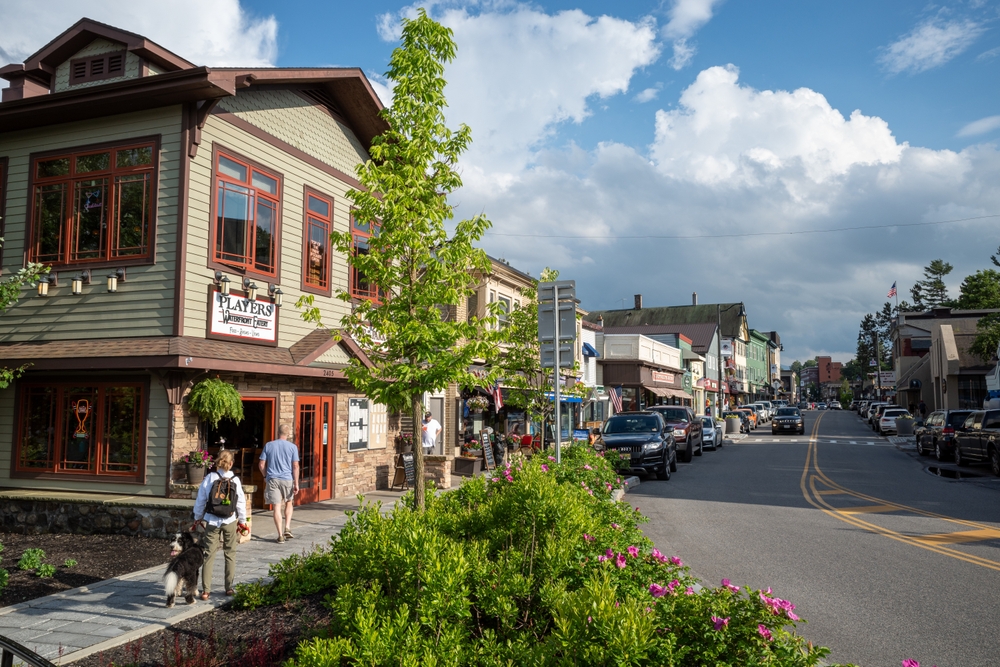
The assumption that Adirondack buyers want maximum privacy and distance from town is giving way to a different market reality: properties within walking distance of restaurants, coffee shops, and waterfronts are outperforming remote listings, even when those remote properties offer superior trail access or acreage.
The Premium Buyers Are Paying
Chase Jermano, a Licensed Real Estate Broker with Tina Leonard Real Estate, LLC, says the shift is more pronounced than most people in the market would anticipate. Buyers arriving from dense metro areas, including downstate New York, northern New Jersey, Connecticut, and Boston, are not, as a rule, seeking isolation. They are seeking a different kind of daily life, and that life still requires walkable infrastructure.
“A lot of people think, oh, it’s so remote here, everybody wants to live in the middle of nowhere,” Jermano says, “but what a lot of people tell us is you want to be able to walk to dinner, coffee, walk to the lake or river without getting back in the car.”
According to Jermano, the car-dependence of more remote listings becomes especially apparent in winter, when the friction of driving to every errand or meal compounds quickly. Buyers who experience that friction firsthand often recalibrate what they actually want from a second home, and the recalibration tends to move them toward village-adjacent properties, not away from them.
Remote Properties Still Sell, But to a Narrower Buyer
Remote properties with strong trail or water access have not stopped selling. The market for them remains active. But Jermano says the buyer pool is more specific: someone explicitly prioritizing acreage and privacy over convenience, and that narrower demand base affects both pricing power and resale speed.
“The remote but close to trails, it still sells and sells well, but it’s a different buyer,” Jermano says. “Usually somebody that wants the privacy, wants the acreage over the convenience.”
The distinction matters for sellers trying to assess long-term value. A remote property with exceptional trail access may attract strong interest from a particular type of buyer, but the pool willing to accept the trade-offs (car dependence, winter access challenges, distance from services) is smaller than the pool for a walkable village property with outdoor access nearby.
Jermano also points to a life-stage dimension. He notes that his own preferences shifted after moving from Lake Placid, where he lived close to mountain bike trails, to Saranac Lake, where the walkable village amenities were the draw. The trail access he gave up has affected how often he actually rides. Buyer preferences are not static, he says, and properties that serve a buyer well at one life stage may feel limiting at another.
Which Towns Capture Both Sides
The towns Jermano identifies as best positioned offer walkable village infrastructure and outdoor access in close proximity, a combination he describes as increasingly difficult to find and increasingly valuable.
Lake Placid, in his assessment, leads the market. Its name recognition, year-round event calendar, village services, and constrained buildable inventory create conditions where properties hold value and move faster than comparable homes elsewhere in the region.
“Outdoor access isn’t just a lifestyle feature here; it’s definitely more of a scarcity-driven value,” Jermano says, pointing to Adirondack Park land-use restrictions that limit new development and make existing walkable-plus-outdoor-access properties harder to replicate over time.
Saranac Lake, he says, is beginning to follow a similar trajectory. Unlike Lake Placid, it functions as a working village rather than a resort destination, which gives it a different character, but the combination of walkable amenities and access to the Saranac Lake chain of lakes is drawing buyers who want both convenience and water access without paying Lake Placid prices.
Matching Buyers to the Right Trade-Off
Jermano says the walkability question has become a standard part of his early buyer conversations, not because remote properties are a bad choice, but because buyers who underestimate how much they will rely on town infrastructure tend to be the ones who call him a year later with regrets.
“I’ve had people buy houses more remote, and then they call me in a year, and they’re like, I can’t live like this,” Jermano says.
His approach involves surfacing that preference early, before a buyer falls in love with a remote listing that will not support the daily life they are actually envisioning. For buyers who genuinely want privacy and acreage, remote properties remain a strong fit. But for the larger share of metro-area second home buyers who want outdoor access woven into a walkable daily routine, Jermano argues that the walkable village properties, despite higher prices, hold value more reliably over time.
As Adirondack Park land-use constraints continue to limit what can be built, the towns that credibly offer both walkable amenities and direct outdoor access are the ones where inventory is tightest and competition among buyers is strongest. That dynamic, Jermano says, is what separates a lifestyle purchase from one that also functions as a durable financial decision.
Chase Jermano is a licensed real estate agent and broker at Tina Leonard Real Estate, specializing in waterfront, second-home, and investment properties across the Adirondacks, including Lake Placid, Keene, and the surrounding region.
This article is intended for informational purposes only and does not constitute legal, financial, or investment advice. The views and opinions expressed herein reflect those of the individuals quoted and do not represent an endorsement of any company, product, or service mentioned. Readers should conduct their own due diligence and consult qualified professionals before making any investment decisions.