Statewide production rankings in New York real estate are usually a metropolitan story. The volume sits where the prices sit, and the teams at the top of the leaderboards tend to work the downstate markets where a single transaction can carry a quarter’s numbers.
The current standing in one category runs against that. As of October 7, 2026, The Sharman Team ranks #1 among New York small teams at Real Broker by closed sales volume – a three-person operation based in Livingston County, working a market built around Conesus Lake and the western Finger Lakes.
The Numbers
The Sharman Team’s year-to-date figure stands at $16,634,855 in closed volume across 45 sides, placing it first among 24 small teams statewide on the brokerage’s production leaderboard.
Two details give the figure more weight than a raw total suggests. The team has three members, competing in a category that extends to teams of five. And the total covers only the period since the team moved to Real Broker in February 2026 – roughly eight months rather than a full year. Sharman made that move after finishing 2025 as the top producer at his previous brokerage, with $17 million in closed sales.
Leaderboard standings are year-to-date and remain open until the calendar year closes. The position described here is current rather than final.
A Market That Does Not Look Like A Leaderboard Market
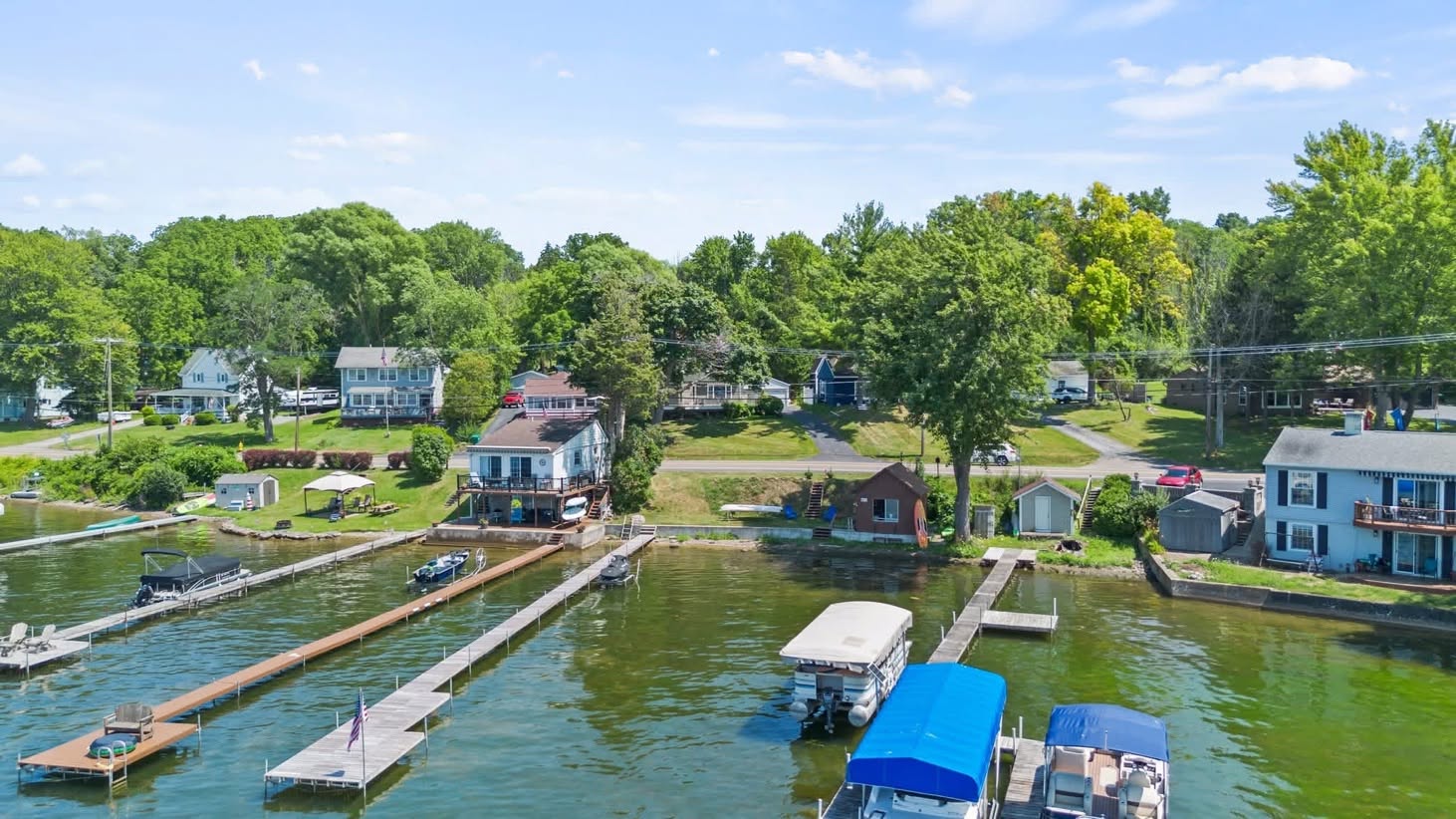
Based in Livingston County, The Sharman Team is a small, family-run team led by Matthew Sharman, who personally drives the majority of its production. Sharman works waterfront and lifestyle property around Conesus Lake, Honeoye Lake, and Silver Lake alongside residential business across the greater Rochester area. It is a market of narrow lots, limited inventory, and properties that resist standardized valuation – a long way from the uniform suburban product that supports high-volume production elsewhere.
“It’s great to represent western New York and the Finger Lakes and be recognized as a production leader,” Sharman says. “Production leadership in New York isn’t something people necessarily expect to come out of Livingston County.”
“We’re based in smaller communities, but we’ve never treated geography as a limit,” Sharman says. “Competing statewide while keeping the local relationships that built this business is something I’m proud of.”
His point is narrower than a regional contest: that a concentrated local market, worked by a small team with deep knowledge of a specific geography, can produce volume competitive with markets structured very differently.
The Structural Argument
Sharman attributes part of the result to how the brokerage model works rather than to effort alone, and pushes back on an assumption he encounters regularly.
“A lot of people assume that the leaner and more tech-driven you get, the more transactional you become with clients,” he says. “I’ve found the opposite. Without the traditional overhead and constraints, you’re able to get closer to people and provide better service.”
The reasoning is that cost structure dictates behavior. Carrying physical offices and the overhead that accompanies them creates pressure toward volume and throughput. Removing that, in his account, frees capacity for the slower work – walking a buyer through documents, talking someone out of a property, holding a relationship open across a multi-year decision.
Whether that generalizes is an open question, and the leaderboard itself suggests more than one answer. Sharman makes the point himself.
“There’s a wide variety of team formats on that list,” he says. “It’s good to see that there are different ways of doing things in different markets and you can still be successful.”
What It Signals
For a regional market, the practical read is that specialization and scale are not opposed. The teams that dominate statewide production rankings usually do so through breadth. A result like this one comes from the opposite direction – a small operation working a market it knows in detail, where the knowledge itself is the differentiator.
“I’ve never believed the biggest team is automatically the best team,” Sharman says. “I’d rather run a small, tight operation where I’m personally involved than build a big organization just to be big.”
Sharman’s framing of his own practice is consistent with that. Asked about the direction of the business generally, his answer was less about growth than about method.
“‘That’s the way it’s always been done’ is not in my vocabulary,” he says. “There’s always a better way to do things.”
The standing will be settled when the year closes. Until then, it remains what it is, a current position, held by a team of three, in a category where it was not expected.
About the Expert
Matthew Sharman is a lakefront and lifestyle real estate authority with The Sharman Team at Real Broker NY LLC, serving Greater Rochester, the GLOW region, and the western Finger Lakes, with particular expertise in Conesus Lake and Livingston County lakefront property.
This article is based on information provided by the expert source cited above. It is intended for general informational purposes only and does not constitute legal, financial, or real estate advice. Readers should conduct their own research and consult qualified professionals before making any real estate or financial decisions.