There is a moment that Bill Melnick has watched happen often enough that he has come to expect it. A buyer arrives in Salisbury, Connecticut for a specific reason: a child starting at Hotchkiss, a lake house they have been thinking about for years, a farmhouse they saw online and could not stop thinking about. They buy the house. And then, somewhere in the months that follow, they realize that what they came for was only part of what they found.
Bill Melnick of Elyse Harney Real Estate has worked the Salisbury market for years and describes the town’s effect on buyers in consistent terms. “People may first come to Salisbury for a house, a school, a lake or a weekend,” he said. “What surprises them is how quickly they develop a life here.”
That gap between what draws buyers in and what keeps them is, in many ways, the Salisbury story.
The Social Geography of the Town
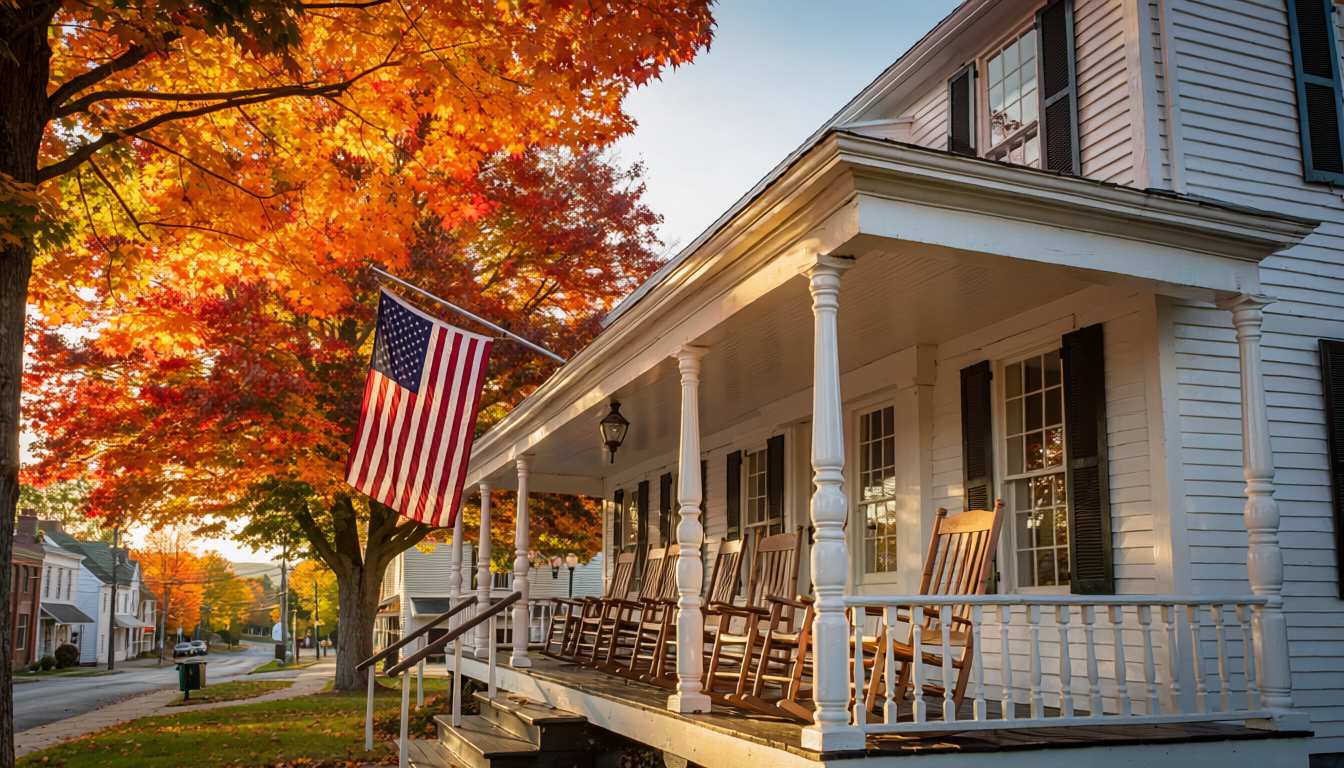
Salisbury is not a town with a single center, but it has something close to one. The White Hart Inn, which anchors Salisbury Village, functions as a gathering point that cuts across the town’s various constituencies in a way that few places do.
“Sit on the porch at the White Hart for long enough and eventually you’ll see everybody,” Melnick said. “People who’ve lived here forever, weekenders, school parents, visitors, writers, real estate people. It’s not exclusive in the sense of being a private club. It’s actually the opposite. It’s one of those places where all the different versions of Salisbury intersect.”
That intersection is not incidental. It is part of what makes the community function. Salisbury draws a genuinely varied population: longtime residents with multi-generational roots in the area, families who arrived because of Hotchkiss or one of the other schools nearby, weekenders who have been coming for decades, and a newer wave of buyers who have effectively made the town their primary base while maintaining a city apartment. The White Hart is where those populations meet, which is rarer than it sounds in a town of this kind.
Two Forms of Scarcity
The Salisbury real estate market is shaped by two distinct forms of scarcity, and buyers who understand both tend to make better decisions about what they are actually purchasing.
The first is water. True lakefront property on Salisbury’s lakes is finite in a way that cannot be addressed by new construction or subdivision. The shoreline exists in a fixed quantity. “Someone unfamiliar with the market might look at a lake house and try to understand the price based on the size of the house,” Melnick said. “That’s often the wrong way to look at it. They’re not just buying square footage. They’re buying frontage, views and an experience that can’t be replicated.”
The second form of scarcity is history. A great Salisbury Colonial or farmhouse, with original floors, fireplaces, barns, stone walls, mature trees, and two hundred years of presence on the same piece of land, cannot be reproduced. “You can build a historically inspired house,” Melnick said. “You can’t build a house that’s been sitting beautifully on the same piece of land for 200 years.”
These two scarcities produce very different buyer profiles and very different conversations, but they share a common logic: the thing being purchased is genuinely irreplaceable, and the price reflects that.
Land, Conservation, and What Neighbors Might Build
Sophisticated buyers in Salisbury have learned to ask a question that does not appear on any listing sheet: what can be built on the land around this property?
Acreage alone tells a buyer relatively little. What matters is whether the land is usable, what the views are, and whether neighboring parcels are protected from development. “Ten acres can be extraordinary or relatively meaningless,” Melnick said. “Is it meadow or woods? Is it usable? What are the views? What’s around it? Is neighboring land protected? Can somebody build in your view someday?”
Conservation easements and land preservation agreements answer that last question definitively. For buyers who are purchasing a view as much as a house, knowing that the fields and forests surrounding them cannot be subdivided is not a minor consideration. It is a material part of what they are buying. “I sometimes think some of Salisbury’s greatest assets aren’t the houses that have been built,” Melnick said. “They’re the places that never will be.”
The Outdoors as Everyday Life
The Appalachian Trail passes directly through Salisbury. The lakes offer swimming, boating, and shoreline that feels genuinely removed from the pressures of city life. Skiing is accessible in winter. Cycling and hiking are available without planning a trip or booking a vacation.
What Melnick notices is that buyers who move to Salisbury stop treating these things as amenities and start treating them as the texture of a normal week. “You don’t have to plan a hiking vacation,” he said. “You can finish work at four o’clock and be on a trail shortly afterward. That’s a very different relationship with the outdoors.”
That shift, from recreation as something you schedule to recreation as something you do, is one of the changes that buyers most consistently describe after they have been in Salisbury for a year or two. It is also one of the things that makes the town difficult to leave.
Explore Salisbury and Litchfield County communities.
Bill Melnick is a luxury real estate specialist with Elyse Harney Real Estate, serving Litchfield County and surrounding markets in Connecticut.
This article is based on information provided by the expert source cited above. It is intended for general informational purposes only and does not constitute legal, financial, or real estate advice. Readers should conduct their own research and consult qualified professionals before making any real estate or financial decisions.