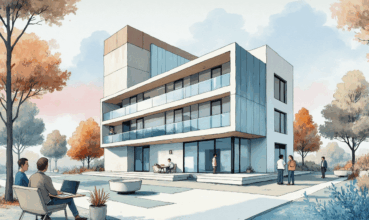

The senior housing sector is experiencing its strongest demand and occupancy rates since before the pandemic. Still, many investors remain anchored to outdated narratives of distress, accord...

Senior Housing Gains Lender Interest Over Traditional Real Estate

Written by:
Date:
13 Feb 2026
Share via Facebook

Share via Linkedin

Share via X

Copy to clipboard


Healthcare real estate, particularly skilled nursing facilities, is attracting new capital as lenders recognize a deposit advantage that multifamily and office properties cannot match, according to Nachum Soroka, Vice President of the Healthcare Group at Eastern Union.
Regional banks, debt funds, and alternative life insurance companies are increasingly interested in senior housing. This is driven less by interest rate trends and more by the sizable deposit balances these properties generate. Soroka explains that a $20 to $25 million skilled nursing facility can produce $1 million to $1.5 million in average daily deposit balances, far exceeding what is typical for similarly sized multifamily or office deals. This steady deposit flow changes the economics for lenders.
Deposit-Driven Lending Shifts
Banks are under pressure to secure stable, low-cost deposits. Senior housing assets, particularly skilled nursing facilities, naturally generate these deposits through resident payments, insurance reimbursements, and daily operational cash flows. These funds remain with the lending institution, giving banks a direct financial incentive to back these projects.
Soroka notes that slightly higher yields also attract lenders. “A good rate in my world should be somewhere in the six-and-a-half percent range. For a multifamily property, they might be looking for something half a point cheaper,” he says, emphasizing that the yield premium, combined with deposit generation, creates a clear economic benefit for banks and other lenders.
This deposit-driven logic is prompting lenders to reconsider their allocations. The multifamily sector, which has faced headwinds in recent years, no longer offers the same appeal, while senior housing is emerging as a preferred destination for capital.
New Entrants in Senior Housing Finance
This shift is visible across a variety of capital sources. Soroka points to a growing presence of debt funds, which are now more active in the sector than in the past. “The debt funds are definitely expanded. If you know exactly what box they want to be operating in, they’re out there,” he says.
Alternative life insurance companies, which have not traditionally focused on senior housing, are now entering the market. Even credit unions, known for their conservative approach, are structuring larger healthcare real estate deals, often with fixed-rate financing and less restrictive covenants.
Regional banks, which pulled back during the liquidity crunch following the failures of Silicon Valley Bank and Signature Bank, are now returning to the market with more capital to deploy. Soroka observes that these banks are increasingly open to considering senior housing deals as they seek new sources of deposits and yield.
Family offices and foreign investors are also allocating more capital to senior housing, particularly to the independent living segment. As the baby boom generation ages into their eighties, these investors see long-term demand supporting the sector.
The Role of Credit Metrics
The appeal of senior housing goes beyond deposit economics. Soroka emphasizes that operational fundamentals are strong, with healthy cash flows and robust debt service coverage ratios. “When a deal works, it demonstrates strong metrics, including robust debt service coverage ratios. It just looks like excellent credit metrics,” he says.
This combination of reliable cash flow, strong credit metrics, and deposit generation is making senior housing a more mature and transparent asset class. Institutional capital is now flowing through multiple channels, from regional banks to alternative life companies and credit unions.
Soroka stresses the importance of matching each deal to the right lender. “For every deal, you have to think creatively and determine which deal works best for each type of lender,” he says.
Eastern Union’s Strategy in Senior Housing
Eastern Union, a commercial mortgage brokerage with offices in five states, originates about $4 billion in loans annually. Soroka’s healthcare group manages nearly $1 billion in annual revenue, focusing on assisted living and skilled nursing properties.
The firm distinguishes itself by conducting extensive front-end work for clients. Soroka says, “We will prepare very, very thorough decks offering memorandums. That way it makes the decision a lot easier for the capital partners that we’re looking to place the loans with.” Eastern Union also provides acquisition diligence and underwriting services, positioning itself as an in-house consultant rather than a purely transactional broker.
Recently, the company expanded its equity division, adding team members to provide joint-venture equity and recapitalization services alongside debt placement. Soroka attributes this move to higher demand from family offices and alternative investors seeking exposure to senior housing.
Looking Ahead: Permanent Shift or Temporary Reallocation?
Whether lender interest in senior housing marks a lasting change or a temporary response to challenges in other real estate sectors depends on how healthcare assets perform in the coming years. For now, Soroka says the financial case is clear: senior housing provides deposit generation and yield advantages that traditional real estate cannot match.
As demographic trends support continued demand for senior housing, and as lenders prioritize stable deposits and strong credit metrics, the sector is likely to remain a focal point for new capital. The result is a realignment in real estate finance, with senior housing at the center of lender and investor attention.
Similar Articles
Explore similar articles from Our Team of Experts.