

Nashville’s distressed property market is showing early signs of a significant increase, even as overall market activity remains subdued for the holidays. According to Moren Adenubi, owner...

How Rent Math Is Splitting Commercial Real Estate Into Winners and Losers

Written by:
Date:
16 Dec 2025
Share via Facebook

Share via Linkedin

Share via X

Copy to clipboard

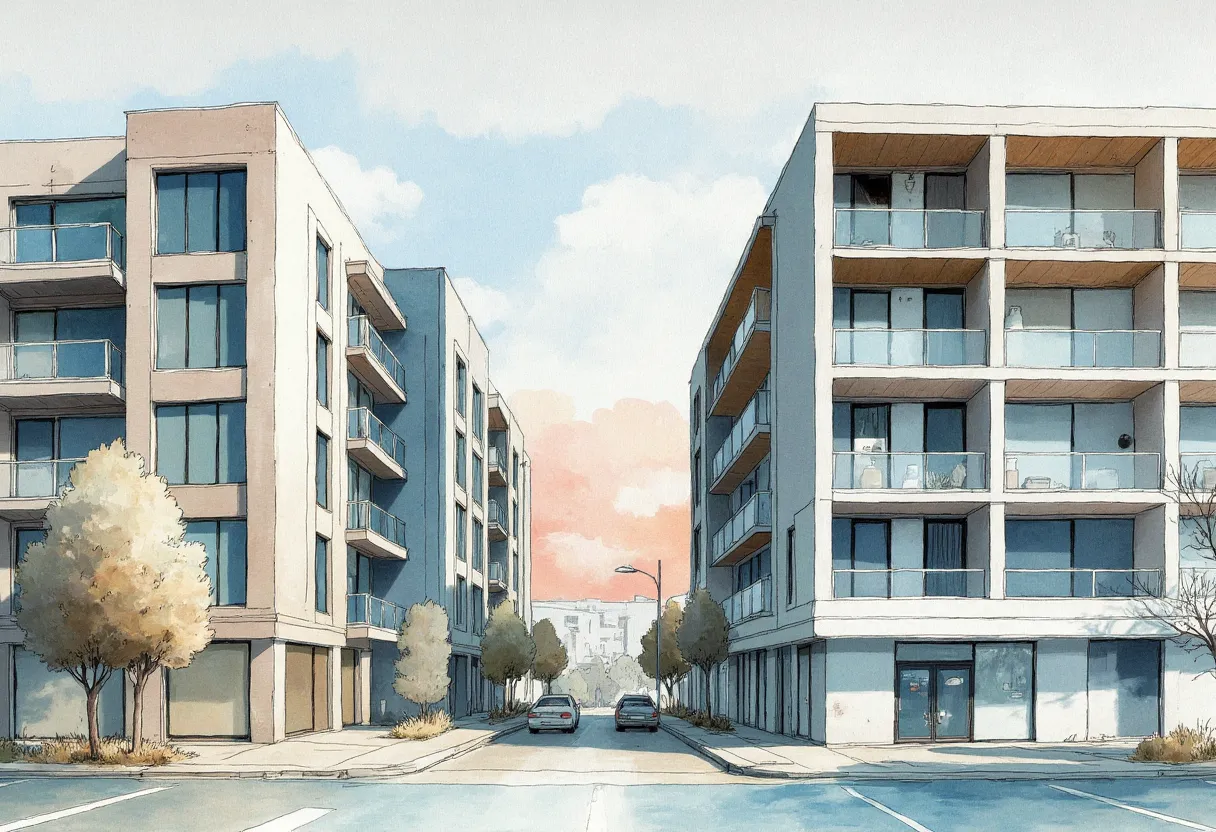
Connecticut’s commercial real estate financing market has split into clear tiers, driven by a fundamental question that now determines whether a property can access capital: Is there a rent level that still makes the economics work, even under stress? For multifamily properties, the answer remains yes. For office buildings, it is increasingly no.
Jeff Kravet, President of Kravet Realty LLC, says financing decisions now hinge on whether a property has a rent level that can still support the deal under stress. Multifamily remains the easiest asset class to finance because lenders can always identify a viable rent that produces income. Office buildings, by contrast, often lack a workable rental scenario, making them far harder to finance. “There may not be a number,” Kravet says.
Kravet says this goes beyond temporary market trends or interest rate cycles. It reflects a deeper uncertainty about whether certain property types—especially office—can reliably generate income in the future, making them effectively unfinanceable regardless of location or current occupancy.
The Multifamily Advantage
Multifamily rental properties continue to attract lenders because they offer what banks and investors value most: predictable, resilient cash flow. Even when lenders model worst-case scenarios—assuming higher vacancy rates or lower rents—they can still identify a rent level that produces positive cash flow.
“There’s always a number that I can rent, but it’s not zero,” Kravet says. Lenders may assume rents could fall 20%, or vacancies could rise, but a viable rental number always exists for apartments. This mathematical certainty translates into easier access to financing and more competitive loan terms. As a result, multifamily assets face fewer financing obstacles than any other commercial property type in Connecticut’s current market. Buyers can secure loans, and sellers can negotiate from a position of relative strength.
Retail and Industrial: Conditional Access
Retail and industrial assets occupy a middle ground. Financing is still available, but only for properties that meet specific criteria.
For retail, lenders focus on visibility, parking, and the quality of established tenants. “You give me a retail space on a side street with bad visibility and no parking, there may not be a number that I can find a tenant at,” Kravet says. Properties lacking these fundamentals often cannot secure loans, regardless of location.
Industrial assets face similar scrutiny. Basic features—such as ceiling height, loading docks, and drive-in doors—are now essential. “You give me an industrial space with eight-foot ceilings and no drive-in doors and no loading docks, there may not be a number that I can find a tenant at,” Kravet observes.
After several years of strong demand, Connecticut’s industrial market is also cooling. “There was a feeling that there was no end to how much you can get on an industrial property if you had 30-foot clear span, drive-in doors, and sprinklers,” Kravet says. “I think that ship has sailed temporarily.” Lenders and buyers are now more cautious, and properties without top-tier features are seeing reduced interest.
The Office Crisis
Office properties face the most severe financing constraints. Kravet says the issue is not just tighter lending standards, but a deeper uncertainty about the future of office demand. With remote work, downsizing, and changing tenant needs, lenders cannot be confident that there is any rent level that will fill vacant office space.
“Office, unless you have a clear path to conversion, the numbers don’t work,” Kravet says. Without a realistic scenario for future income, lenders cannot justify loans at rates that make sense for buyers or sellers. This creates a cycle: properties that cannot access financing do not trade, which in turn makes their values even more uncertain and discourages further lending.
The result is a two-tier market. Sellers of multifamily assets can command strong prices and attract multiple bidders. Sellers of office properties face a limited pool of buyers, most of whom cannot make the financing math work.
The Leverage Problem
Rising interest rates and compressed spreads between cap rates and borrowing costs are another obstacle for all commercial real estate deals. “The deal typically needs to have positive leverage,” Kravet explains. “If you’re going in at a six and a half cap rate and you’re getting a six and three-quarters rate, you’re going to struggle getting to the finish.”
This squeeze means that even if there is money available, it may not be at a rate that allows the deal to make financial sense. “It’s really the question of the spreads and does the deal make sense with the current rate,” Kravet says.
To bridge these gaps, Kravet has used seller financing on several deals. Creative capital structures can help transactions move forward when traditional debt is unavailable or too expensive. But Kravet notes that seller financing only works when both parties are confident in the property’s ability to generate reliable rental income—again, circling back to the fundamental importance of a workable rent number.
Practical Strategies and Outlook
Kravet’s firm has navigated this environment by focusing on asset classes with active lending and by structuring creative deals when needed. This strategy has paid off: “2025 was the single best year I’ve ever had as a commercial broker in the business,” Kravet says. He credits this success to a clear understanding of which properties can realistically access capital and at what cost, rather than assuming all commercial real estate is equally financeable.
Whether the current financing hierarchy will persist depends on broader economic factors and shifts in property use. For now, however, the mathematical certainty of multifamily rental income is giving residential assets a structural advantage that office and other commercial classes cannot easily match. In Connecticut’s market, and increasingly nationwide, a property’s ability to generate predictable rent under stress is the dividing line between those that can get financed—and those that cannot.
Similar Articles
Explore similar articles from Our Team of Experts.



Salt Lake City Office Buildings Drop From $350 to $100 Per Square Foot as Class A Space Grows Scarce
Office buildings in Salt Lake City that once sold for $350 per square foot are now trading for as little as $100 per square foot, according to Kip Paul, Vice Chairman of Investment Sales at ...