
Industry veteran Sergio Grado, who has worked across Houston, Dallas, Austin, and San Antonio for over two decades, says Texas’s major real estate markets now face distinct challenges that...

From Power to Permits: The Real Challenges of Building a Data Center

Written by:
Date:
20 Dec 2025
Share via Facebook

Share via Linkedin

Share via X

Copy to clipboard

Data centers are rapidly multiplying in response to the surging demand for cloud computing, streaming, and artificial intelligence. Yet, constructing one is a complex, years-long endeavor that extends far beyond choosing a plot of land and starting construction. The process involves securing land, negotiating power agreements, establishing fiber connectivity, and navigating extensive regulatory requirements—most of which must be resolved before any physical work begins.
Here is a detailed look at what it actually takes to build a data center, and where projects most often encounter delays.
Step 1: Site Selection – Land, Power, and Connectivity
The foundation of every data center project is the site, but not just any land will do. Data centers require three key ingredients: suitable land, reliable power, and robust network connectivity. Of these, access to electrical power is often the deciding factor.
“You need land, you need power, and you need connectivity,” says Brant Carter Vice President of Product at Sitetracker, who advises data center operators on site planning and deployment. “Most data centers are prioritizing access to power right now.”
This means searching for sites close to substations, power plants, or locations with surplus grid capacity. Once a potential site is identified, developers must conduct environmental reviews, legal due diligence, and preliminary engineering to assess whether the project is feasible and what challenges may arise.
Step 2: Securing Power Agreements and Permits
Obtaining power for a data center is a complex process. Developers usually must negotiate power purchase agreements (PPAs) with utility companies—a process that can take several months or even years, depending on the region and the size of the facility. In areas where the local electrical grid is already under strain, some operators consider on-site generation or renewable energy options to supplement the supply.
Permitting is another significant hurdle. Every project requires approvals for zoning, construction, and environmental impact from local authorities. This is where many data center projects stall, as municipalities often lack the capacity to process the influx of applications quickly.
“Permits are very hard to predict,” Carter says. “A lot of cities don’t have the bandwidth to deal with the demand being put on their communities.” If a municipality is already engaged with large-scale developments or infrastructure upgrades, data center applications may be delayed as city resources are allocated elsewhere.
Step 3: Building the Fiber Network
A data center must be connected to high-speed, reliable internet to function. This often means building or leasing fiber optic lines to link the facility to broader telecommunications networks. In many cases, this requires laying new fiber across miles of rural or undeveloped land, which brings additional permitting and construction challenges.
“There’s a lot of network buildout going on right now, connecting pretty remote areas to data center hubs,” Carter says.
This stage can proceed alongside construction, but setbacks in fiber deployment can delay the entire project’s timeline.
Step 4: Construction and Testing
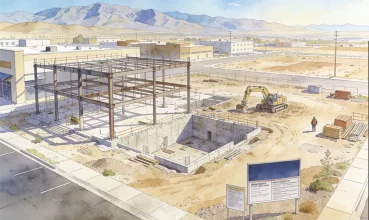
With permits secured and power agreements in place, construction can finally begin. This phase includes erecting the physical structure, installing advanced cooling systems, setting up backup generators, and integrating electrical and data infrastructure.
After the building is complete, the facility enters the commissioning phase. Every system—power, cooling, security, and network connections—must be rigorously tested to ensure reliability before any servers or IT equipment are installed. Depending on the size and complexity of the data center, commissioning can take several weeks to months.
Step 5: Ongoing Operations and Efficiency
Once operational, the focus shifts to maintaining efficiency and reliability. Operators continuously monitor power usage, cooling performance, and network stability. Many use specialized software to track these factors in real time and to coordinate responses when issues arise.
“We keep everyone organized in one place,” Carter says. “You can track deliverables, manage documents, and keep all your stakeholders on the same page.”
Where Projects Get Delayed
The most common pitfall in data center development is underestimating the time required for the initial phases. Site selection, due diligence, and permitting can take a year or more—often longer than the construction itself. Relying on basic tools like spreadsheets and email to manage the process can quickly lead to confusion, missed deadlines, and lost documents.
“If you’ve got your data spread over SharePoint folders and your milestones in an Excel spreadsheet, it can get out of sync quickly,” Carter says.
Another frequent issue is misjudging the cost and complexity of connecting to the electrical grid or building out fiber infrastructure. Costs can escalate rapidly if delays require rerouting or if additional permitting is needed.
Key Takeaways for Developers
Building a data center involves far more than construction. Success depends on anticipating delays, maintaining meticulous records, and ensuring coordination across multiple stakeholders from the outset. “These are long-running projects,” Carter says. “Keeping good records and managing collaboration with outside parties is critical.”
This article is provided for informational purposes only and does not constitute legal, financial, or investment advice.
Similar Articles
Explore similar articles from Our Team of Experts.


Commercial Real Estate, Market Analysis & Policy, Industry News, Residential Real Estate, Featured Articles
The Austin real estate market is in a period of adjustment. After an unprecedented surge during the pandemic years, activity has slowed and the landscape is shifting. Mike Martine, Vice Pres...