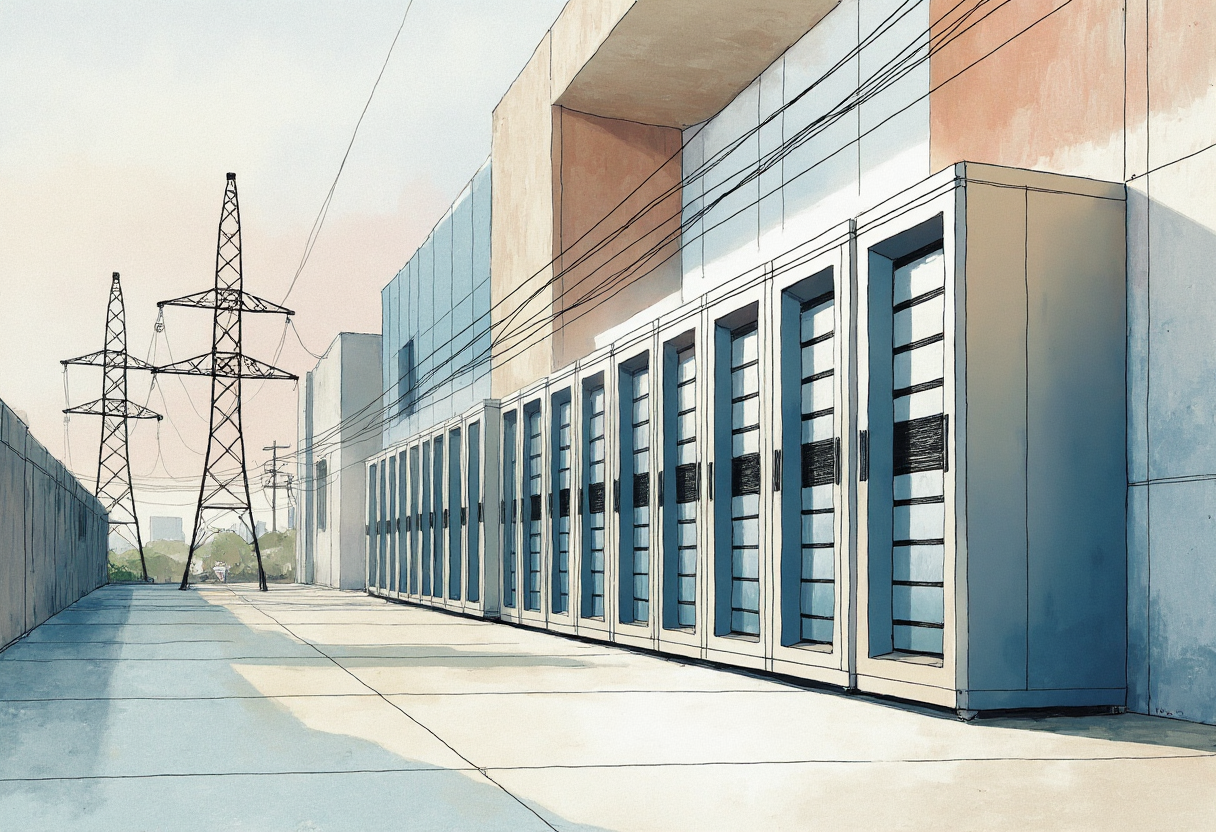
Leading real estate analyst warns new data center developers face multi-year waitlist for power access, creating unexpected constraints on industry growth.
The data center industry faces a severe power access bottleneck that will limit new development through at least 2029, according to Vikram Malhotra, Managing Director and Co-Head of Mizuho Americas. This constraint comes despite concerns about potential overbuilding in the sector.
“If a data center or a landlord does not have power contracted, and you’re a new player coming in, best of luck getting power before 2028 or 2029,” Malhotra says, highlighting how utility constraints are creating a “real demand-supply imbalance.”
The Power Problem Behind the Headlines
While recent industry discussion has focused on potential overbuilding risks, with even OpenAI’s Sam Altman expressing concerns about excess capacity, Malhotra argues these analyses miss a crucial factor: securing power access.
According to Malhotra, the U.S. currently has approximately 30 gigawatts of data center capacity. While there are plans to add another 20 gigawatts over the next five years, bringing total capacity to around 50 gigawatts, the ability to power these facilities presents a significant hurdle.
“A large chunk of what’s being built today is actually being built by owner users or owner operators, the hyperscalers themselves,” Malhotra explains. “While the headline may sound alarming, we have eight or nine gigawatts on a base of 25 to 30 gigawatts, it really is a lot of space that’s accounted for already.”
Market Implications
The power access constraints are likely to create advantages for established players who already have utility contracts in place, Malhotra argues. “There’s a real demand supply imbalance today, and I think it’s going to start to translate into pricing power for the landlords tomorrow.”
This dynamic could particularly benefit companies like Digital Realty Trust, which Malhotra predicts will ‘finally go from not producing really any sizable earnings growth to starting to produce very consistent, high single digit earnings growth over the next two to three years.’
Looking Ahead: The AI Factor
While computational efficiency improvements and potential shifts in hyperscaler spending patterns could impact demand, Malhotra sees sustained growth driven by emerging AI applications, particularly private AI deployments.
“I would imagine a Walmart, a big bank, a big manufacturer would want their own private model for their own business purposes, and not just have some generic models,” Malhotra notes. This trend toward private AI implementations could drive demand for both large and small data center facilities.
The power access bottleneck, combined with these demand drivers, suggests the industry may be entering a period of constrained but stable growth rather than facing an oversupply crisis, according to Malhotra’s analysis.
An increase in home renovations is reshaping Long Island through upgrades to existing properties rather than new development. Instead of selling and moving to larger homes, many homeowners a...
Maine’s industrial real estate market is experiencing a significant cooling period after five years of unprecedented growth, according to a veteran broker who sees this as a major shif...
New York State is changing its approach to housing affordability, shifting from direct price controls to removing barriers to new construction. According to Jared Antin, Executive Director a...
Conventional wisdom often casts oil-dependent real estate markets as risky, prone to dramatic swings in home values when energy prices fall. Yet Chris Cline of Grassroots Realty Group, a REA...
Three years ago, buying a home in St. Augustine required waiving inspections, submitting offers without seeing the property, and competing against multiple bidders. Today, the pace has slowe...
Property values along the South Jersey Shore, New Jersey, continue to rise even as the number of sales drops sharply. This pattern is driven by long-term inventory constraints rather than ty...