

For over a century, the Multiple Listing Service (MLS) has served as the backbone of residential real estate transactions in America. Now, that foundation is showing signs of stress as multi...

'Carbon Capture Won't Scale Until We Decentralize It Like The Internet,' Says AirBuild CEO

Written by:
Date:
19 Jun 2025
Share via Facebook

Share via Linkedin

Share via X

Copy to clipboard

The path to widespread carbon capture adoption may mirror the internet’s evolution, according to AirBuild CEO David Gory, who argues that localized solutions are key to driving broader implementation.
“Carbon capture isn’t going to spread or become a thing until we can decentralize it, just like the Internet didn’t become a theme until everybody had a piece of it in their pockets,” Gory says, outlining his company’s vision for distributed environmental technology.
Nature’s Blueprint
According to Gory, the answer may lie in one of Earth’s most efficient carbon capture systems: algae. “Algae is responsible for roughly 50% of the carbon capture on the planet in its own natural habitat,” he notes. This observation led AirBuild to develop systems that create optimal growing environments for algae within built infrastructure.
The approach aims to restore natural balance in urban development, Gory says. “We’re getting rid of these plants, these trees, to build our much-needed infrastructure. If there’s a way to integrate nature back into it, we’re restoring that balance.”
Testing and Validation
The company has already demonstrated promising results, according to Gory. At the University of Massachusetts Amherst, AirBuild ran a 3,000-hour prototype test focused on a critical technical challenge.
“We’re trying to prove that we can force algae to capture carbon from the air and not organic carbon from water, while also cleaning water,” Gory explains. “We were successful in proving the direct air capture part.”
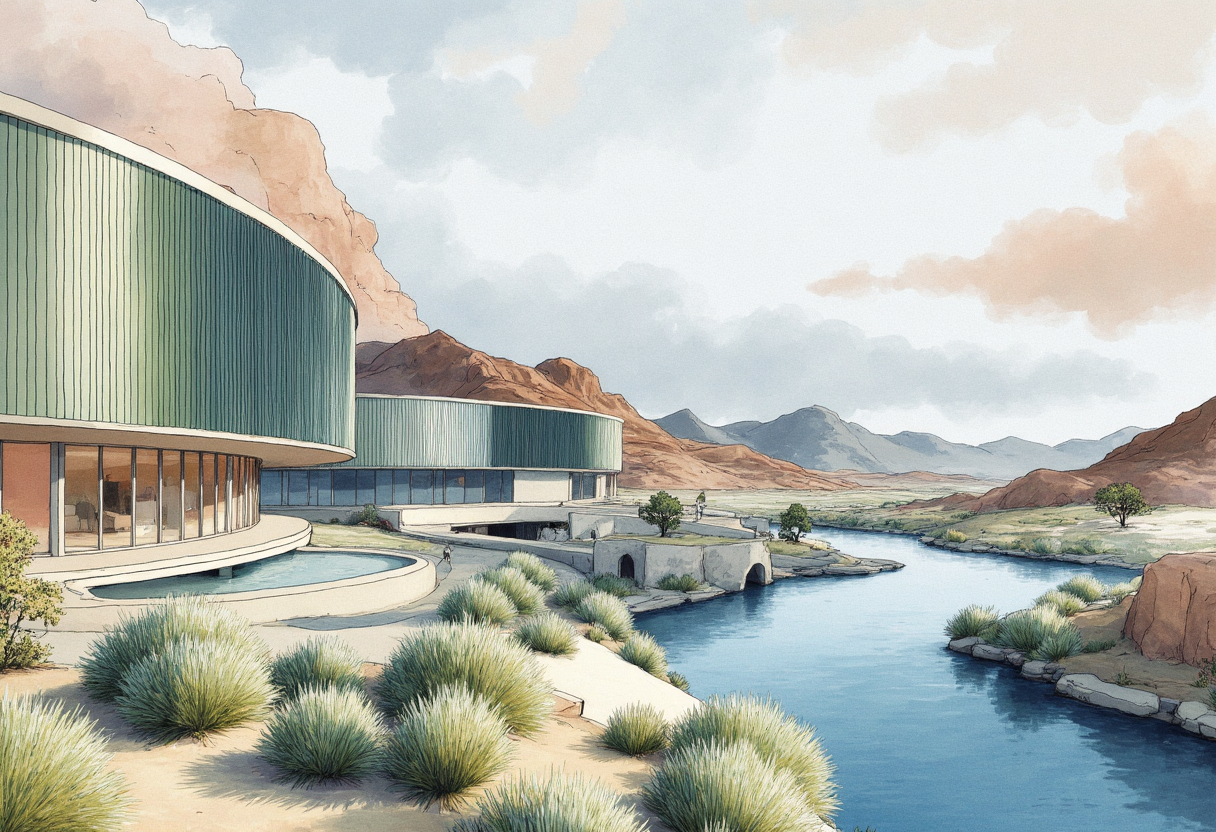
Following this validation, AirBuild is now moving to commercial deployment, having just signed a land lease in Green River, Utah for their first full-scale installation.
Multiple Environmental Benefits
The technology’s potential extends beyond carbon capture, according to AirBuild CTO Ejike Ken-Opurum. The system also produces biochar, which he says offers additional environmental advantages.
“Biochar is amazing for permanent carbon capture as well as soil remediation because it helps with nutrient retention and water retention,” Ken-Opurum explains. This creates opportunities for partnerships with agricultural communities.
The Business Model
Rather than selling units directly, AirBuild is pursuing partnerships with municipalities. “The agreements we’re going in with cities is: give us the land and put up the project development costs. We partner with you, bring in our expertise, and build out this solution,” Gory says.
This approach appears to be gaining traction. The Green River installation will potentially demonstrate significant regional impact. “At full scale deployment in all 37 acres we’ve secured, we’ll be able to treat 50% of the river flow on average,” Gory says, noting that the Green River feeds into the Colorado River system that supplies water to California, Arizona and Nevada.
Looking Forward
AirBuild represents one emerging example of how decentralized environmental solutions might scale. As the company prepares to open its seed funding round in Q4 2023, the industry will be watching to see if this distributed approach to carbon capture can indeed follow the internet’s path to widespread adoption.
Similar Articles
Explore similar articles from Our Team of Experts.




Perspectives, Residential Real Estate, Real Estate Investment, Property Technology, Market Analysis & Policy
The leader of a major build-to-rent housing company is pushing back against claims that institutional investors are squeezing out individual homebuyers, citing statistics that he says tell a...

