Durham’s housing inventory has climbed enough that buyers can afford to be selective – and the properties sitting longest are the ones that look like everything else on the market. For investors and small builders working on the city’s infill lots, that shift has changed the calculus on what to build, how to price it, and how much risk a vacant parcel actually carries.
William Patrick and his wife Christina Patrick run The Phayes Group, brokered by eXp Realty, and co-run Phayes Building Co. The couple sells homes for investor clients across the Research Triangle while building spec homes on small urban lots in Durham. Their experience illustrates a market where differentiation in design and finish – not just location – increasingly separates homes that sell from homes that sit.
What’s Selling and What Isn’t
With more inventory available, buyers no longer compromise on condition or layout. A few years ago, a home with a small master bedroom or dated finishes would still attract offers because there was little else to choose from. That dynamic has reversed.
“Most of the time, they want the house to be in perfect condition,” Christina Patrick says. “They’re just a lot more critical than they were a few years ago.” Homes that need any improvement before move-in are lingering, and so are what the couple describes as cookie-cutter houses – properties with basic finishes, limited curb appeal, and floor plans identical to everything else listed nearby.
What does move: homes that are move-in ready with functional layouts and at least one distinguishing feature, whether that is lot size, outdoor living space, or a strong neighborhood. “Unless you give them exactly what they want, they’re just going to keep looking, or they’re going to try to lowball you,” Christina Patrick says.
The Infill Learning Curve
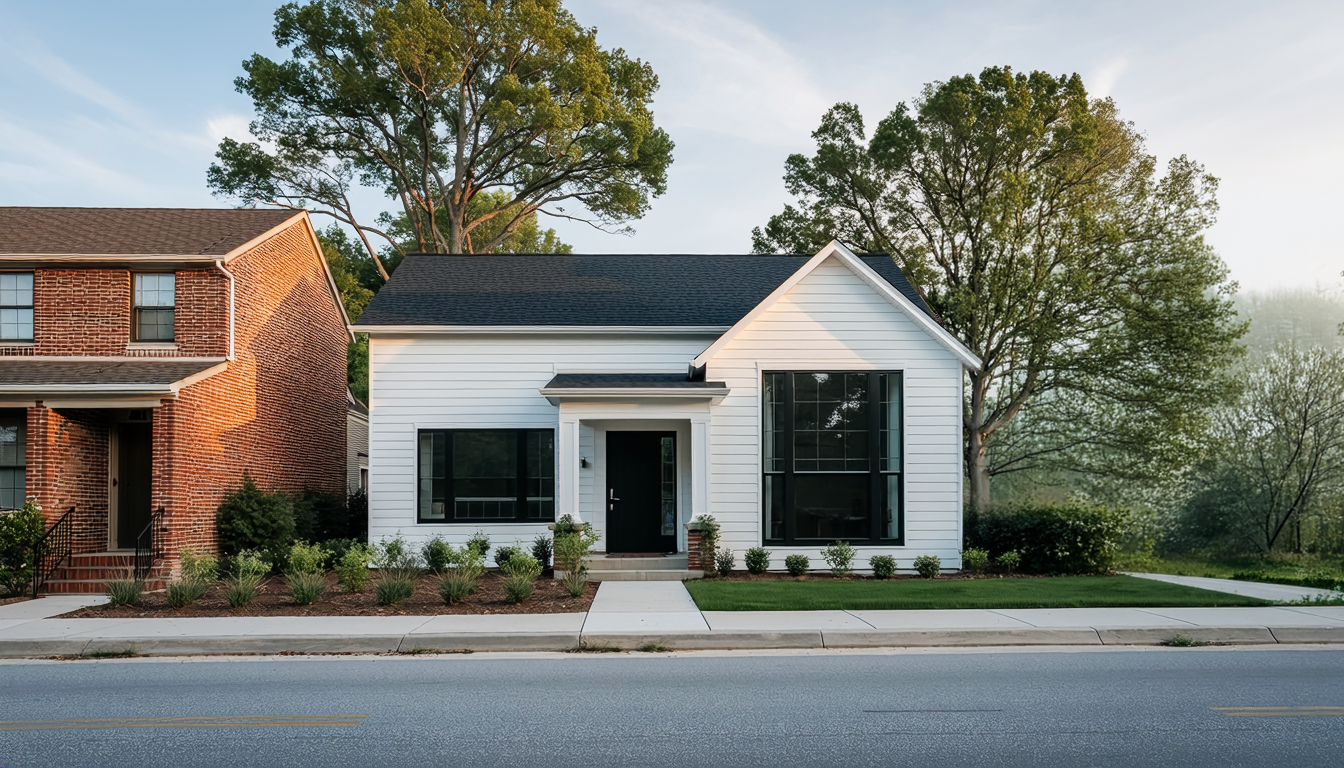
The couple’s first new-construction project, on Elizabeth Street near downtown Durham, exposed how much complexity sits beneath a vacant lot. The parcel was roughly 3,700 square feet – small enough to require rezoning into what Durham classifies as a “tiny lot,” which limits the home’s footprint to 800 square feet and total size to 1,200 square feet. What they expected would take a couple of months in planning took about 12 months just to get the property rezoned. Water and sewer, which they assumed were already connected, had to be brought to the lot separately.
“All the little nuances that we kind of had to learn about building a home, we sort of learned on that first project,” Christina Patrick says. Their second Durham build, which recently went under contract, moved from lot purchase to sale in roughly 10 months – a compression that reflects hard-won familiarity with the city’s permitting process rather than any loosening of requirements.
Finding buildable lots still depends heavily on networking through real estate connections. Evaluating them requires checking zoning, setbacks, lot size, and utility access before committing capital. “It’s definitely riskier,” Christina Patrick says. “You have to basically spend a lot of money to figure out whether or not a lot is even usable, especially if it’s on septic.”
Building Against the Grain
For their most recent build – a 1,763-square-foot single-level home in Durham – the couple made deliberate choices that run counter to what most area builders produce: 10-foot ceilings, engineered hardwood, marble countertops, and an all-one-level layout. The buyer was a young couple in their early 30s purchasing their first home.
The strategy is a direct response to what the resale market is punishing. Christina Patrick says that if a builder offers buyers something with strong resale value that appeals to the broadest possible market, rather than a generic spec home, the house is far less likely to sit or require repeated price cuts. “We don’t want to just give them something cookie-cutter,” she says.
Investor Hesitation
Investor sentiment in the Triangle has cooled noticeably. Many of the couple’s flip-oriented clients are backloaded on projects that have not sold, which makes them reluctant to acquire more. Wholesalers have more deals available and fewer takers. Some investors who cannot sell their flips are converting them to rentals, though high interest rates make positive cash flow difficult to achieve.
Pricing discipline has become non-negotiable. Comparable sales data cannot stretch beyond roughly three months, according to William Patrick, and any feature the home lacks – space, condition, layout – now gets penalized by buyers who have alternatives. “You have to make sure that you price and present your house well from the start,” Christina Patrick says. “Otherwise it might take longer for you to sell in this market.”
Density Questions
Durham is actively encouraging small-lot and zero-lot-line development, including flag lots that allow multiple homes on parcels in residential neighborhoods. The couple sees this firsthand but raises a concern about long-term appreciation in areas where density increases too aggressively. “We think that houses should be more livable and not just packed all on top of one another,” Christina Patrick says.
On the demand side, the outlook has a concrete anchor: pharmaceutical company AbbVie has announced a manufacturing facility in Durham expected to create around 730 jobs. Combined with ongoing mixed-use development and corporate expansion at Research Triangle Park, Christina Patrick says she expects the area’s fundamentals to keep strengthening. “I think it’s going to keep growing,” she says. “Overall, it’s looking good for Durham just based on its position and all the things it has going for it with hospitals, schools, and RTP.”
For small builders weighing whether to start another infill project, the Durham market rewards specificity over volume. Buyers have enough choices to wait for a home that meets their standards – and enough inventory to walk away from one that does not.
About The Experts: William and Christina Patrick run The Phayes Group, brokered by eXp Realty, and co-run Phayes Building Co. in the Research Triangle region of North Carolina, focusing on investor-oriented sales and small-lot new construction.
This article is based on information provided by the expert source cited above. It is intended for general informational purposes only and does not constitute legal, financial, or real estate advice. Readers should conduct their own research and consult qualified professionals before making any real estate or financial decisions.