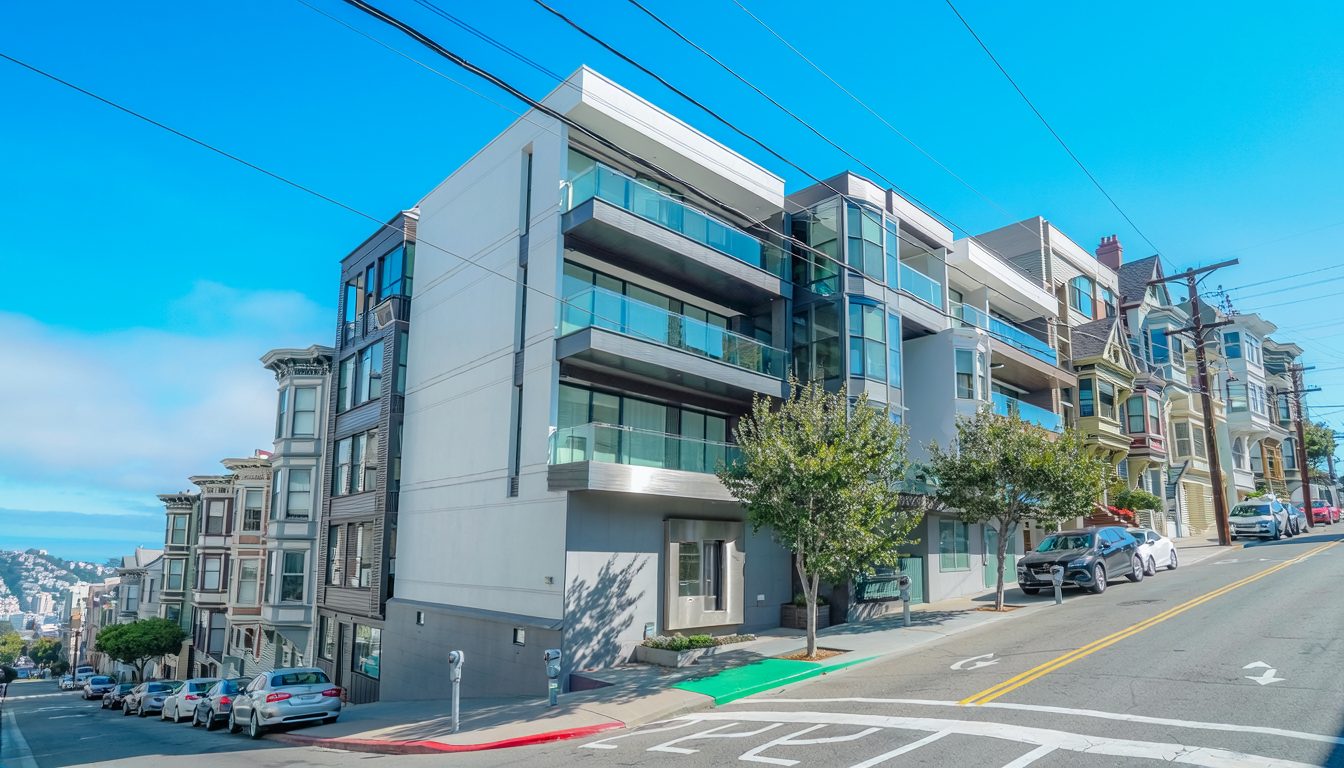
For most of the past two decades, the conventional playbook for condominium buyers in San Francisco followed a predictable arc: buy a studio, sell in five to seven years, move up to a one-bedroom, repeat. Appreciation was reliable enough that buyers could treat each purchase as a stepping stone. That assumption no longer holds, according to Lynn Bell, a broker with Christie’s International Real Estate who leads the Bay Group team in San Francisco. Condo valuations in the city have declined over the past decade, and buyers who once counted on a quick equity gain are now penciling in longer holding periods – and scrutinizing the costs of ownership in ways they never did before.
Bell has spent much of her career on the developer side, including years with Lennar. She currently consults for developers while also handling resale across the city’s attached-housing market. Her read on the current moment centers on a psychological shift among condo buyers that is changing not just what they buy but how carefully they evaluate it.
A Longer Holding Period
The traditional five-to-seven-year condo cycle in San Francisco depended on a market that rewarded short holds with steady appreciation. That pattern broke during and after the pandemic, when the city’s tech-driven economy enabled widespread remote work and triggered an exodus that hit harder than in most urban markets. Bell says San Francisco was the most impacted urban area during COVID because of how tech-centric its economy is, and the city is still recovering.
Buyers are no longer banking on selling at a profit within a few years. “They’re now saying, well, I might not sell it in five years, it might not be seven years, or maybe if I have to sell it, I’m going to keep it and then move on to my two-bedroom,” Bell says. That shift in expected holding period turns every monthly cost into a bigger factor in the purchase decision – and one cost in particular has drawn intense buyer attention.
HOA Budgets Are Key
Rising HOA dues have become a focal point for San Francisco condo buyers, driven largely by insurance costs. Bell notes that a number of insurance companies left California, shrinking the pool of providers and pushing premiums higher. Utility and labor costs have added to the pressure. Where HOA dues once occasionally decreased when a building found a more competitive insurance provider, the current environment offers little relief.
The shift in buyer behavior has been direct. Bell says buyers used to receive large disclosure packages and depend on their agents to navigate them. That dynamic has reversed. “Now buyers are not depending on an agent necessarily to get their questions answered. They’re asking you those questions and they want to walk through those budgets and understand them,” she says. First-time buyers in particular are driving this change – Bell observes that today’s first-time condo buyer tends to be older and more inclined to self-educate before signing.
In new construction, Bell says this translates to at least two tours before a buyer moves to contract, with substantially more due diligence on budgets and management companies between visits. Buyers are reading disclosures themselves rather than outsourcing that work to their agents, and the budget line items – insurance, reserves, management fees – are getting the closest attention. Bell adds that buyers are also paying more attention to management company consolidation. The industry has seen significant consolidation in recent years, and buyers want to understand who is running their building and how.
No New Construction
The supply side of San Francisco’s condo market is effectively frozen. Bell says nothing pencils for new residential development right now – construction costs, timelines, and the complexity of building in the city have made new for-sale projects financially unworkable. What is being built is multifamily rental housing, which has pushed rents up and made the rent-versus-buy calculation even more difficult for prospective owners.
Bell says buyers are closely analyzing whether purchasing makes sense at all, or whether renting and investing in the stock market is the better financial move. Rents in the Bay Area have gone up significantly, making neither option clearly superior. Bell is currently helping Lennar finish the first phase of a master-planned community called the Shipyard, but the next phase is not teed up to launch. “It doesn’t make sense right this second to do that,” she says.
Existing owners, meanwhile, are reluctant to sell. Many are locked into mortgage rates at or below three percent and have little incentive to move unless forced by a life event – a divorce, a job relocation, a growing family. That lock-in effect further constrains the already limited inventory of attached housing.
Condos vs. Single-family
The condo market’s caution stands in sharp contrast to San Francisco’s single-family segment, where cash-rich buyers – many connected to the tech sector – are bidding properties well above asking prices. Bell notes that single-family homes listed at two million dollars are selling for four million. Anticipation of future IPOs from companies like Anthropic and OpenAI is already pulling capital into the market ahead of any liquidity event.
The divergence underscores something Bell emphasizes about San Francisco: the city contains dozens of micro markets that behave differently from one another. The planning commission recognizes roughly 36 neighborhoods; real estate agents sometimes work with as many as 100 distinct sub-markets. “You really have to be incredibly educated as an agent and as a developer about what’s happening in each of these individual markets,” she says.
San Francisco’s land constraints give the city one structural advantage: recovery cycles here have historically been shorter than in less supply-constrained markets. Bell points out that parts of the Midwest still have not fully recovered from the financial collapse, while San Francisco rebounded relatively quickly from that period. Whether that pattern holds after the pandemic disruption – which hit the city harder and differently than prior downturns – is what Bell and other market participants are watching closely.
For the year ahead, Bell expects a market that demands sharper marketing, more time spent educating buyers, and close attention to a buyer pool that is more analytical than it has been in years. “I think it’s going to be a very interesting year,” she says.
About the Expert: Lynn Bell is a broker with Christie’s International Real Estate and leads the Bay Group team, focused on San Francisco and the core Bay Area.