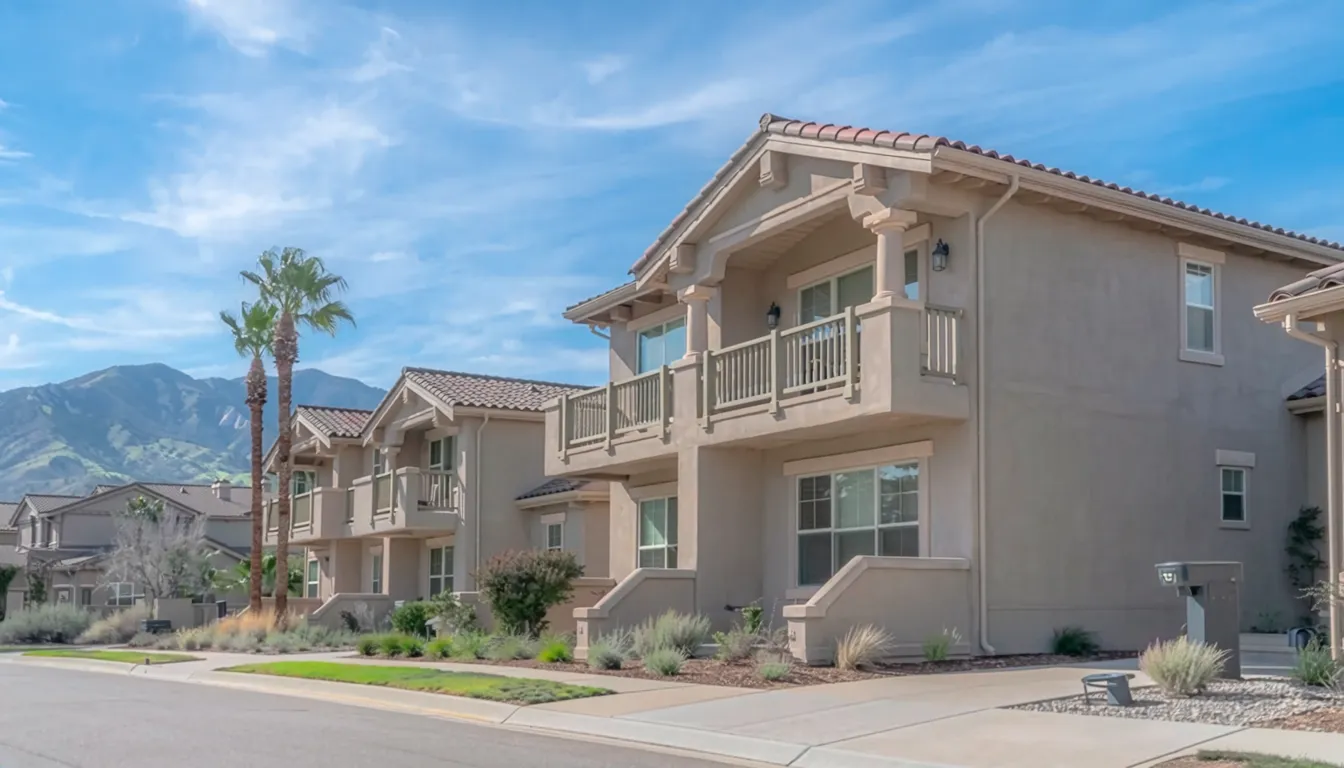
Orange County, California, has long been treated as a single housing market in national coverage. But a widening gap between condos and detached homes is reshaping how properties move – and what they sell for – in communities like Rancho Santa Margarita, a master-planned city in the county’s southern interior. The split is not driven by buyer preference alone. Changes in how Fannie Mae and Freddie Mac evaluate condo communities for conventional lending are pulling financing out from under entire neighborhoods, according to Steven Hurd, a Realtor with Hurd Homes Real Estate Group at eXp Realty of California, who has sold real estate in the area for over 18 years. The price effects are already measurable.
Across Orange County, detached homes are selling in an average of 99 days. Condos are taking 128 days. That nearly 30-day gap matters in a market where overall demand is already thin – roughly 1,300 homes went into escrow countywide in the most recent month, according to Steven. During the pandemic, that monthly figure ran between 2,500 and 3,500. The current level is close to 2007, which Steven describes as the lowest point for pending sales in modern Orange County history.
Yet prices on detached homes are not falling. Inventory is also low, which means buyers have limited room to negotiate. “Prices still are not coming down,” Steven says. “There aren’t these drastic price drops. So I think that’s the frustration buyers are experiencing.”
Condos, however, are telling a different story.
The Conventional Lending Squeeze
The divergence between condos and detached homes traces in large part to updated requirements from Fannie Mae and Freddie Mac. These agencies, which underwrite the majority of conventional mortgage loans, now require condo communities to carry insurance covering the full replacement cost of the community. In a market where property values have risen substantially, many HOA boards cannot afford the upgraded policies without sharp increases in dues – increases that are already straining owners.
Steven points to a specific case. A condo community in Rancho Santa Margarita lost its conventional lending approval after failing to meet the new coverage thresholds. A unit in that community sold for $1,060,000 in August 2024. Less than a year later, the same floor plan sold for $916,000 – a loss of $144,000 that Steven attributes directly to the financing restriction. Without conventional approval, roughly 40 to 50 percent of potential buyers cannot get a loan in that community, he says.
The financial pressure compounds. HOA fees across condo communities have risen 75 to 100 percent over the past decade, by Steven’s estimate. His mother bought a home in 2016 with HOA dues of $330 a month; those dues are now $700 – a 112 percent increase. That cost escalation, combined with the lending restrictions, is making condos harder to sell and cheaper when they do.
A New Layer of Review
As of August, according to Steven, Fannie Mae added another requirement: a full review of a condo community’s HOA documents before approving financing. Previously, conventional loan approval rested primarily on the buyer’s qualifications. Now the agency also evaluates the community’s reserves, governance documents, and financial health.
The practical consequence falls on sellers. A buyer can enter escrow and receive personal loan approval, only for the deal to collapse two or three weeks later when Fannie Mae rejects the condo community itself. “You could literally get a buyer into escrow and find out 15 or 20 days later that they approved the buyer but did not approve the condo community, and now the deal’s dead,” Steven says.
Steven estimates that losing conventional approval can reduce a condo’s sale price by $50,000 to $100,000.
Who’s Still Buying
Despite the affordability strain, Rancho Santa Margarita continues to draw a specific buyer profile. Roughly 80 percent of purchasers are young families, according to Steven, drawn by safety – the city was rated the safest in California in 2025 by Patch.com, per Steven – along with highly rated schools and a walkable, master-planned layout. The city sits about 30 minutes from the coast, far enough inland that it functions as a self-contained community rather than a commuter corridor.
A growing share of buyers are arriving from Los Angeles, enabled by remote work. “They’re saying, we want to plant our feet in Orange County because we can get more home and still earn the LA income,” Steven says.
The luxury segment is performing differently from the rest of the market. Steven says homes above $2.5 million peaked in sales volume in August, while average buyers face the worst conditions. That split reinforces how unevenly the current market is functioning – even within a single county.
Headlines Over Affordability
One trend Steven is watching closely is the role of news headlines on buyer psychology. He says some of his clients can afford to buy but are hesitating because of anxiety about geopolitical events, rising gas prices, and the direction of interest rates. “Headlines have more of an influence on buyer psychology right now than ever before, almost more than the actual affordability for them,” he says.
That hesitation does create openings for buyers willing to act. Steven and his wife recently purchased a home and secured concessions from the seller because activity at that price was unusually low. Rates at the time were below 6.5 percent, but buyer anxiety kept competition thin. “There was not as much activity as there normally would have been,” he says, “because buyers were nervous about what was going on in the headlines.”
For condo owners in communities that have lost or may lose conventional lending approval, the financial stakes are immediate. The gap between condos and detached homes in Orange County is not a matter of preference or lifestyle – it is a financing problem, and until condo communities meet the new coverage and documentation requirements, the buyers who can purchase in those communities will remain a shrinking pool.
About the Expert: Steven Hurd is a Realtor with Hurd Homes Real Estate Group at eXp Realty of California, covering Rancho Santa Margarita and the surrounding area of Orange County, California, for over 18 years.
This article is based on information provided by the expert source cited above. It is intended for general informational purposes only and does not constitute legal, financial, or real estate advice. Readers should conduct their own research and consult qualified professionals before making any real estate or financial decisions.