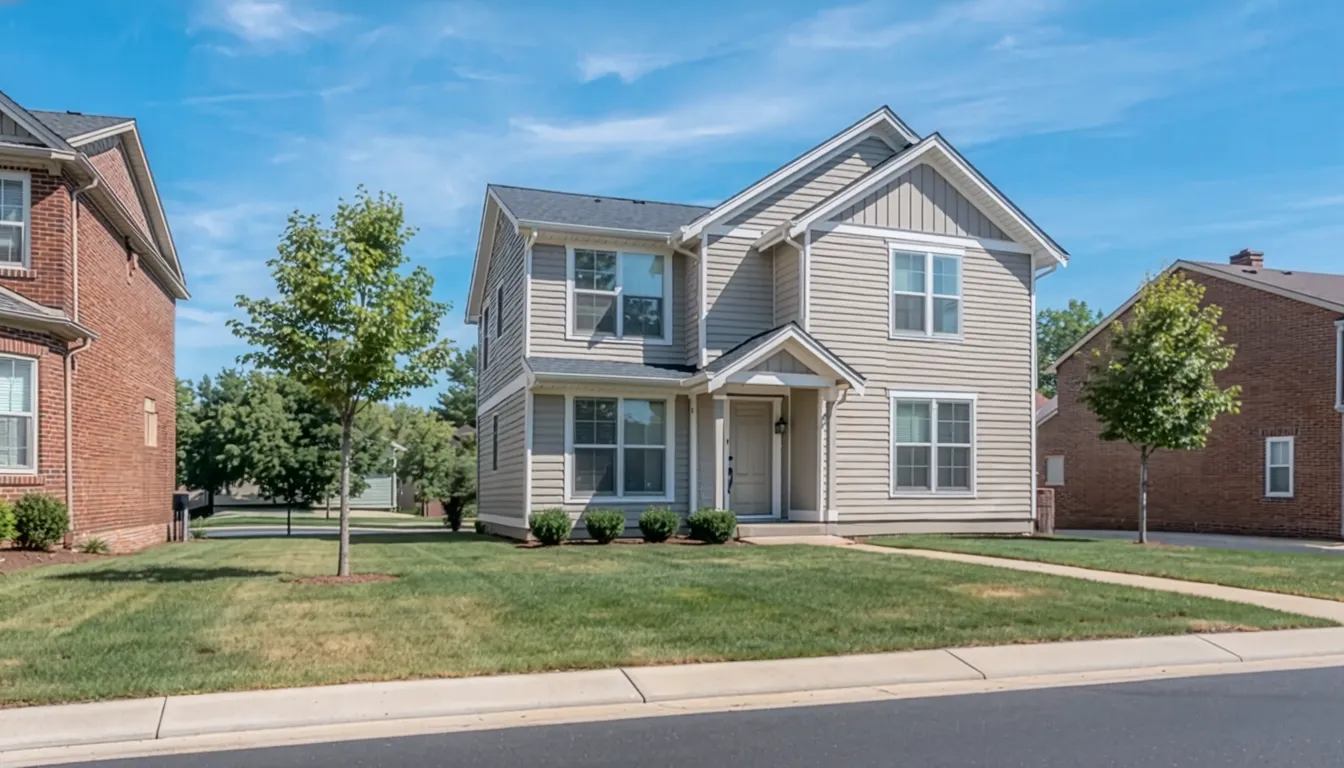
In most small cities struggling with housing affordability, the playbook is familiar: release publicly owned land, offer incentives, and wait for private developers to build. In Covington, Kentucky – a city of 40,000 directly across the Ohio River from Cincinnati – that approach ran into a basic math problem. New construction on infill lots costs roughly $300,000, but the buyers who need the housing can only afford around $250,000. Private builders, particularly small ones, can’t absorb that gap. So the city decided to build the houses itself.
Brandon Holmes, the city’s executive director of community development, is leading the effort. His department manages federal grant programs, code enforcement, surplus real estate sales, and residential construction. The city is using its own vacant lots, federal HOME and Community Development Block Grant funds, and modular construction to build workforce housing priced for families at or below 80% of the area median income as defined by HUD.
Why the Private Market Stalled
Covington’s housing market has changed visibly over the past 10 to 15 years. Higher-income residents have moved into its walkable urban core and hillside neighborhoods, drawn by proximity to Cincinnati at lower prices. But the economics for smaller developers and rehabbers have tightened considerably.
“A couple years ago you might have made $100,000 off a flip,” Holmes says. “Now you might make $30,000 to $50,000 if you know what you’re doing and you have everything lined up perfectly.”
Construction and rehab costs have risen. Most of the best shells for renovation have already been taken. And production builders – the ones with purchasing power to buy materials at scale – don’t operate on scattered infill lots. Holmes points to carpet pricing as an example: what costs a small builder six dollars per foot might cost a national production builder two dollars, bought out for the entire year and warehoused. That gap compounds across every material category.
Meanwhile, out-of-state investors began buying Covington properties sight unseen, attracted by prices that looked cheap relative to larger markets. “A lot of times they didn’t understand the economics of Covington, and it wasn’t necessarily as good,” Holmes says.
The Modular Calculation
Rather than stick-built construction, the city chose modular – factory-built housing set on permanent foundations. This is distinct from manufactured housing, which arrives on a removable chassis and originated as a HUD-backed path for trailer homes to qualify for permanent financing. Holmes has worked with modular construction across multiple roles over 20 years and selected a builder whose quality-control standards he already knew.
The practical advantage is speed and repeatability. Once a building plan is approved by the state of Kentucky, identical units can be ordered without returning for new approvals. A house can be ordered on a Friday and enter production a week later, with delivery in six weeks. The first two units on Pleasant Street taught the team a critical sequencing lesson: install infrastructure – sewer laterals, water lines – before the house arrives, not after. That change alone should shave four to eight weeks off production time per unit.
Holmes says the cost comparison cut in a surprising direction. “It was almost the same price, if not more expensive, for me to do a manufactured unit, which to me is lower quality, versus modular, where 100 years from now those houses will still be here.”
Infrastructure Nobody Sees
What separates the city’s approach from typical infill work is what happens underground. Covington is more than 200 years old, and its clay sewer lines and lead water laterals are failing regularly. Holmes says he has personally replaced eight to ten laterals out of a 113-unit portfolio he manages for the city – and only half of that portfolio is scattered-site housing.
Some neighborhoods have trunk sewer lines serving three or four houses before connecting to the street main. When part of that trunk collapses, every house on it has a problem. Holmes has seen buyers purchase renovated homes from flippers who ignored the laterals entirely, only to face major repair costs months later. “Sometimes when the price is too good, it looks too good, it is too good to be true because shortcuts were taken,” he says.
The city’s projects replace all underground infrastructure as part of construction – an additional roughly $20,000 per unit that Holmes considers non-negotiable given the age of existing systems.
Current Market Conditions and Pricing Pressure
Covington’s market remains active but has slowed from its recent pace. Holmes, who has been tracking comparable sales daily as he prepares to list his first two completed units, reports that move-in-ready homes priced correctly still sell fast. Homes that miss on price sit – and even after reductions, they can linger. He has tracked price drops of 5 to 15% from initial list prices on homes in his target area.
Interest rates are the most immediate headwind. Holmes stress-tested his project at 7.25% and found the impact on buyer affordability stark. To bridge the gap, the city has partnered with local banks offering portfolio mortgage products with credit score thresholds around 600, no private mortgage insurance, and no down payment requirement. The city is also providing down payment assistance on the units it builds.
What’s Next on Pleasant Street
Phase one – two modular units – is nearing completion and should be listed within roughly a week. Phase two covers five additional units on the same side of the street, using already-approved plans where possible to skip the state review process. Phase three involves the opposite side of the street, where Holmes closed on the final house and lots he needed in November. That phase has topographic challenges still being worked through but will also use modular construction.
Beyond Pleasant Street, the city has sold lots for a 12-unit apartment building, has nine parcels expected to yield 11 to 12 houses, and holds 19 lots in another subdivision awaiting an RFP for a builder. The goal for the full Pleasant Street block is roughly 20 units that reset comparable sales for the surrounding neighborhood. “It serves as the catalyst and comps that can be used for other people that come in that want to do more infill development and rehab work,” Holmes says.
For buyers in Covington’s target income range, the combination of subsidized pricing, replaced infrastructure, and favorable lending terms represents a path to homeownership that did not exist before the city stepped in as builder. Whether similar efforts follow in other small cities depends on whether they have the same combination Holmes assembled here: vacant land, federal subsidy, and someone willing to act as developer rather than wait for one.
About the Expert: Brandon Holmes is the executive director of community development for the city of Covington, Kentucky, leading its federal grant programs, code enforcement, surplus real estate sales, and residential construction efforts.
This article is based on information provided by the expert source cited above. It is intended for general informational purposes only and does not constitute legal, financial, or real estate advice. Readers should conduct their own research and consult qualified professionals before making any real estate or financial decisions.