Most national conversations about housing affordability assume entry-level and mid-range homes move quickly while luxury inventory lingers. In the Mount Pleasant and barrier island submarkets around Charleston, South Carolina, that pattern is inverted. Homes listed between $1 million and $2 million are selling briskly, while properties in the $300,000 to $700,000 range – the segment most dependent on mortgage financing – are sitting.
The explanation is straightforward: cash buyers are driving the upper end, and they are indifferent to interest rates. “My million-dollar, two-million-dollar stuff is flying off the shelf and my three-to-seven-hundred is just sitting,” says Lynn Burnett, a 23-year real estate veteran with Coastal Island Properties, a four-agent team operating across Mount Pleasant, the Charleston barrier islands, and surrounding submarkets. “The million-dollar people are not worried about getting a loan. They’re looking for a place to park their cash.”
That divergence between cash-fueled luxury and rate-sensitive mid-range housing is shaping inventory, competition, and investment strategy across the broader Charleston market – and it varies sharply from one zip code to the next.
Builders Are Setting Terms Resale Sellers Cannot Match
In Summerville, a fast-growing suburban area north of Charleston where developable land remains plentiful, resale sellers face a specific structural disadvantage: builders are buying down mortgage rates to levels no individual seller can replicate. Burnett recounts a conversation with a builder who told her directly that resale could not compete. The builder was offering 4.99 percent on a 30-year fixed mortgage. The same day, Burnett saw 7.3 percent cross her desk for conventional financing.
That gap makes new construction nearly impossible to beat on monthly payment terms in areas where both options exist. “There’s no way a home seller is going to be able to compete against that,” Burnett says. “They can’t buy it down that far.”
The result in Summerville and the northern part of West Ashley, where new construction is also abundant, is that mid-range resale homes sit longer because builders can offer financing terms that individual sellers cannot match.
The dynamic reverses in places like Mount Pleasant, James Island, and the inner parts of West Ashley, where little to no developable land remains. In those submarkets, resale is the only option. “If you want a home in those areas, you’re buying resale no matter what,” Burnett says. Sellers there face no builder competition, and properties priced correctly still move.
A Rental Licensing Bottleneck Is Redirecting Investor Strategy
For investors considering the Mount Pleasant market, the most immediate constraint is not pricing – it is permitting. The waiting list for a short-term rental license in Mount Pleasant currently stands at roughly 600 applicants. Burnett says her team applied two years ago and learned they were 350th on the list, with an estimated seven to eight years before a license would be issued.
Charleston proper has its own restrictions, with only a small portion of the city eligible for licensed short-term rentals. Folly Beach, the barrier island south of the city, has recently imposed caps on the number of rental properties allowed – a move Burnett describes as still contentious locally.
The licensing bottleneck has pushed investor interest toward midterm rentals – 30-day minimum stays – which do not require a short-term license. Burnett points to the Medical University of South Carolina, one of the area’s largest employers, as a consistent source of demand from traveling medical professionals. “Traveling nurses, traveling doctors, traveling anything in the hospital,” she says. “That’s really a nice little niche in the market.”
For investors evaluating the Charleston area, the distinction between short-term and midterm rental strategy is not optional – it determines which properties pencil out and which submarkets are even accessible.
Condition and Pricing Determine Speed More Than Location Alone
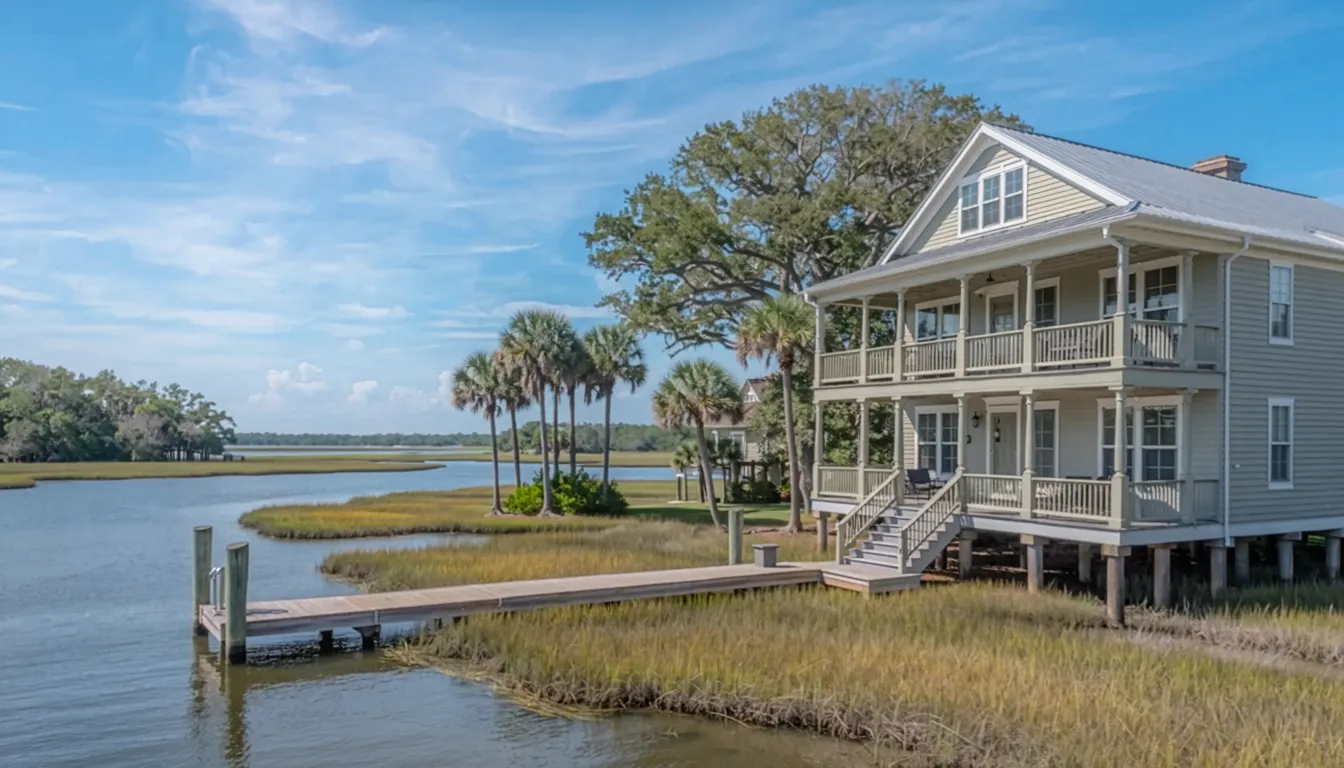
Even within submarkets where resale dominates, the spread in days on market is wide. Burnett says properties in excellent condition that are priced aggressively still move fast, regardless of segment. “If the house is in great condition and it’s priced super competitive, it’s flying off the market,” she says. Waterfront homes with docks, priced correctly, are also clearing quickly.
The properties that stall share a common profile: average condition, average pricing, and no distinguishing feature that justifies a premium. Some neighborhoods with elevated inventory levels are also seeing longer days on market simply because supply has outpaced demand in those specific pockets.
For sellers in the mid-range, the lesson is concrete: in a market where cash buyers dominate the upper tier and builders control the financing narrative in growth corridors, a resale home in the $300,000 to $700,000 range needs to stand out on condition and price to avoid sitting.
A Market of Many Markets
Greater Charleston’s geography creates a patchwork of distinct submarkets that function almost independently. Mount Pleasant is suburban and residential. Sullivan’s Island has virtually no short-term rental inventory and draws primarily homeowners and families with multigenerational ties. Isle of Palms skews toward weekly and daily rentals and includes the gated Wild Dunes community. James Island and Folly Beach carry a more informal character, with older housing stock and limited room for new construction. Johns Island, about 45 minutes from the city, still has developable land and is seeing rapid construction, while the neighboring gated communities of Kiawah and Seabrook attract buyers who want a more secluded resort setting.
The buyer profile shifts depending on which submarket is in play. Mount Pleasant draws more primary residents, while the islands attract second-home and investment buyers. “Sometimes they’re looking in Mount Pleasant, but a lot of times they’re looking to be at the beaches,” Burnett says.
Burnett says broader uncertainty – including interest rates, global conflict, and inflation concerns – is weighing on buyer confidence even among those who do not need financing. For cash buyers, the hesitation is less about affordability and more about timing relative to economic conditions they cannot predict. For rate-dependent buyers, the math is simpler: until borrowing costs come down, the mid-range segment will remain the slowest-moving part of the market while properties above $1 million continue to trade on a different set of rules entirely.
About the Expert: Lynn Burnett is with Coastal Island Properties, a four-agent team covering Mount Pleasant, the Charleston barrier islands, and surrounding submarkets in South Carolina, and has 23 years of real estate experience.
This article is based on information provided by the expert source cited above. It is intended for general informational purposes only and does not constitute legal, financial, or real estate advice. Readers should conduct their own research and consult qualified professionals before making any real estate or financial decisions.