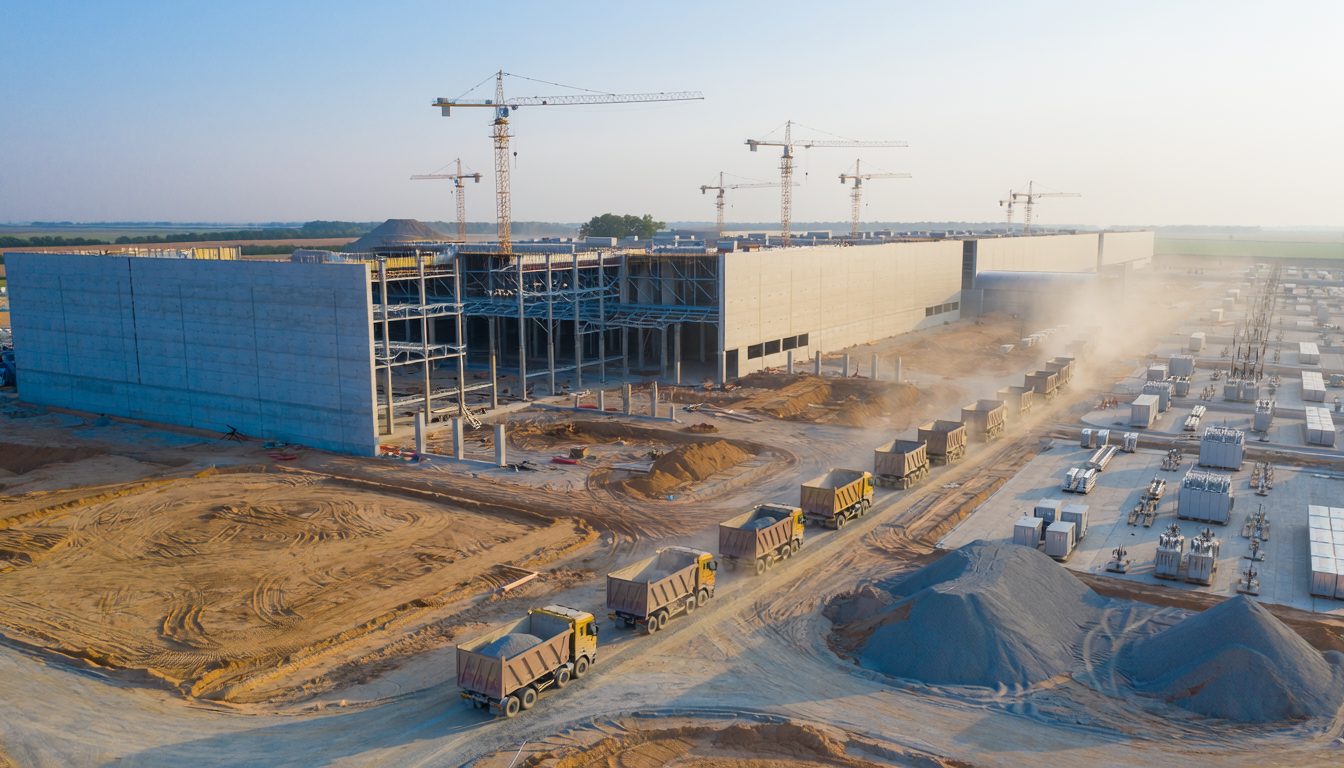
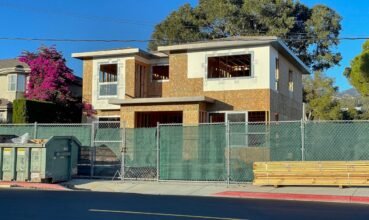
Data center construction is pushing smaller buyers to the back of the line for sand, gravel, and stone. Wherever large campuses go up, they claim local supply before anyone else places an order. When a quarry commits its stock to one of those projects, the homeowner building a pool or the small developer pouring a foundation doesn’t get a rain check – they get a delay, a higher price, or both.
The scale behind that shift has no recent precedent. Data center construction starts reached $84.1 billion through July 2026, nearly three times the total at the same point a year earlier. One of the country’s largest building materials producers estimates that a typical data center building consumes about 150,000 tons of aggregates, roughly what it takes to build a four-mile lane of interstate. And because aggregates are heavy and uneconomical to haul long distances, that demand falls on the quarries closest to each site. Indiana has logged more than $10 billion in data center starts this year, Texas ranks among the leading states for new construction, and in Tennessee, a single AI campus in Memphis carries an estimated $35.8 billion price tag.
Erik Mesikäpp, co-founder of Aggregate Markets, one of a small number of online marketplaces for bulk construction materials, sees the strain most clearly in those three states, where the company does most of its business. “This week we had a situation where one of our customers wanted to have material delivered but all the quarries had sold out to the data center,” he says.
Bigger Projects, Longer Waits
Sold-out quarries don’t reflect a collapse in production. Output continues – Vulcan Materials, the country’s largest aggregates producer, reported a 1% rise in shipments in the second quarter, with large projects among the drivers – but allocation has shifted toward the biggest buyers. According to Mesikäpp, large infrastructure projects command priority because they represent larger, longer-term contracts, and their investors will pay to move faster.
That willingness traces to how data centers make money. A facility generates no revenue until it comes online, so every month cut from the build schedule brings income forward, and Mesikäpp says investors push hard on deadlines as a result. “They have more money, bigger wallets, so they’re willing to pay even a little bit on top,” he says. The buyers who can’t match that premium end up waiting. “If you’re not on the top of the line, you’re kind of screwed.”
For residential builders, property owners, and developers working at modest scale, waiting comes with higher material prices, higher trucking costs, and project delays. Mesikäpp estimates that delivered prices on the orders he sees have risen about 5% over the past year, and more on some. Producers’ own numbers point the same direction: Vulcan reported mix-adjusted aggregates pricing up 5% year over year in the second quarter, and Knife River and Amrize both expect mid-single-digit aggregates price increases for 2026. Fuel compounds the problem at both ends. Mesikäpp points to higher fuel prices as a driver of last-mile delivery costs, and higher diesel costs drove most of a 7% rise in Vulcan’s per-ton cash cost of sales in the same quarter.
Mesikäpp describes the mood among builders and developers as resignation more than resistance. Projects already permitted and scheduled can’t pause and wait for prices to fall, and he doesn’t expect them to. “In most cases they don’t – they will only continue to keep increasing,” he says. Budgets set even a couple of years ago no longer match current costs, he adds, and some property owners have started scaling back – a large pool project, for instance, becomes a smaller one.
Fewer Quarries, Less Leverage
Data center demand explains who gets material first. A separate structural shift – consolidation – explains why smaller buyers have fewer places to turn when they land at the back of the line. The number of active pits and quarries in the U.S. now sits below its 2000 level, according to an analysis by L.E.K. Consulting, and the 10 largest producers hold only about 40% of the market, leaving ample room for further acquisitions. Deal activity bears that out: the industry recorded 107 announced or closed aggregates transactions in 2025, according to investment bank Capstone Partners, even in a year when deal volume fell.
Mesikäpp sees a trade-off for buyers in that consolidation. Larger operators bring standardized processes, consistent documentation, and the ability to route orders between quarries they own in the same region – useful when one location runs dry. But they also remove the leverage smaller buyers once had when two competing quarries sat near each other. “You could haggle a little bit over the prices because the guy down the road who owns the quarry, he’s going to make me that price – can you compete?” he says. “That’s not going to happen anymore when a large quarry owns both of them.” For homeowners and small contractors buying for a single project, the result is fewer options and less room to negotiate.
The independent quarries and haulers still operating face their own decision. Some owners have received buyout offers they consider attractive, Mesikäpp says, while others, particularly those running multi-generational family operations, resist selling. “If this trucking company or quarry has been with you from – maybe your grandparents started it – then you don’t want to sell as much,” he says. Some one-person operations, he adds, see little reason to keep competing against better-capitalized companies, while others are looking for the customers large producers aren’t prioritizing.
Relationships Still Matter
For small buyers, finding an independent quarry with stock often comes down to who they know. Mesikäpp counts bulk construction materials among the least digitized corners of construction, and he says the industry’s relationship-driven culture slows the adoption of tools that could make available supply easier to see. “I think the times have passed where you needed to know a guy who knows a guy and then you’re going to call that guy and try to get them to come to your job site whenever they have time,” he says.
That has begun to change as more ways to buy material online appear. Large producers have built online portals for ordering, tracking, and billing, though those mostly serve existing account holders, and a handful of independent marketplaces, Aggregate Markets among them, connect buyers with quarries and haulers they might not otherwise reach. Better visibility only goes so far, though. Aggregates still can’t travel far economically, so when every quarry within a practical haul distance has committed its output to a data center campus, knowing who has stock doesn’t create more of it.
The pressure shows no sign of easing. More than 1,500 data center projects sit in some stage of planning nationwide, and one building materials industry advisor describes the buildout as a demand driver that will run for a decade rather than a single wave of projects. For smaller builders and property owners, that means a local materials market increasingly organized around its largest buyers – one where the budget set two years ago won’t hold, and where the competing quarry down the road that once kept prices in check may now belong to the same owner.
About the Expert: Erik Mesikäpp is co-founder of Aggregate Markets, an e-commerce platform for bulk construction materials serving customers across the United States, with primary operations in Indiana, Tennessee, and Texas.